
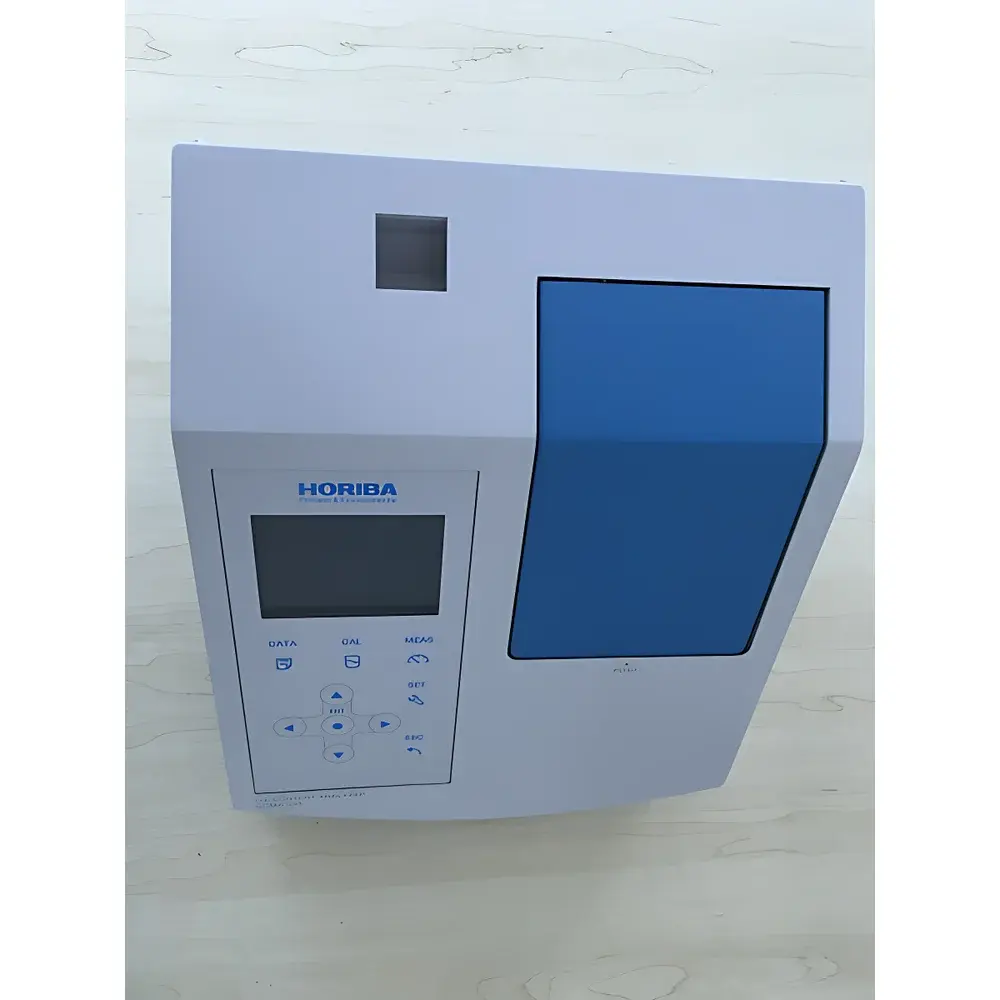
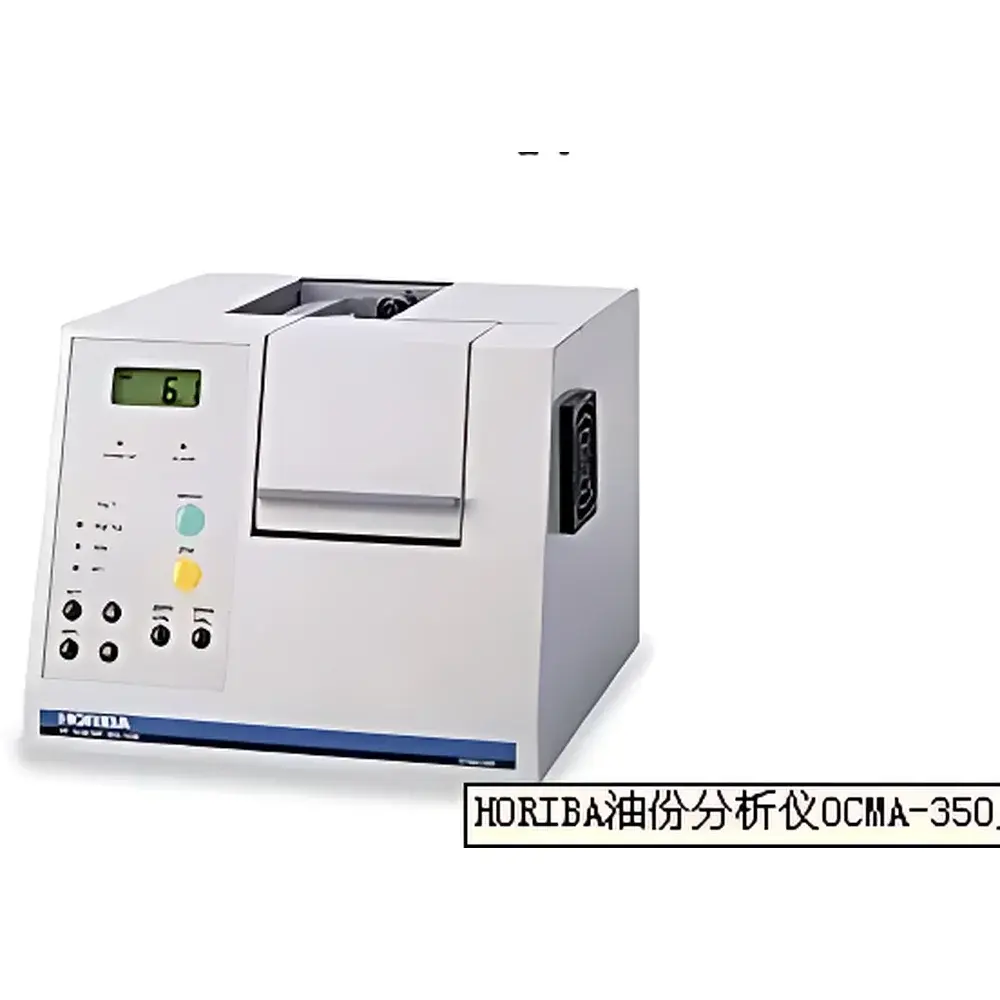
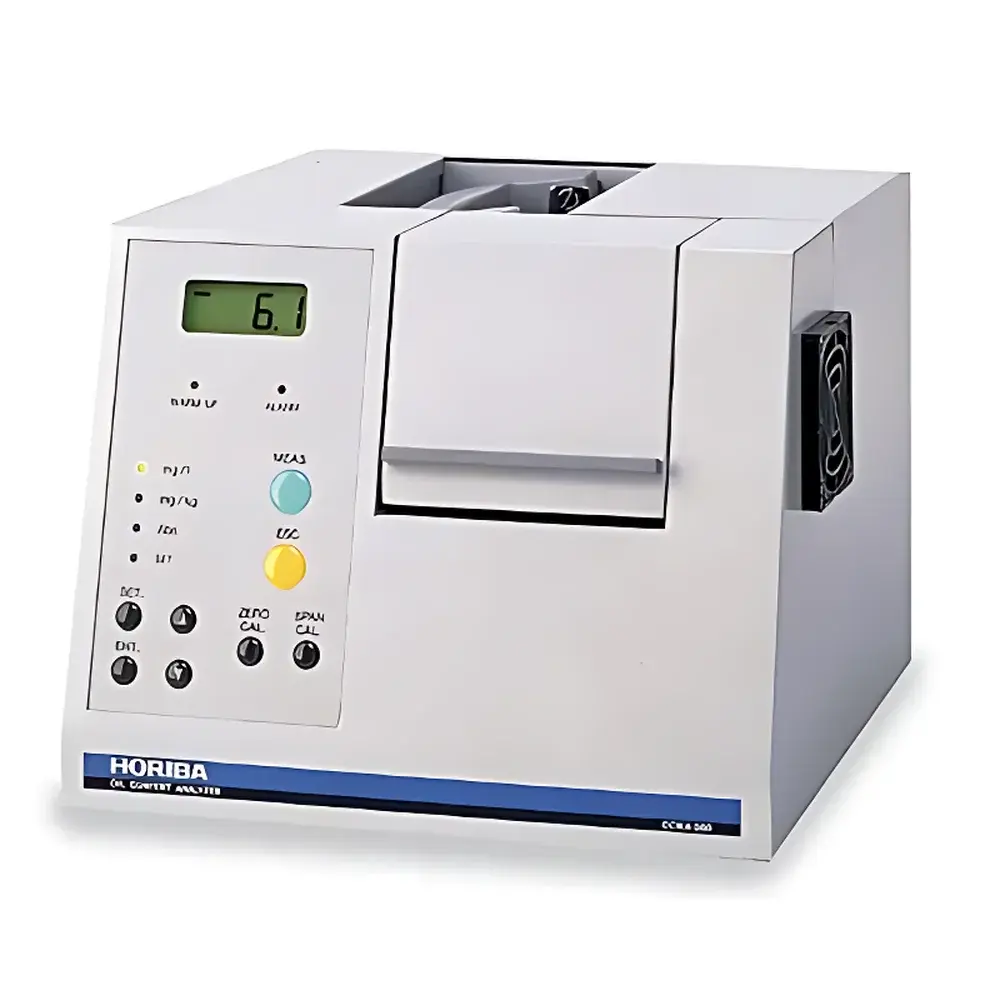
HORIBA OCMA-555 Portable Oil Content Analyzer
| Brand | HORIBA |
|---|---|
| Origin | Japan |
| Model | OCMA-555 |
| Instrument Type | Portable |
| Measurement Principle | Non-Dispersive Infrared (NDIR) Absorption Spectrophotometry |
| Measurement Range | 0–200 mg/L (water), 0–1000 mg/kg (soil), 0–1 Abs |
| Detection Limit | 0.1 ppm |
| Solvent Compatibility | S-316 (OCMA-550) / H-997 (OCMA-555) |
| Repeatability | ±0.4 mg/L (0–9.9 mg/L), ±2.0 mg/L (10.0–99.9 mg/L), ±4 mg/L (100–200 mg/L), ±1% F.S. (0–1 Abs) |
| Display | Backlit LCD with timestamping |
| Interface | RS-232C, Parallel Printer Port |
| Power Supply | 230 V AC, 50 Hz |
| Dimensions | 250 × 200 × 285 mm (W × H × D) |
| Detector | Thermoelectric Sensor |
| Cell | Quartz Cuvette (200 mm path length) |
Overview
The HORIBA OCMA-555 Portable Oil Content Analyzer is an engineered solution for quantitative determination of hydrocarbon-based oil residues in aqueous and solid-phase environmental matrices. It operates on the principle of non-dispersive infrared (NDIR) absorption spectrophotometry—specifically targeting the characteristic C–H stretching vibration band near 3.4 µm (2940 cm⁻¹)—a region where mineral oils, lubricants, and petroleum-derived hydrocarbons exhibit strong, selective absorbance. Unlike broad-spectrum UV-Vis methods, NDIR ensures high specificity by eliminating interference from common waterborne organics (e.g., humic substances, surfactants) and suspended solids (SS). The instrument requires prior solvent extraction using HORIBA-recommended H-997 reagent—a chlorinated hydrocarbon blend optimized for complete oil recovery while exhibiting negligible IR absorption at the analytical wavelength. This enables direct photometric quantification without spectral deconvolution or multivariate calibration. Designed for field-deployable and laboratory-based environmental compliance workflows, the OCMA-555 delivers trace-level sensitivity (detection limit: 0.1 ppm) and robust reproducibility across regulatory concentration ranges defined in EPA Method 1664B, ISO 9377-2, and JIS K 0102.
Key Features
- Triple-unit display mode: switch seamlessly between mg/L (for water extracts), mg/kg (for soil/sediment extracts), and absorbance (Abs) for method validation and raw data review.
- Integrated timestamping and auto-zero calibration upon power-on—ensuring measurement traceability and minimizing operator-induced drift.
- Thermoelectric detector with stable thermal response and no moving optical components—eliminating alignment sensitivity and enhancing long-term baseline stability.
- Backlit LCD interface with intuitive menu navigation; supports real-time viewing of absorbance spectra peak position and intensity.
- Dual communication interfaces: RS-232C for bidirectional data logging to LIMS or spreadsheet software, and parallel port for direct thermal printer output compliant with GLP documentation requirements.
- Compact footprint (250 × 200 × 285 mm) and 230 V AC operation—enabling deployment in mobile labs, wastewater treatment control rooms, and on-site remediation monitoring stations.
Sample Compatibility & Compliance
The OCMA-555 accommodates samples pre-extracted using standardized protocols per ASTM D7066, ISO 11533, and JIS K 0102. Validated matrices include surface water, industrial effluent, groundwater, soil leachates, and swab extracts from metal parts or precision components. Its 200 mm path-length quartz cuvette enables high-sensitivity detection even at low oil concentrations, while maintaining compatibility with turbid or particulate-laden extracts when used with centrifugation or membrane filtration pretreatment. The system meets essential regulatory criteria for environmental monitoring: data integrity aligns with FDA 21 CFR Part 11 expectations via audit-trail-capable external software (e.g., HORIBA’s optional OCMA Data Manager); measurement uncertainty is documented per ISO/IEC 17025:2017 Annex A.5 for accredited laboratories performing oil-in-water analysis under NPDES or RCRA compliance programs.
Software & Data Management
While the OCMA-555 operates as a standalone photometer, its RS-232C interface supports ASCII-formatted output including sample ID, timestamp, measured absorbance, selected unit, and instrument status flags. When paired with HORIBA’s OCMA Data Manager (v3.2+), users gain automated calibration curve generation, multi-point standard verification reports, and export to CSV or PDF formats compatible with enterprise LIMS. All data files retain embedded metadata (operator ID, extraction solvent lot, cuvette ID), satisfying ALCOA+ principles (Attributable, Legible, Contemporaneous, Original, Accurate, Complete, Consistent, Enduring, Available) required in GMP-aligned environmental QA/QC environments.
Applications
- Regulatory wastewater discharge monitoring—verifying compliance with oil & grease limits in municipal and industrial outfalls.
- In-process verification of degreasing efficiency in semiconductor wafer cleaning lines and precision machining facilities.
- Field screening of contaminated soils at brownfield sites prior to excavation or thermal treatment.
- Quality control of recycled solvents and reclaimed cooling oils in metalworking operations.
- Validation of oil-water separator performance in offshore platform bilge treatment systems.
- Research-grade quantification of bio-oil migration in aquifer sediment columns.
FAQ
What extraction solvent is required for the OCMA-555?
H-997 solvent is mandatory for OCMA-555 operation; it is chemically distinct from S-316 (used with OCMA-550) and optimized for minimal IR background at 2940 cm⁻¹.
Can the instrument measure emulsified oil without phase separation?
No—emulsified oil must first be broken via acidification, centrifugation, or coagulation per EPA 1664B prior to H-997 extraction.
Is the quartz cuvette included with the base configuration?
Yes—a sealed, matched-path quartz cuvette (200 mm optical path) is supplied with each OCMA-555 unit, along with calibration standards and pipetting tools.
Does the analyzer support multi-point calibration?
Calibration is performed externally using certified oil-in-solvent standards; the instrument stores only zero and span values—not full calibration curves—to maintain regulatory simplicity.
How is solvent reuse implemented?
HORIBA SR-305 solvent regeneration system (sold separately) employs dual-layer activated carbon and activated alumina cartridges to remove polar impurities and water from spent H-997, extending solvent lifecycle by >80% versus single-use protocols.
Related Products







