
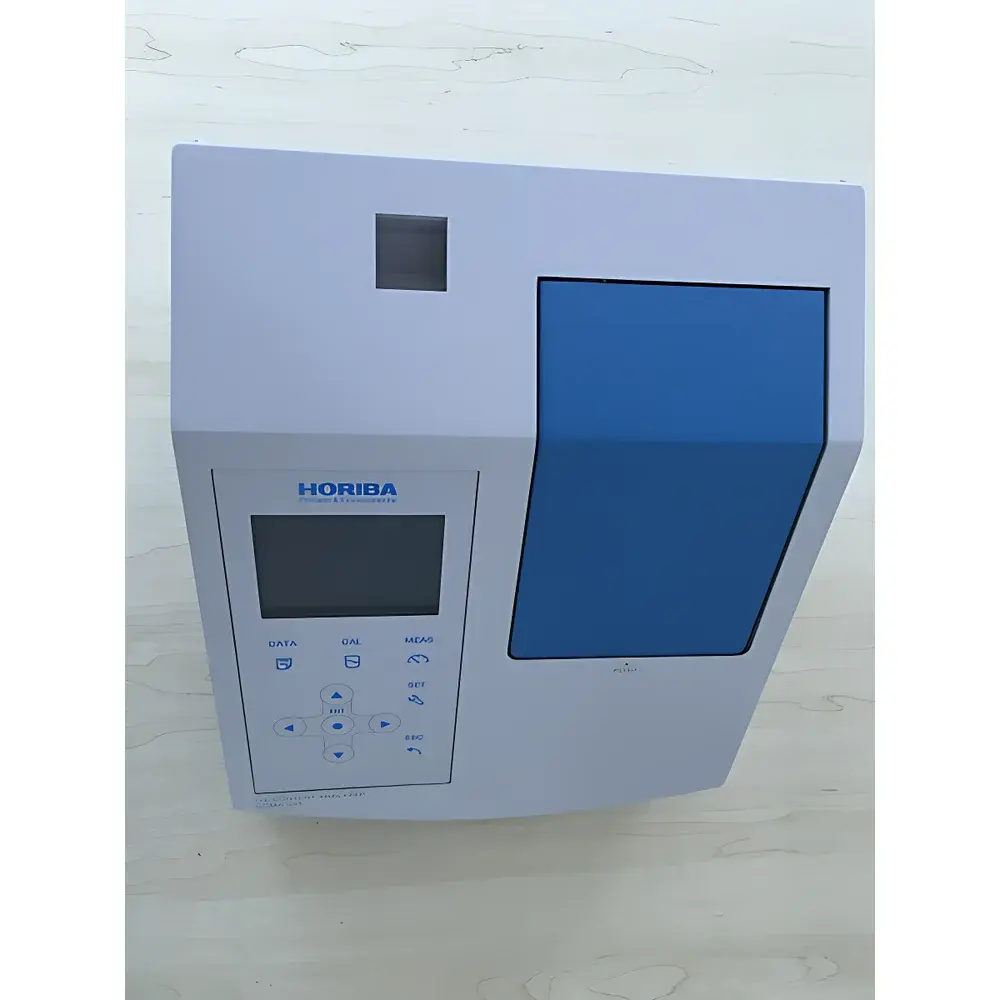
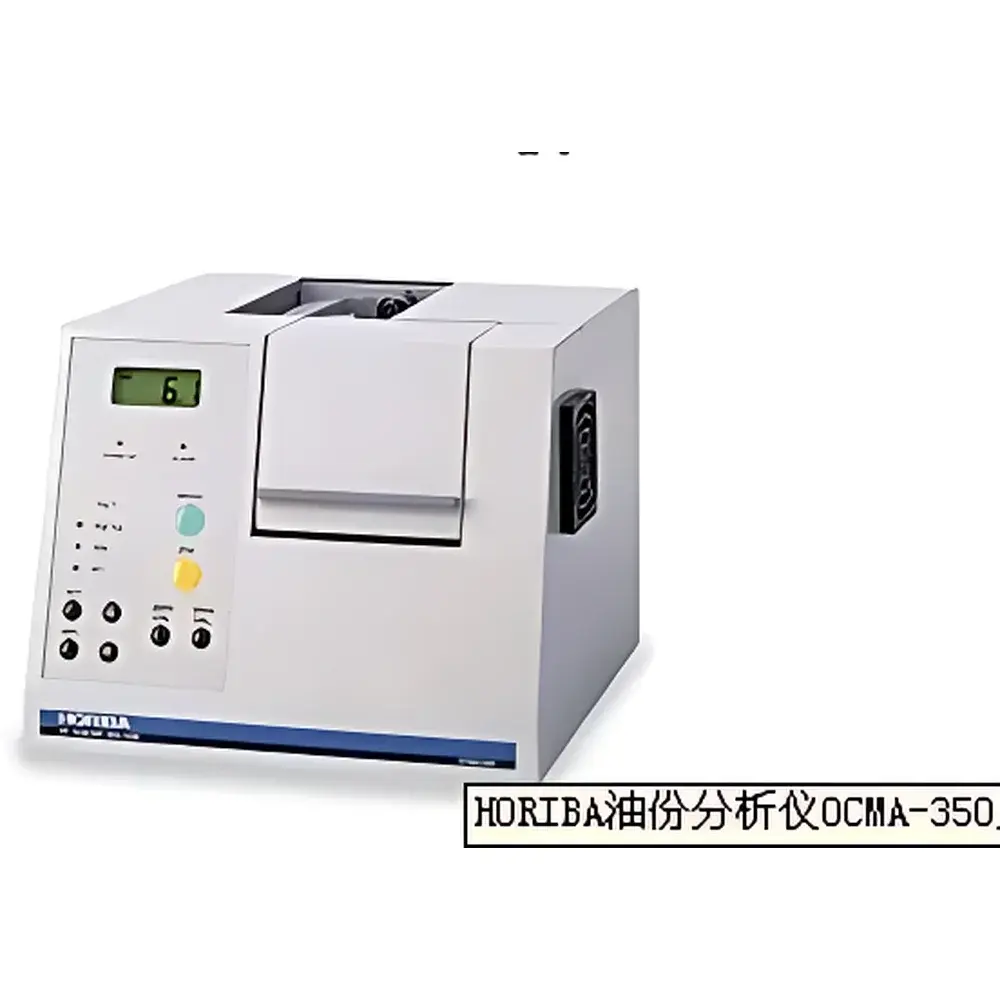
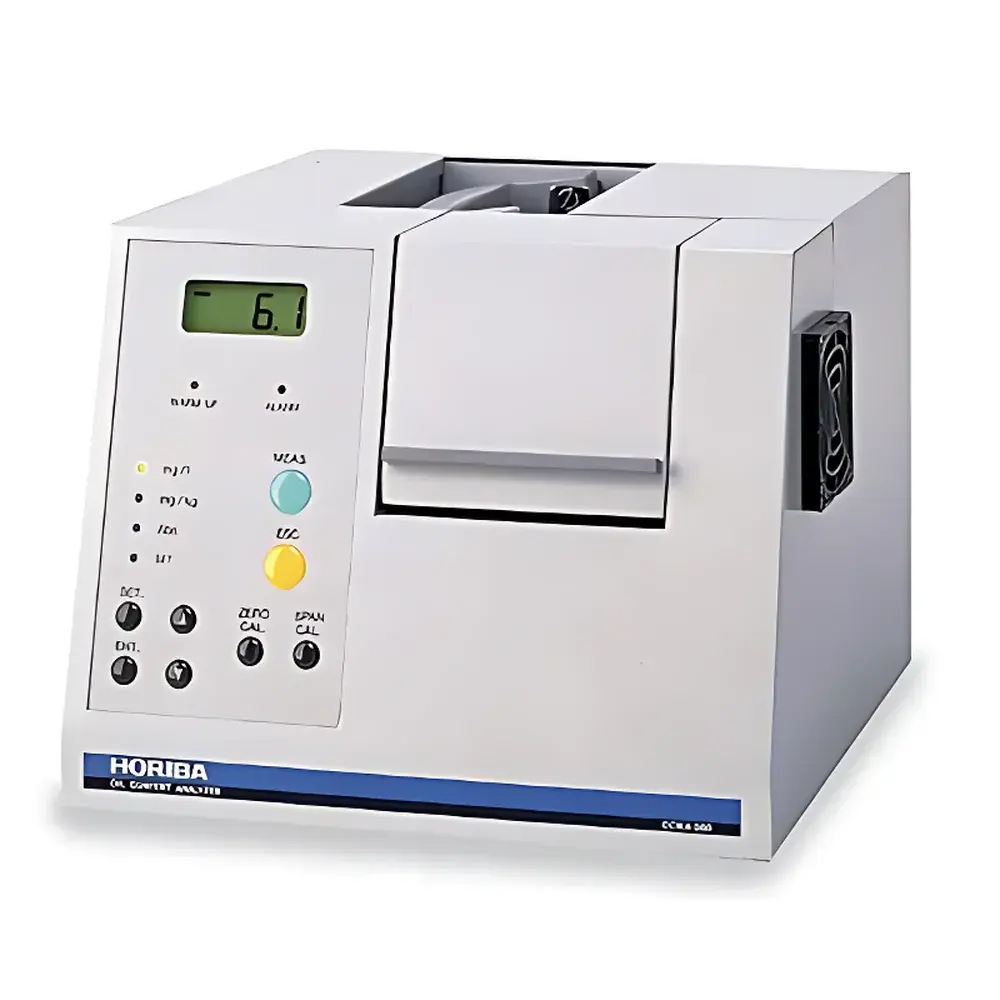
HORIBA OCMA-550/555 Oil Content Analyzer
| Brand | HORIBA |
|---|---|
| Origin | Japan |
| Model | OCMA-550 / OCMA-555 |
| Instrument Type | Portable |
| Measurement Principle | Non-Dispersive Infrared (NDIR) Absorption Spectrophotometry |
| Extraction Solvent | OCMA-550 — S-316 |
| Measurement Range | 0–200 mg/L (water), 0–1000 mg/kg (soil), 0–1 Abs |
| Detection Limit | 0.1 ppm |
| Repeatability | ±0.4 mg/L (0–9.9 mg/L), ±2.0 mg/L (10.0–99.9 mg/L), ±4 mg/L (100–200 mg/L), ±1% F.S. (0–1 Abs) |
| Display | Backlit LCD with timestamping |
| Interface | RS-232C, Parallel Printer Port |
| Power Supply | 230 V AC, 50 Hz |
| Dimensions | 250 × 200 × 285 mm (W × H × D) |
| Sample Cell | 200-mm pathlength quartz cuvette |
| Compliance | Designed for ASTM D7066, ISO 9377-2, and EPA Method 1664-compatible workflows |
Overview
The HORIBA OCMA-550 and OCMA-555 Oil Content Analyzers are portable, laboratory-grade instruments engineered for precise quantification of hydrocarbon oil residues in aqueous and solid-phase environmental samples. Both models operate on the principle of non-dispersive infrared (NDIR) absorption spectroscopy—specifically targeting the characteristic C–H stretching vibration band near 3.4 µm—enabling selective detection of aliphatic and aromatic hydrocarbons while excluding interferences from water, solvents, or particulate matter. Unlike fluorescence-based alternatives, NDIR provides superior specificity for total petroleum hydrocarbons (TPH) and is widely accepted in regulatory frameworks including EPA Method 1664, ASTM D7066, and ISO 9377-2. The OCMA-550 employs S-316 (1,1,2-trichloro-1,2,2-trifluoroethane) as its extraction solvent, whereas the OCMA-555 utilizes H-997 (a proprietary, low-toxicity halogenated hydrocarbon blend), offering enhanced operator safety and reduced environmental impact without compromising analytical fidelity.
Key Features
- Triple-unit measurement capability: switch seamlessly between concentration units—mg/L (for water extracts), mg/kg (for soil/sediment extracts), and absorbance (Abs)—directly on the instrument interface
- Integrated real-time timestamping and auto-calibration sequence initiated after zero-point stabilization, ensuring traceable, GLP-compliant data generation
- Backlit monochrome LCD display with intuitive menu navigation and on-screen result logging—no external PC required for basic operation
- Dual communication interfaces: RS-232C serial port supports bidirectional data exchange with LIMS or custom acquisition software; parallel printer port enables immediate hardcopy output
- Optimized optical architecture featuring a thermoelectrically stabilized detector and 200-mm pathlength quartz flow cell, delivering high signal-to-noise ratio and long-term photometric stability
- Compact benchtop footprint (250 × 200 × 285 mm) with ruggedized housing suitable for field deployment, mobile labs, or QC environments with limited space
Sample Compatibility & Compliance
The OCMA series is validated for use with a broad range of sample matrices requiring TPH quantification under environmental monitoring and industrial hygiene protocols. It accommodates pre-extracted liquid samples (e.g., wastewater effluents, cooling tower blowdown, bilge water), homogenized soil/sludge suspensions, and surface wipe extracts from machined parts or semiconductor wafers. Extraction must be performed prior to analysis using standardized procedures—S-316 for OCMA-550 or H-997 for OCMA-555—with phase separation and filtration steps adhering to EPA SW-846 Method 3510C. The instrument’s measurement uncertainty profile meets the repeatability requirements outlined in ISO/IEC 17025 for accredited testing laboratories. While not intrinsically compliant with FDA 21 CFR Part 11, audit trails and electronic records can be implemented via external software when paired with HORIBA’s optional data management suite.
Software & Data Management
Although the OCMA-550/555 operates autonomously, its RS-232C interface supports ASCII-formatted output compatible with third-party data acquisition platforms—including LabVIEW, MATLAB, and custom Python scripts—for automated reporting and statistical process control (SPC). Each measurement record includes date/time stamp, unit selection, raw absorbance value, calculated concentration, and instrument ID. When connected to a Windows-based host, data may be imported into Excel or exported to CSV for integration into enterprise environmental databases. Optional HORIBA software modules provide calibration curve management, multi-point standardization, and trend analysis across time-series datasets—essential for discharge monitoring compliance and preventive maintenance validation in metalworking fluid systems.
Applications
- Regulatory wastewater discharge verification per NPDES permits and local sewer authority limits
- In-process monitoring of degreasing bath efficiency in precision machining and electroplating facilities
- Soil screening at brownfield sites and hazardous waste characterization per RCRA guidelines
- Surface cleanliness validation for aerospace components, medical device substrates, and semiconductor wafer carriers
- Performance assessment of oil-water separators, API tanks, and coalescing filters in marine and industrial settings
- Research applications involving biodegradation kinetics of hydrocarbons in activated sludge or biofilm reactors
FAQ
What extraction solvents are required for each model?
The OCMA-550 requires S-316 (1,1,2-trichloro-1,2,2-trifluoroethane), while the OCMA-555 uses H-997—a lower-global-warming-potential alternative developed by HORIBA specifically for environmental compliance and occupational safety.
Can the instrument measure emulsified or dissolved oil fractions?
No. The OCMA series quantifies only extractable petroleum hydrocarbons (EPH) following solvent partitioning. Emulsified or truly dissolved fractions require prior acidification or centrifugation to facilitate phase separation before extraction.
Is the quartz cuvette reusable, and what cleaning protocol is recommended?
Yes—the supplied 200-mm pathlength quartz cuvette is designed for repeated use. Rinse thoroughly with fresh S-316 or H-997 between analyses, followed by air-drying in a particle-free environment; avoid ultrasonic cleaning or organic solvents other than the designated extractant.
Does the analyzer support multi-point calibration?
Yes. Manual entry of up to five standard concentrations allows linear or polynomial curve fitting. Calibration data is retained in non-volatile memory and can be recalled or overwritten as needed.
How is solvent recovery handled?
HORIBA offers the SR-305 Solvent Regenerator (optional), which employs dual-bed activated carbon and activated alumina columns to remove polar contaminants and water from used S-316 or H-997—extending solvent life and reducing disposal costs in high-throughput labs.







