
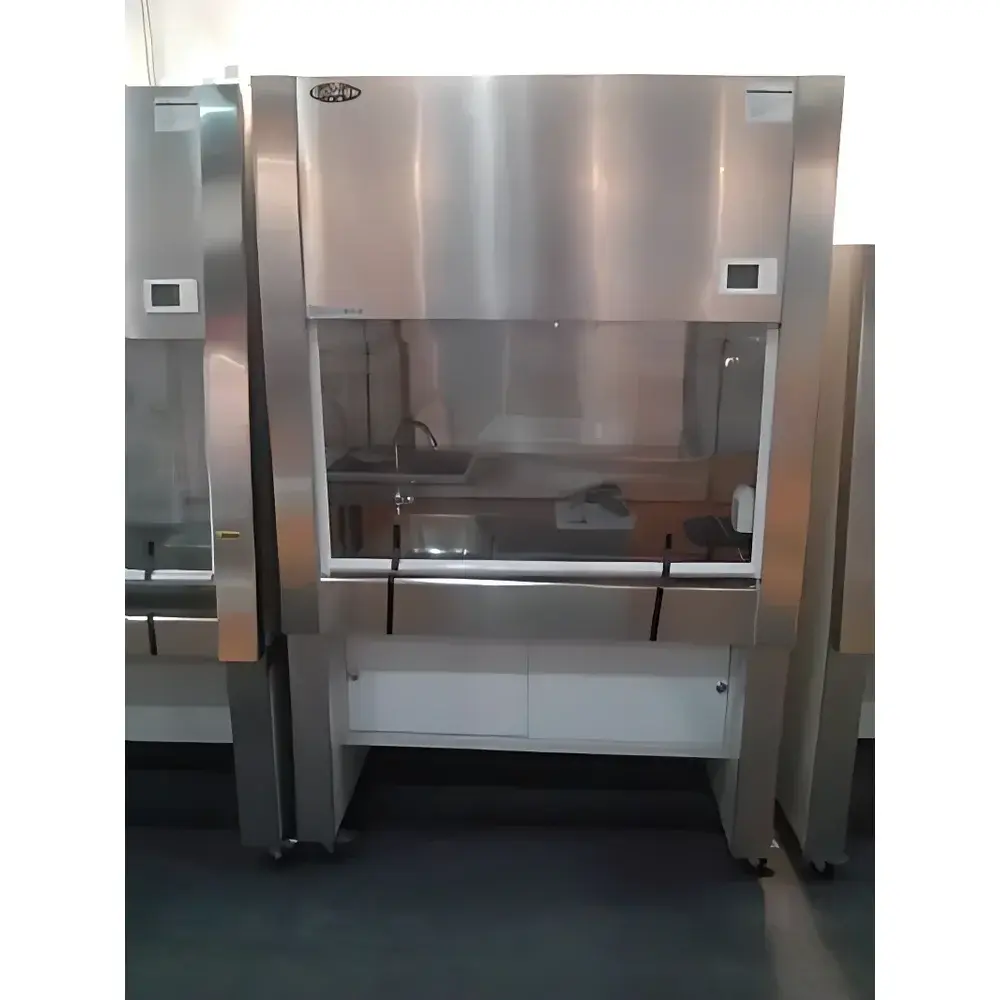
Jiangsu-made SW-CJ-1D Single-Person Horizontal Laminar Flow Clean Bench
| Origin | Jiangsu, China |
|---|---|
| Manufacturer Type | Authorized Distributor |
| Model | SW-CJ-1D |
| Price | USD 680 (FOB Jiangsu) |
| Cleanliness Class | ISO Class 5 (equivalent to Fed. Std. 209E Class 100 @ ≥0.5 µm) |
| Microbial Count | ≤0.5 CFU/plate·hour (Φ90 mm settle plate) |
| Average Air Velocity | 0.25–0.45 m/s (dual-speed control) |
| Noise Level | ≤62 dB(A) |
| Vibration Peak-to-Peak | ≤1.0 µm (X/Y/Z axes) |
| Illuminance | ≥300 lx |
| Power Supply | AC 220 V ±10%, 50 Hz |
| Max. Power Consumption | 130 W |
| Net Weight | <85 kg |
| HEPA Filter Size & Qty | 695 × 455 × 50 mm × 1 |
| Fluorescent Lamp / UV Lamp | 15 W × 1 / 15 W × 1 |
| Work Area Dimensions | 700 × 500 × 500 mm |
| Overall Dimensions | 850 × 580 × 1600 mm |
| User Capacity | Single operator, front-facing access |
Overview
The SW-CJ-1D Single-Person Horizontal Laminar Flow Clean Bench is an ISO Class 5-certified local exhaust ventilation system engineered for unidirectional airflow containment in non-sterile but particle-controlled laboratory environments. It operates on the principle of horizontal laminar flow: ambient air is drawn through a pre-filter, pressurized by a low-noise centrifugal blower into a plenum chamber, and then uniformly discharged across the work surface after passing through a certified HEPA filter (EN 1822 H13 or equivalent). This creates a continuous, high-velocity curtain of filtered air—free of particles ≥0.5 µm at ≥99.99% efficiency—that sweeps contaminants away from the operator and sample zone. Designed for applications where personnel protection is not required (unlike biosafety cabinets), the SW-CJ-1D prioritizes product protection and procedural integrity in pharmaceutical QC, cell culture prep, microbiological assay setup, and precision instrument handling.
Key Features
- Horizontally oriented laminar airflow ensures consistent, low-turbulence particle removal across the full 700 × 500 mm work area.
- Dual-speed fan control (0.25–0.45 m/s) enables precise adjustment of face velocity to match procedural requirements—critical for volatile reagent handling or heat-sensitive samples.
- Robust enclosure constructed from high-density medium-density fiberboard (MDF) with electrostatic powder-coated finish—resistant to corrosion, static accumulation, and routine disinfectant exposure.
- Stainless steel work surface (304 grade) provides chemical resistance, non-porosity, and ease of decontamination between runs.
- Integrated 15 W UV-C lamp (254 nm) supports surface decontamination during idle periods; interlocked safety switch prevents UV exposure during operation.
- Front-access configuration with sash-less open-face design minimizes ergonomic strain and facilitates large equipment integration.
- Low acoustic signature (≤62 dB[A]) supports extended use in shared lab spaces without auditory fatigue.
Sample Compatibility & Compliance
The SW-CJ-1D is validated for use with non-hazardous biological materials, sterile media preparations, and non-volatile chemical reagents. It complies with ISO 14644-1:2015 (Cleanrooms and associated controlled environments — Part 1: Classification of air cleanliness by particle concentration) for Class 5 operation under static and operational conditions. While not certified to NSF/ANSI 49 or EN 12469 (which govern biosafety cabinets), its performance aligns with GMP Annex 1 (2022) recommendations for Grade A local protection in aseptic processing zones when installed within a Grade C background environment (e.g., ISO Class 8 cleanroom). Routine microbial monitoring per ISO 14698-1 is recommended to verify bioburden control. The unit meets CE marking requirements for electromagnetic compatibility (EMC Directive 2014/30/EU) and low-voltage safety (LVD Directive 2014/35/EU).
Software & Data Management
The SW-CJ-1D operates via a tactile membrane control panel with dedicated switches for fan speed, fluorescent lighting, and UV irradiation. No embedded software or digital data logging is included—consistent with IEC 61000-4-2/3/4 compliance for industrial-grade reliability in electromagnetically noisy lab settings. For laboratories requiring audit-ready documentation, optional external environmental monitoring systems (e.g., calibrated anemometers, particle counters, and temperature/humidity loggers) may be deployed per FDA 21 CFR Part 11 guidelines. Maintenance records—including pre-filter cleaning dates, HEPA replacement logs, and velocity verification reports—should be retained as part of GLP/GMP quality system documentation.
Applications
- Preparation of sterile culture media and inoculation plates in microbiology and molecular biology labs.
- Assembly and handling of sterile medical devices prior to packaging validation.
- Weighing and dispensing of active pharmaceutical ingredients (APIs) in non-cytotoxic formulation areas.
- Calibration and maintenance of precision analytical instruments requiring particulate-free staging.
- Electronics assembly and optical component handling where electrostatic discharge (ESD) control is secondary to particulate exclusion.
FAQ
What is the recommended background environment for installing the SW-CJ-1D?
It must be placed in a controlled room meeting ISO Class 8 (100,000) or better—ideally within a Grade C GMP suite—to prevent upstream contamination from compromising laminar flow integrity.
How often should the HEPA filter be replaced?
Under standard usage (8 hrs/day, 5 days/week), replace every 18 months—or sooner if face velocity falls below 0.25 m/s after pre-filter cleaning and voltage adjustment.
Can this unit be used for handling hazardous biological agents?
No. The SW-CJ-1D provides product protection only—not personnel or environmental protection. Biosafety Level 2+ work requires a Class II Type A2 or B2 biosafety cabinet per NIH/CDC guidelines.
Is UV lamp validation required before first use?
Yes. Radiometric verification of UV intensity (≥40 µW/cm² at 1 m distance) using a NIST-traceable UV meter is mandatory prior to commissioning, per ISO 15858:2016.
Does the unit support integration with building management systems (BMS)?
Not natively. Optional 4–20 mA analog outputs for airflow and status signals can be added via third-party interface modules compliant with Modbus RTU protocol.



