
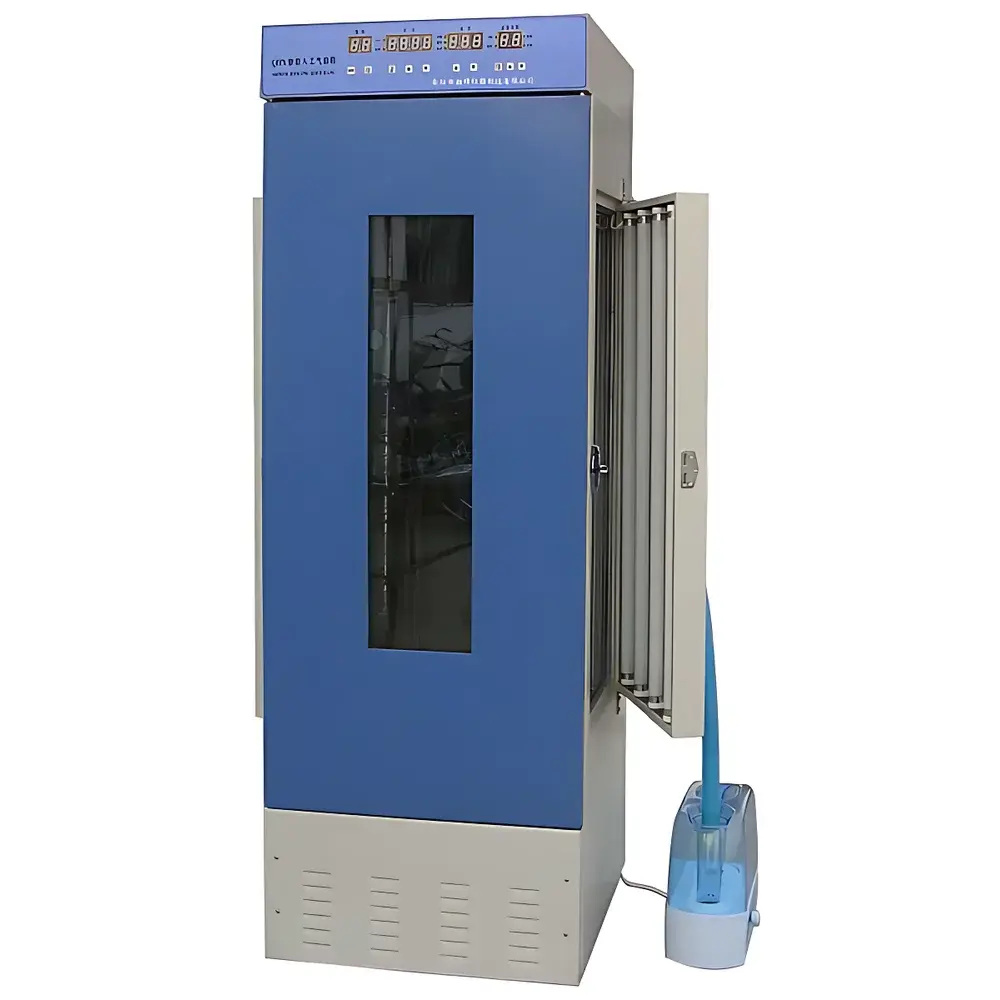
Langbo ZW-1000 Plant Growth Chamber
| Brand | Langbo |
|---|---|
| Origin | Jiangsu, China |
| Model | ZW-1000 |
| Temperature Range | 0–50 °C |
| Chamber Volume | 1000 L |
| Internal Dimensions (W×D×H) | 1000×1000×1000 mm |
| Light Source | LED cold-light panels |
| Illuminance Range | 0–12,000 lx |
| Illumination Layers | 4 |
| Temperature Uniformity | ±1.0 °C (±1.5 °C below 0 °C) |
| Humidity Range | 50–95 %RH |
| Humidity Uniformity | ±5 %RH |
| Light Intensity Control | 0–100 % of E<sub>max</sub>, stepless dimming |
| Airflow Pattern | Near-horizontal |
| Air Velocity | 0.1–0.3 m/s |
| Compressor Operation Mode | Intermittent |
| LED Panel Lifespan | 10,000 h |
| Continuous Operation Capability | 24/7, year-round |
Overview
The Langbo ZW-1000 Plant Growth Chamber is a precision-engineered environmental control system designed for reproducible, long-term plant phenotyping, seed germination studies, photobiology experiments, and controlled-environment agriculture (CEA) research. It operates on a dual-climate control principle—integrating active thermoelectric or compressor-based cooling with resistive heating, coupled with independent humidity generation and condensation-based dehumidification—to maintain stable, programmable conditions across temperature, relative humidity, and photosynthetically active radiation (PAR). Unlike standard incubators, the ZW-1000 incorporates four independently addressable LED illumination layers, each calibrated to deliver uniform spectral output (typically white + red/blue supplemental peaks) within the 400–700 nm range, enabling precise simulation of diurnal cycles, seasonal light quality shifts, and stress-induction protocols. Its 1000 L internal volume and cubic 1000 mm × 1000 mm × 1000 mm chamber geometry support multi-tiered experimental setups—including pots, hydroponic trays, and growth racks—while maintaining airflow homogeneity via low-turbulence, near-horizontal laminar circulation at 0.1–0.3 m/s.
Key Features
- Stable dual-mode climate control: temperature range 0–50 °C with ±1.0 °C uniformity (±1.5 °C at sub-zero setpoints); humidity range 50–95 %RH with ±5 %RH spatial consistency
- Four-layer modular LED lighting system delivering 0–12,000 lx illuminance; each layer supports independent intensity modulation from 0–100 % of maximum output, enabling dynamic light ramping and spectral profiling
- Robust mechanical architecture: stainless steel interior, insulated double-wall construction, and sealed door gasketing ensure minimal thermal leakage and contamination resistance
- Compressor-based refrigeration with intelligent intermittent cycling—optimized for energy efficiency and extended component service life without compromising stability
- Engineered for continuous operation: rated for uninterrupted 24/7/365 duty cycle under laboratory or greenhouse-adjacent environments
- LED light panels certified for ≥10,000 h operational lifetime at nominal drive current, minimizing maintenance intervals and photometric drift over time
Sample Compatibility & Compliance
The ZW-1000 accommodates a broad spectrum of botanical specimens—from Arabidopsis thaliana seedlings and rice tillers to mature tomato or lettuce plants—and supports integration with common growth substrates (soil, rockwool, agar plates, aeroponic mist nozzles). Its chamber geometry permits standardized placement per ASTM E1980 (Standard Practice for Calculating Solar Reflectance Index of Horizontal and Low-Sloped Opaque Surfaces) and facilitates replication across multi-chamber trials. While not pre-certified to ISO 17025 or GLP, the system’s hardware design aligns with foundational requirements for audit-ready environmental monitoring: all sensors (PT100 temperature, capacitive RH) are field-calibratable, and operational logs—including setpoint deviations, alarm events, and runtime statistics—can be exported in CSV format for traceability. Optional validation packages support IQ/OQ documentation per GxP-aligned workflows.
Software & Data Management
The ZW-1000 is operated via an integrated 7-inch TFT touchscreen HMI with embedded real-time clock and non-volatile parameter storage. Users define up to 16 multi-stage programs, each specifying time-scheduled transitions in temperature, humidity, light intensity, and on/off states per illumination layer. Data logging occurs at user-selectable intervals (1–60 min), recording sensor values and actuator status. Export is supported via USB 2.0 port; no proprietary cloud platform or vendor-locked firmware is required. For integration into centralized lab infrastructure, optional RS485 Modbus RTU communication enables connection to SCADA systems or LIMS platforms—supporting automated data ingestion and remote supervisory control without third-party middleware.
Applications
- Controlled-environment phenotyping: quantifying genotype-by-environment interactions under defined photoperiods, temperature gradients, and drought-mimicking humidity regimes
- Seed dormancy and germination kinetics: standardized testing per ISTA guidelines using repeatable moisture and light triggers
- Abiotic stress physiology: simulating heatwaves, cold snaps, or high-VPD conditions while monitoring stomatal conductance or chlorophyll fluorescence in situ
- Microbial-plant interaction studies: maintaining sterile or semi-sterile conditions during rhizosphere microbiome inoculation experiments
- Teaching and training labs: scalable platform for undergraduate botany, ecology, and biotechnology curricula requiring hands-on environmental manipulation
FAQ
Can the ZW-1000 operate below 0 °C?
No. The specified minimum operating temperature is 0 °C. Sub-zero functionality is not supported due to condensation management and refrigerant limitations.
Is humidity control available during light-off periods?
Yes. Humidity generation and regulation operate independently of illumination state, allowing full environmental control across dark phases of circadian protocols.
What calibration standards are recommended for routine verification?
NIST-traceable portable hygrometers (e.g., Rotronic HC2-S) and PT100 reference probes are advised for quarterly performance checks; calibration certificates are user-maintained.
Does the system meet FDA 21 CFR Part 11 requirements?
Out-of-the-box, it does not include electronic signature, audit trail, or role-based access control. These capabilities require external LIMS integration or custom firmware development.
Can custom chamber dimensions be fabricated?
Yes. Langbo offers non-standard engineering services for bespoke volume, door configuration, or sensor port layouts—subject to minimum order quantity and lead time negotiation.




