
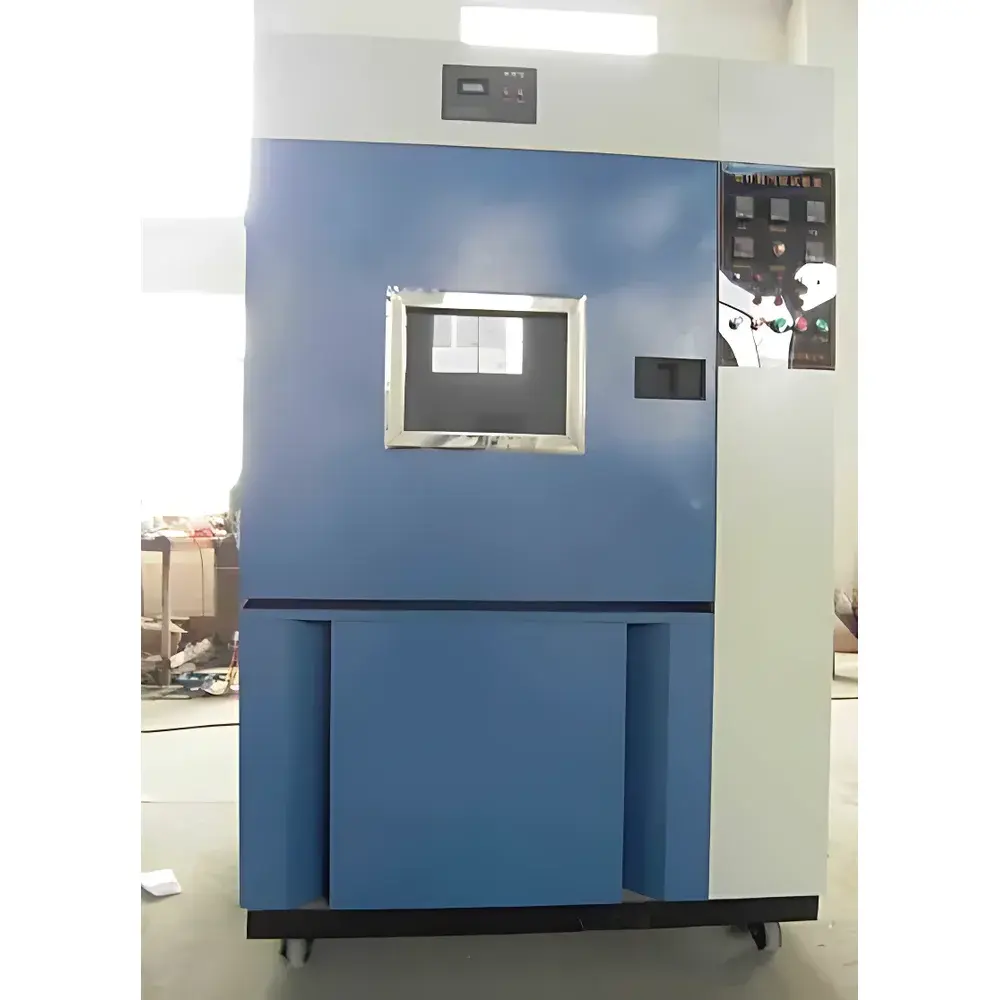
LBGFSN-050 Xenon Arc Weathering Test Chamber for Photovoltaic Module Durability Testing
| Origin | Jiangsu, China |
|---|---|
| Manufacturer Type | Authorized Distributor |
| Origin Classification | Domestic (China) |
| Model | LBGFSN-050 |
| Price | USD 17,800 (FOB Jiangsu) |
| Internal Dimensions | 800 × 800 × 700 mm (W × D × H) |
| Xenon Lamp Power | ~6 kW |
| Lamp Cooling | Water-Cooled or Air-Cooled Options |
| Temperature & Humidity Controller | Imported Microprocessor-Based Digital Controller |
| Refrigeration System | Twin-Stage Cascade Refrigeration with Imported French “TECO” Hermetic Piston Compressor |
| Inner Chamber Material | SUS#304 Stainless Steel |
| Outer Chamber Material | High-Quality Carbon Steel with Electrostatic Powder Coating |
| Air Circulation | Forced Convection via High-Efficiency Centrifugal Blower |
| Safety Protections | Leakage Current Protection, Low-Water-Level Cut-off, Over-Pressure/Over-Current Trip, Power-Failure Memory Function |
| Supply Voltage | AC 380 V ±10%, 3-Phase 5-Wire |
| Ambient Operating Conditions | 5–30 °C, ≤85% RH |
| Compliance Standards | GB/T 2423.24–1995, GB/T 16422.2, GB 9344, GB/T 1865–1997, IEC 61215, IEC 61646, IEC 60904-9 (Class A Solar Simulator Requirements for Spectral Match) |
Overview
The LBGFSN-050 Xenon Arc Weathering Test Chamber is a purpose-engineered environmental simulation system designed specifically for accelerated aging and durability validation of photovoltaic (PV) modules under controlled solar irradiance, temperature, and humidity conditions. Based on the principle of xenon arc spectral simulation—reproducing full-spectrum sunlight (290–2500 nm) with close spectral match to terrestrial AM1.5G irradiance—the chamber enables standardized evaluation of photochemical degradation, polymer yellowing, encapsulant delamination, backsheet embrittlement, and interconnect corrosion. Its dual-stage cascade refrigeration architecture, combined with precision microprocessor-based climate control and uniform forced-air circulation, ensures stable thermal-hygrometric profiles across the entire test volume—critical for reproducible qualification testing per IEC 61215 and IEC 61646 requirements.
Key Features
- High-fidelity xenon lamp source (~6 kW) with optional water-cooled or air-cooled configurations, calibrated to meet IEC 60904-9 Class A spectral match criteria for irradiance uniformity and spectral distribution.
- Robust chamber construction: interior lined with electropolished SUS#304 stainless steel for corrosion resistance; exterior fabricated from carbon steel with electrostatic powder coating for mechanical durability and long-term stability.
- Independent heating, cooling, and humidification subsystems—minimizing cross-interference, improving control resolution, extending component service life, and reducing maintenance downtime.
- Twin-stage cascade refrigeration circuit utilizing an imported French TECO hermetic piston compressor—capable of achieving rapid temperature transitions and maintaining low-temperature stability down to –40 °C (optional configuration).
- Forced convection airflow system with centrifugal blower and optimized duct geometry—ensuring <±1.5 °C temperature uniformity and <±3% RH uniformity across the 800 × 800 × 700 mm test volume per ISO 17025-recommended verification protocols.
- Integrated safety architecture including leakage current protection, automatic low-water cutoff for humidifier and lamp cooling circuits, over-pressure/over-current tripping, and non-volatile power-failure memory to retain setpoints and runtime data after unexpected shutdown.
Sample Compatibility & Compliance
The LBGFSN-050 accommodates standard and oversized PV modules up to 750 mm × 750 mm footprint with vertical or horizontal mounting flexibility. Its internal dimensions (800 × 800 × 700 mm) provide ample clearance for auxiliary fixtures such as IV curve tracers, thermocouple arrays, or optical monitoring ports. The system is fully compliant with major international photovoltaic qualification standards, including IEC 61215-2 (MQT 10: UV Preconditioning), IEC 61646 (Thin-Film Damp Heat + UV), and IEC 61730-2 (Safety Testing). It also satisfies national standards GB/T 2423.24 (Test SD: Simulated Solar Radiation with Temperature), GB/T 16422.2 (Xenon Arc Exposure), GB/T 1865–1997 (Weathering of Plastics), and GB 9344 (Plastic Aging under Artificial Light). All operational parameters—including irradiance intensity (measured via NIST-traceable UV/VIS radiometer), black panel temperature, chamber air temperature, and relative humidity—are continuously logged and exportable for GLP/GMP audit readiness.
Software & Data Management
The chamber operates via a dedicated microprocessor-based controller with a 7-inch color touchscreen interface supporting multi-segment programmable cycles (up to 99 steps per program), real-time trend plotting, and password-protected parameter locking. Data logging interval is configurable from 1 second to 60 minutes; all records—including irradiance, temperature, humidity, runtime, alarm events, and safety status—are stored internally (≥30 days at 1-min intervals) and exportable via USB or RS485 to CSV or Excel-compatible formats. Optional Ethernet connectivity enables integration into centralized laboratory information management systems (LIMS) and supports remote monitoring via secure HTTP/HTTPS. Audit trail functionality complies with FDA 21 CFR Part 11 requirements when paired with validated user access controls and electronic signature modules.
Applications
- Accelerated UV exposure testing of crystalline silicon and thin-film PV modules per IEC 61215 MQT 10 and IEC 61646 Annex A.
- Damp heat + UV sequential stress testing for evaluating encapsulant hydrolysis and backsheet adhesion loss.
- Qualification of new EVA, POE, and silicone encapsulants under combined thermal, UV, and humidity stress.
- Outdoor reliability correlation studies using accelerated weathering data to predict field performance (e.g., PID susceptibility, discoloration kinetics).
- Material screening for front sheets, backsheets, junction boxes, and frame adhesives under realistic solar spectra.
- Research-grade photodegradation analysis in university and industrial R&D labs focused on next-generation PV technologies.
FAQ
What irradiance levels can the LBGFSN-050 achieve, and how is spectral output verified?
The system delivers adjustable irradiance from 0.35 to 1.10 W/m²/nm (340 nm band), calibrated using a NIST-traceable spectroradiometer. Spectral match to AM1.5G is verified quarterly per IEC 60904-9 Annex E.
Is the chamber suitable for continuous unattended operation during long-term qualification tests?
Yes—equipped with redundant safety interlocks, non-volatile memory, and remote alarm notification (via relay or optional SMS/email gateway), it supports 1,000+ hour uninterrupted test cycles.
Can the controller be integrated into existing lab automation infrastructure?
Standard Modbus RTU (RS485) protocol support enables seamless integration with SCADA, MES, or custom Python/LabVIEW control environments.
Does the system include calibration documentation traceable to national metrology institutes?
Each unit ships with a factory calibration certificate for temperature, humidity, and irradiance sensors, with traceability to CNAS-accredited laboratories (ISO/IEC 17025).
What maintenance intervals are recommended for the xenon lamp and refrigeration system?
Xenon lamps require replacement every 1,500–2,000 hours of operation; compressor oil and refrigerant filters should be serviced annually or per 3,000 operating hours—logbook templates and preventive maintenance checklists are provided.



