
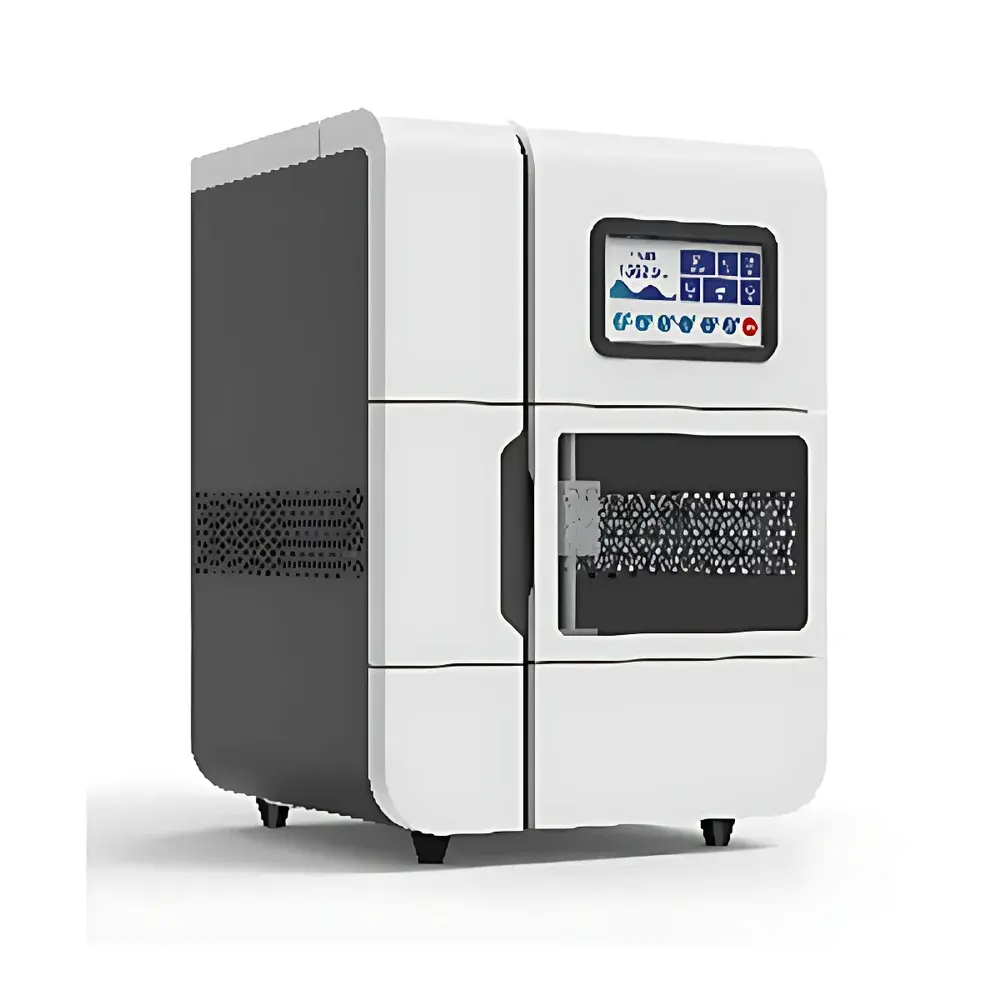
Luban Instruments LIC100 Fully Automated COD Analyzer
| Brand | Yoke |
|---|---|
| Origin | Shanghai, China |
| Manufacturer Type | Direct Manufacturer |
| Instrument Type | Laboratory-Grade |
| Model | LIC100 |
| Measurement Principle | Rapid Digestion–Spectrophotometric Method (HJ/T 399–2007) |
| Measurement Range | 4–10,000 mg/L COD (segmented auto-ranging) |
| Sample Throughput | 16 samples per batch |
| Calibration | Onboard Auto-Standardization |
| Connectivity | Wi-Fi, Bluetooth, USB, Cloud API, WeChat Mini-Program Integration |
| Display | 7-inch Capacitive Touchscreen |
| Compliance | HJ/T 399–2007, ISO 6060, ASTM D1252–22 (Method B) |
Overview
The Luban Instruments LIC100 Fully Automated COD Analyzer is an integrated laboratory platform engineered for precision, reproducibility, and regulatory compliance in chemical oxygen demand (COD) determination. It implements the rapid digestion–spectrophotometric method specified in China’s national standard HJ/T 399–2007, which aligns with internationally recognized principles found in ISO 6060 (Water quality — Determination of chemical oxygen demand) and ASTM D1252–22 (Method B: Closed Reflux–Colorimetric). Unlike manual or semi-automated systems requiring operator intervention at multiple stages—including reagent addition, timed digestion, cooling, dilution, and absorbance measurement—the LIC100 executes the entire analytical workflow autonomously. The instrument utilizes a thermally controlled digestion block capable of reaching and maintaining precise temperatures (165 °C ± 1 °C) for standardized 15-minute digestion cycles, followed by active air-cooling to ambient temperature prior to photometric quantification at 600 nm. This architecture eliminates inter-operator variability, minimizes exposure to hazardous reagents (e.g., potassium dichromate/sulfuric acid mixtures), and ensures traceable, auditable results suitable for environmental monitoring laboratories operating under GLP or ISO/IEC 17025 frameworks.
Key Features
- Fully automated sample processing: 16-position carousel enables unattended batch analysis—ideal for municipal wastewater labs, industrial effluent QA/QC, and third-party testing facilities handling >50 samples/day.
- Integrated dual-zone thermal management: Independent heating (digestion) and forced-air cooling modules ensure strict adherence to HJ/T 399–2007 thermal profiles and eliminate manual cooling delays.
- Pre-filled reagent cartridge system: Eliminates manual reagent preparation; each cartridge contains calibrated volumes of digestion reagent (Cr⁶⁺/H₂SO₄) and color-developing reagent (ferroin indicator), reducing contamination risk and analyst training burden.
- Segmented auto-ranging measurement: Automatically selects optimal optical path and dilution factor based on preliminary absorbance screening—enabling accurate quantification across the full 4–10,000 mg/L range without manual intervention.
- Onboard calibration verification: Built-in reference standards and automatic zero/span checks before each run support long-term stability tracking and meet internal QA requirements for drift control.
- Regulatory-ready data architecture: All measurements are timestamped, user-authenticated, and stored with full audit trail—including digestion temperature logs, cooling duration, raw absorbance values, and dilution factors.
Sample Compatibility & Compliance
The LIC100 accepts aqueous samples with suspended solids ≤ 50 mg/L (pre-filtration recommended for turbid matrices). It is validated for use with domestic sewage, industrial process water, leachate, and surface water per HJ/T 399–2007. Interference mitigation includes chloride compensation algorithms (up to 2,000 mg/L Cl⁻) and spectral correction for nitrate/nitrite overlap. The system conforms to ISO/IEC 17025:2017 clause 7.7 (ensuring result validity), supports 21 CFR Part 11–compliant electronic signatures when deployed with optional LIMS integration, and maintains full traceability for environmental reporting to Chinese MEP (MEE) or international regulators referencing EU WFD or US EPA Method 410.1.
Software & Data Management
The embedded firmware runs on a Linux-based real-time OS with a responsive 7-inch capacitive touchscreen UI. Data export options include CSV (with metadata headers), PDF analytical reports (per sample + batch summary), and direct upload to secure cloud storage via TLS 1.2–encrypted Wi-Fi or Ethernet. Bluetooth 5.0 enables local pairing with handheld barcode scanners for sample ID capture. A RESTful API and WeChat Mini-Program interface allow remote status monitoring, push notifications for completion/error alerts, and integration into existing ELN or LIMS environments. Audit logs record all user actions, parameter changes, and calibration events with immutable timestamps—fully compliant with GLP documentation requirements.
Applications
- Wastewater treatment plant (WWTP) influent/effluent monitoring per discharge permit conditions.
- Pharmaceutical and chemical manufacturing QC labs verifying pretreatment efficiency prior to biological treatment.
- Environmental consulting firms conducting baseline surveys and compliance audits under GB 8978–1996 or local discharge standards.
- University research laboratories studying organic load dynamics in constructed wetlands or anaerobic digesters.
- Third-party certification bodies performing accredited COD testing for ISO 14001 EMS verification.
FAQ
Does the LIC100 require daily recalibration?
No—onboard auto-standardization using certified reference materials occurs before each batch; full calibration verification is recommended weekly or after 200 analyses.
Can the instrument handle high-chloride wastewater samples?
Yes—integrated chloride compensation algorithm corrects for interference up to 2,000 mg/L Cl⁻; samples exceeding this require matrix-matched dilution or pretreatment with mercury sulfate.
Is method validation documentation available?
Yes—factory-issued IQ/OQ protocols, HJ/T 399–2007 performance verification reports, and ISO 6060 comparability data are provided with delivery.
What maintenance is required beyond routine cleaning?
Annual thermal calibration of the digestion block and photometer wavelength verification are recommended; no consumable parts other than reagent cartridges require replacement.
Can raw absorbance data be exported for secondary analysis?
Yes—CSV exports include raw 600 nm and 700 nm (reference) absorbance values, digestion temperature/time profiles, and calculated dilution factors for full transparency.
Related Products







