
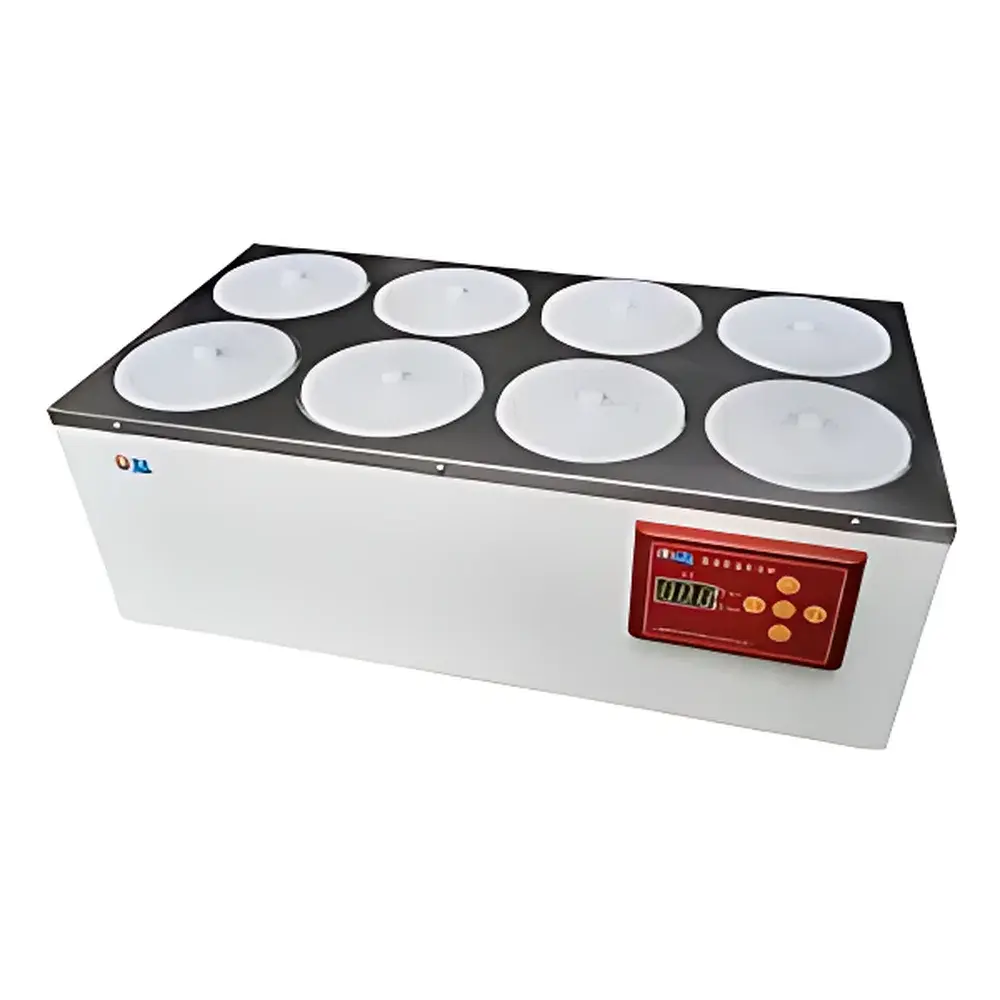
BOXUN HH.S21-8 Dual-Row 8-Position Precision Water Bath
| Brand | BOXUN |
|---|---|
| Origin | Shanghai, China |
| Manufacturer Type | Direct Manufacturer |
| Country of Origin | China |
| Model | HH.S21-8 |
| Price Range | USD 140–700 |
| Housing Material | Powder-Coated Steel |
| Interior Material | Stainless Steel (304) |
| Configuration | Dual-Row, 8-Wells |
| External Dimensions (mm) | 635 × 320 × 225 |
| Chamber Dimensions (mm) | 600 × 290 × 120 |
| Heating Power | 1.5 kW |
| Temperature Range | RT + 5 °C to 100 °C |
| Temperature Uniformity | ±1 °C at setpoint |
| Control System | PID-Based Digital Thermostat with Self-Diagnostic Circuitry |
Overview
The BOXUN HH.S21-8 Dual-Row 8-Position Precision Water Bath is an entry-level yet rigorously engineered constant-temperature immersion system designed for routine thermal stabilization, sample equilibration, reagent warming, and low-energy auxiliary heating in regulated laboratory environments. Operating on resistive heating principles with liquid-phase heat transfer via water or compatible aqueous media, the unit maintains stable thermal conditions across all eight wells through uniform conduction and natural convection within the stainless steel chamber. Its temperature control architecture employs a high-stability platinum resistance sensor (PT100-class equivalent) coupled with a microprocessor-driven PID algorithm, ensuring minimal overshoot and long-term setpoint retention—critical for applications requiring reproducible incubation or enzymatic reaction conditioning.
Key Features
- Dual-row, 8-well configuration optimized for parallel processing of standard test tubes (up to Ø25 mm), culture flasks, and small-volume containers—maximizing throughput without compromising thermal consistency.
- 304 stainless steel interior chamber resistant to corrosion from repeated exposure to water, saline solutions, and mild buffers; seamless welds prevent microbial entrapment and facilitate GLP-compliant cleaning protocols.
- Powder-coated carbon steel outer housing provides mechanical durability and chemical resistance against common lab solvents and disinfectants.
- Digital PID temperature controller with LED display offers intuitive setpoint adjustment (0.1 °C resolution), real-time bath temperature readout, and automatic power cutoff upon reaching upper limit (100 °C).
- Integrated electronic self-diagnostic function continuously monitors heater continuity, sensor integrity, and control loop stability—alerting users to potential faults before operational drift occurs.
- Over-temperature protection circuit (independent of main controller) halts heating if internal temperature exceeds 105 °C, satisfying IEC 61010-1 Class II safety requirements for laboratory equipment.
Sample Compatibility & Compliance
The HH.S21-8 accommodates glass, polypropylene, and polycarbonate vessels commonly used in clinical diagnostics, pharmaceutical QC, and academic research settings. Its open-bath design supports passive immersion of capped or uncapped containers, with no restrictions on vessel height provided clearance above the water line is maintained. The unit complies with basic electrical safety standards applicable to Class II laboratory appliances (IEC 61010-1:2010 + A1:2019). While not certified for sterile processing or ISO 13485 environments, its construction and thermal performance align with general requirements for non-critical temperature-controlled tasks under ISO/IEC 17025-accredited laboratories performing method validation per ASTM E2875 (Standard Guide for Laboratory Water Bath Use).
Software & Data Management
This analog-digital hybrid water bath operates without proprietary software or network connectivity. All operation is local and manual: temperature is set and monitored via front-panel controls and display. No data logging, remote access, or audit trail functionality is included—consistent with its role as a foundational utility device rather than a regulated process instrument. For labs requiring traceable temperature records, external calibrated data loggers (e.g., compliant with NIST-traceable thermistors) may be deployed alongside the unit in accordance with internal SOPs. The absence of embedded firmware eliminates cybersecurity concerns and simplifies qualification under FDA 21 CFR Part 11 when used in non-GxP support roles.
Applications
- Clinical pathology: Serum sample thawing and pre-incubation prior to ELISA, coagulation assays, or immunochemistry workflows.
- Microbiology: Activation of lyophilized cultures, maintenance of molten agar media, and temperature equilibration of inoculated plates.
- Pharmaceutical QA/QC: Dissolution medium conditioning, viscosity reference standard tempering, and extract preparation per USP <724> guidelines.
- Academic research: Enzyme kinetics studies requiring precise thermal initiation, DNA hybridization buffer equilibration, and polymerase chain reaction (PCR) reagent pre-warming.
- Industrial R&D: Emulsion stability testing, coating viscosity assessment, and raw material conditioning in polymer and cosmetic formulation labs.
FAQ
What is the maximum recommended water level for safe operation?
The water level must cover the heater elements but remain at least 20 mm below the top rim of the chamber to prevent overflow during thermal expansion and ensure proper air circulation around the housing.
Can this water bath be used with organic solvents such as ethanol or acetone?
No. The HH.S21-8 is validated exclusively for aqueous media. Organic solvents pose fire hazards, degrade seals, and compromise sensor accuracy due to differing thermal conductivity and vapor pressure profiles.
Is calibration documentation provided with the unit?
Factory calibration certificate is not included by default. Users are expected to perform initial verification using a NIST-traceable thermometer per their laboratory’s metrology procedure prior to first use.
Does the unit support external temperature probes for chamber monitoring?
No. The HH.S21-8 lacks auxiliary input ports or probe interfaces. Temperature feedback is internal only, derived from the fixed-position PT sensor embedded in the bath base.
What maintenance intervals are recommended for long-term reliability?
Bi-weekly descaling with 10% citric acid solution is advised for hard-water regions; quarterly inspection of heater terminals and grounding continuity is required under preventive maintenance schedules aligned with ISO/IEC 17025 Clause 6.4.2.



