
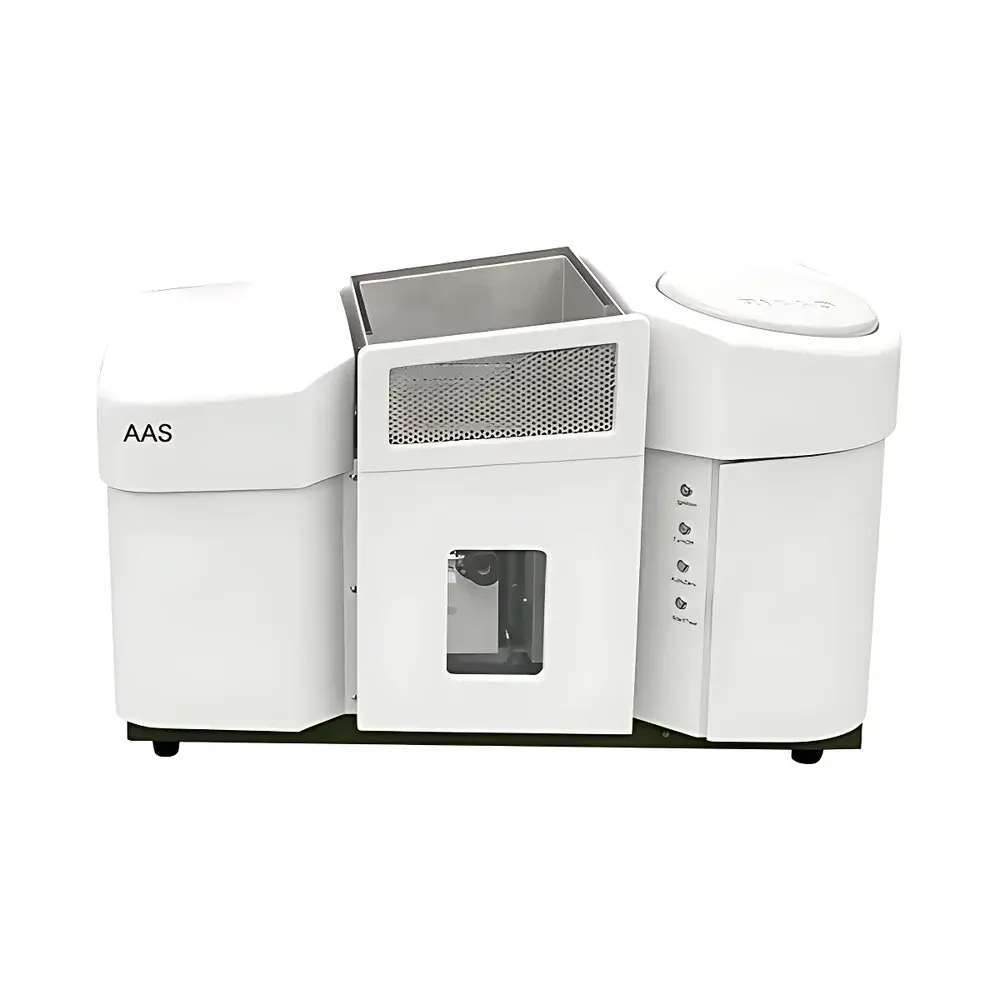
Yoke RG-3638AA Flame and Graphite Furnace Atomic Absorption Spectrometer
| Brand | Yoke |
|---|---|
| Origin | Shanghai, China |
| Manufacturer Type | Direct Manufacturer |
| Instrument Type | Dual-Mode Flame/GF-AAS |
| Monochromator | Plane Grating (1200 grooves/mm) |
| Optical System | Single-Beam Czerny-Turner (350 mm focal length) |
| Detector | Photomultiplier Tube (PMT) |
| Background Correction | D₂ Lamp + Self-Reversal Method |
| Spectral Bandwidth | 0.1/0.2/0.4/0.7/1.4/2.0 nm (6-step motorized selection) |
| Wavelength Range | 190–900 nm |
| Wavelength Accuracy | ±0.2 nm |
| Wavelength Repeatability | ≤0.1 nm |
| Spectral Resolution | 0.2 nm |
| Baseline Drift (Flame, Cu) | ±0.003 A/30 min (static), ±0.005 A/15 min (dynamic) |
| Detection Limits | Cd ≤1.0 pg, Cu ≤25 pg (GF-AAS) |
| Characteristic Mass | Cd ≤0.6 pg, Cu ≤20 pg |
| Precision (RSD) | ≤0.6% (Flame, Cu), ≤3% (GF-AAS, Cd) |
| Lamp Positions | 8-slot automatic turret |
| Light Sources | Hollow Cathode Lamps (HCLs) and Electrodeless Discharge Lamps (EDLs) |
| Safety Systems | Flame gas/oxidant pressure monitoring, graphite furnace cooling water flow & argon pressure interlocks, temperature and power fault detection |
| Power Requirement | 220 V ±22 V, 50 Hz ±1 Hz |
| Dimensions (W×D×H) | 830 × 650 × 560 mm |
| Weight | 90 kg |
Overview
The Yoke RG-3638AA is a dual-mode atomic absorption spectrometer engineered for high-sensitivity elemental quantification across diverse sample matrices. It integrates flame atomic absorption spectroscopy (FAAS) and graphite furnace atomic absorption spectroscopy (GFAAS) in a single platform, enabling seamless method switching without hardware reconfiguration. The instrument operates on the fundamental principle of atomic absorption: ground-state atoms in the gaseous phase absorb characteristic radiation emitted by element-specific hollow cathode lamps. Absorption intensity—measured as peak or integrated absorbance—is directly proportional to analyte concentration in accordance with the Beer-Lambert law. Its Czerny-Turner monochromator (350 mm focal length, 1200 grooves/mm plane grating) delivers high optical throughput and spectral fidelity across the 190–900 nm range, supporting analysis of over 70 metallic and semi-metallic elements. Designed for compliance-driven laboratories, the RG-3638AA supports trace-level environmental monitoring (e.g., EPA Method 7000B), food safety testing (AOAC 992.18), clinical toxicology (ISO 17025-accredited workflows), and industrial QC applications requiring sub-pg detection limits.
Key Features
- Dual-atomization system: Fully independent flame and graphite furnace modules with automated burner head positioning and furnace tube alignment verification.
- High-stability optical train: Single-beam design with thermally compensated optics; wavelength accuracy ±0.2 nm and repeatability ≤0.1 nm ensure long-term calibration integrity.
- Intelligent background correction: Simultaneous D₂ lamp and self-reversal (SR) methods provide >40-fold correction efficiency at 1 A absorbance, critical for complex matrices containing molecular absorbers or scattering particulates.
- Precision gas control: Motorized air/acetylene flow regulation (12-step flame mode) and programmable argon delivery (external: 1 L/min; internal: 0/50/200/250 mL/min) ensure reproducible atomization conditions.
- Advanced furnace thermal management: Programmable ramp-and-hold heating (1–255 s), maximum ramp rate of 2000 °C/s, and three heating modes (time-controlled, light-controlled, general) optimize matrix removal and analyte atomization.
- Comprehensive safety architecture: Real-time monitoring of flame gas pressure, cooling water flow rate, graphite furnace argon pressure, furnace body temperature, and power supply stability—with automatic shutdown and audible/visual alerts upon anomaly detection.
Sample Compatibility & Compliance
The RG-3638AA accommodates aqueous solutions, digested biological tissues, acid-leached soil extracts, and diluted industrial effluents. Flame mode supports direct liquid introduction with high-efficiency glass nebulizer and corrosion-resistant spray chamber; graphite furnace mode enables solid micro-sampling (≤20 µL) and slurry analysis. The system complies with core international standards including ISO 7027 (water quality), ASTM D3919 (trace metals in water), and USP (elemental impurities in pharmaceuticals). All analytical sequences—including method parameters, raw absorbance data, calibration curves, and QC results—are timestamped and stored with full audit trail capability, meeting GLP and GMP documentation requirements under FDA 21 CFR Part 11 when paired with validated laboratory information management system (LIMS) integration.
Software & Data Management
Built-in Windows-based acquisition software provides intuitive workflow navigation, real-time spectral visualization, and automated method development tools. Quantitative analysis supports six curve-fitting algorithms (linear, quadratic, cubic, log-log, exponential, and 4-parameter logistic), standard addition, and interpolation. Up to 30 replicate measurements per sample are processed automatically, reporting mean absorbance/concentration, standard deviation (SD), and relative standard deviation (RSD). Raw data export is supported in CSV, TXT, and XML formats compatible with third-party statistical packages (e.g., JMP, Minitab) and enterprise LIMS. All user actions—including parameter edits, calibration updates, and report generation—are logged with operator ID, timestamp, and reason-for-change fields to satisfy regulatory traceability mandates.
Applications
- Environmental laboratories: Quantification of Pb, Cd, As, Hg, and Cr in drinking water (EPA 200.9), wastewater (EPA 200.8), and soil leachates (TCLP).
- Food and agriculture: Monitoring of essential (Fe, Zn, Cu) and toxic (Cd, Pb, Ni) elements in cereals, dairy products, and infant formula per EU Commission Regulation (EU) No 1881/2006.
- Clinical and forensic toxicology: Trace metal analysis in whole blood, urine, and hair samples for occupational exposure assessment and poisoning diagnosis.
- Pharmaceutical manufacturing: Elemental impurity screening in active pharmaceutical ingredients (APIs) and excipients per ICH Q3D guidelines.
- Geological and metallurgical R&D: Multi-element assay of ores, alloys, and catalysts following ISO 11885 and ASTM E1019 protocols.
FAQ
What atomization techniques does the RG-3638AA support?
It supports flame AAS, graphite furnace AAS, hydride generation AAS (for As, Se, Sb, Bi, Te, Sn, Pb, Ge), and flame emission spectroscopy (for alkali and alkaline earth metals).
Is the instrument compliant with FDA 21 CFR Part 11?
The system’s software includes electronic signature capability, audit trail logging, and user access controls. Full Part 11 compliance requires site-specific validation documentation and administrative procedures per organizational SOPs.
Can the RG-3638AA analyze solid samples directly?
Yes—graphite furnace mode allows direct solid micro-sampling (e.g., filter papers, tissue punches) and slurry analysis with appropriate matrix modifiers and pyrolysis optimization.
What maintenance is required for long-term performance stability?
Routine maintenance includes weekly cleaning of the nebulizer and burner head, quarterly alignment verification of the optical path, annual PM calibration using NIST-traceable standards, and periodic replacement of graphite tubes (typically 200–300 firings per tube depending on matrix).
Does the system support remote operation and data sharing?
Yes—via Ethernet interface, the instrument can be operated remotely using VNC or RDP protocols. Data files are accessible via shared network folders or integrated cloud-synced storage when deployed within validated IT infrastructure.
Related Products




