
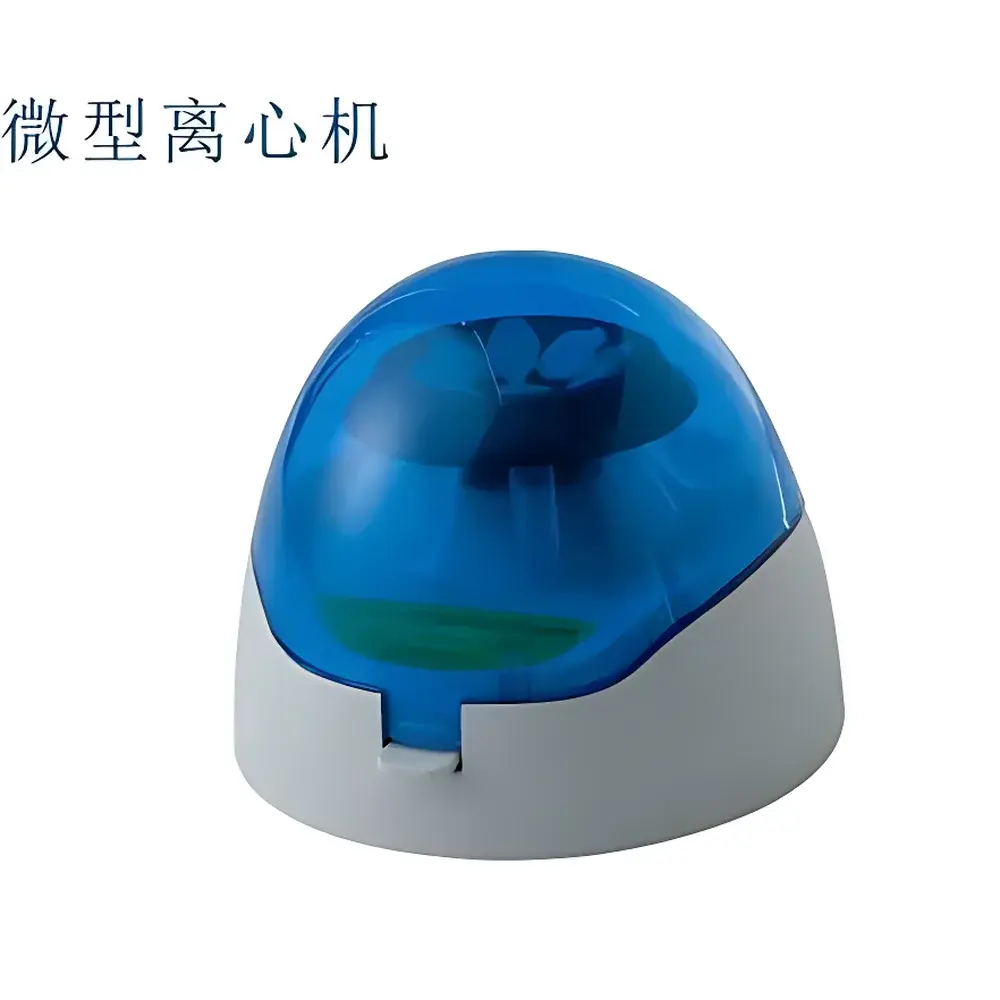
Langbo LB-6000 Microcentrifuge
| Brand | Langbo |
|---|---|
| Origin | Jiangsu, China |
| Manufacturer Type | Authorized Distributor |
| Product Category | Domestic |
| Model | LB-6000 |
| Instrument Type | Palm-Sized Centrifuge |
| Speed Range | 0–6,000 rpm |
| Max RCF | 1,600 × g |
| Max Capacity | 8 × 2.0 mL tubes |
| Rotor Configuration | Fixed-angle rotor (dual-standard: 1.5/2.0/0.5/0.2 mL tubes and 4 × 8-strip PCR tubes) |
| Dimensions | 150 × 120 × 180 mm (W × D × H) |
| Safety Features | Lid interlock, automatic rotor recognition, over-speed protection, imbalance detection |
| Housing Material | Reinforced polymer composite |
| Compliance | CE-marked per IEC 61010-1 for laboratory equipment safety |
Overview
The Langbo LB-6000 Microcentrifuge is a compact, benchtop-ready centrifugal instrument engineered for rapid, reliable micro-volume sample processing in resource-constrained or space-limited laboratory environments. Operating on the principle of sedimentation under centrifugal force, it delivers consistent separation performance for pelleting cells, bacteria, precipitated nucleic acids, and particulate contaminants from small-volume liquid samples (0.2–2.0 mL). Its fixed-angle rotor geometry ensures efficient radial acceleration and short sedimentation path lengths—critical for preserving biological integrity during brief spin cycles. Designed for routine use in academic teaching labs, QC/QA workflows in chemical manufacturing, and preliminary screening in biotech pilot operations, the LB-6000 prioritizes operational simplicity, mechanical robustness, and electrical safety compliance without compromising reproducibility.
Key Features
- Palm-sized footprint (150 × 120 × 180 mm) enables placement directly beside pipettes, vortexers, or thermal cyclers—ideal for laminar flow hoods and mobile lab carts.
- Dual-standard rotor compatibility: accommodates eight individual tubes (1.5 mL, 2.0 mL, 0.5 mL, or 0.2 mL) or four 8-well PCR strip racks simultaneously—eliminating frequent rotor swaps during high-throughput micro-prep workflows.
- Brushless DC motor with closed-loop speed control maintains ±30 rpm accuracy across the full 0–6,000 rpm range, ensuring repeatable RCF generation (up to 1,600 × g at maximum speed).
- Integrated safety architecture includes lid interlock switch, real-time imbalance detection, over-speed cutoff, and auto-braking within 12 seconds post-run—fully compliant with IEC 61010-1 Class II requirements for Class A laboratory equipment.
- Housing fabricated from fiber-reinforced polymer composite resists chemical splashes, mechanical impact, and long-term UV exposure—reducing risk of brittle fracture compared to conventional polycarbonate enclosures.
- No external cooling required: passive thermal management via aluminum heat-sink base and optimized airflow channels prevents rotor overheating during repeated 30–90 second runs.
Sample Compatibility & Compliance
The LB-6000 supports standard microcentrifuge tube formats used across molecular biology, microbiology, and analytical chemistry protocols—including conical-bottom polypropylene tubes (1.5/2.0 mL), low-retention PCR tubes, and 0.2 mL strip tubes. It is validated for pelleting Gram-negative and Gram-positive bacterial cultures (e.g., E. coli, B. subtilis) at OD600 ≤ 1.0, recovering >95% of cell mass within 30 seconds at 6,000 rpm. All rotor assemblies are autoclavable at 121°C for 20 minutes, supporting GLP-aligned decontamination procedures. The device bears CE marking under Directive 2014/30/EU (EMC) and 2014/35/EU (LVD), and conforms to ISO 13485-aligned manufacturing controls for in vitro diagnostic support equipment.
Software & Data Management
As a stand-alone electromechanical instrument, the LB-6000 operates without embedded firmware or digital connectivity—minimizing validation overhead in regulated environments. All parameters (speed, time, acceleration/deceleration profile) are set via tactile membrane buttons with LED confirmation; no software installation, driver dependency, or network interface is required. This analog-first design satisfies FDA 21 CFR Part 11 criteria for “non-electronic records” where audit trails are maintained manually in lab notebooks or LIMS entries. Time/speed settings are retained after power cycling, eliminating reconfiguration between shifts.
Applications
- Routine pelleting of microbial cells prior to DNA/RNA extraction or protein lysis.
- Quick-phase separation in solvent-based extractions (e.g., phenol-chloroform, ethyl acetate).
- Clarification of crude lysates and enzyme reaction mixtures before electrophoresis or HPLC injection.
- Micro-volume precipitation recovery (e.g., ethanol/isopropanol nucleic acid precipitation, ammonium sulfate protein fractionation).
- Pre-analytical sample conditioning for handheld spectrophotometers or lateral flow immunoassays requiring particle-free supernatants.
- Teaching laboratory demonstrations of centrifugal force, sedimentation coefficients, and rotor dynamics principles.
FAQ
Is the LB-6000 suitable for clinical diagnostics applications?
Yes—its CE marking, autoclavable rotors, and adherence to IEC 61010-1 allow deployment in CLIA-waived or moderate-complexity clinical labs for specimen preparation steps such as serum separation or pathogen concentration.
Can I use PCR strip tubes without adapter inserts?
Yes—the rotor features precision-machined grooves that securely hold 8-well PCR strips without adapters, minimizing cross-contamination risk and setup time.
What maintenance is required beyond routine cleaning?
None beyond wiping the chamber and rotor with 70% ethanol after each use; the brushless motor requires no lubrication or scheduled servicing over its rated 20,000-hour operational lifetime.
Does the unit meet ISO 15195 requirements for reference measurement laboratories?
No—it is not designed as a reference-grade instrument; however, its speed stability and RCF reproducibility align with ISO 15195 Annex B guidance for secondary calibration devices used in method verification.
Related Products



