
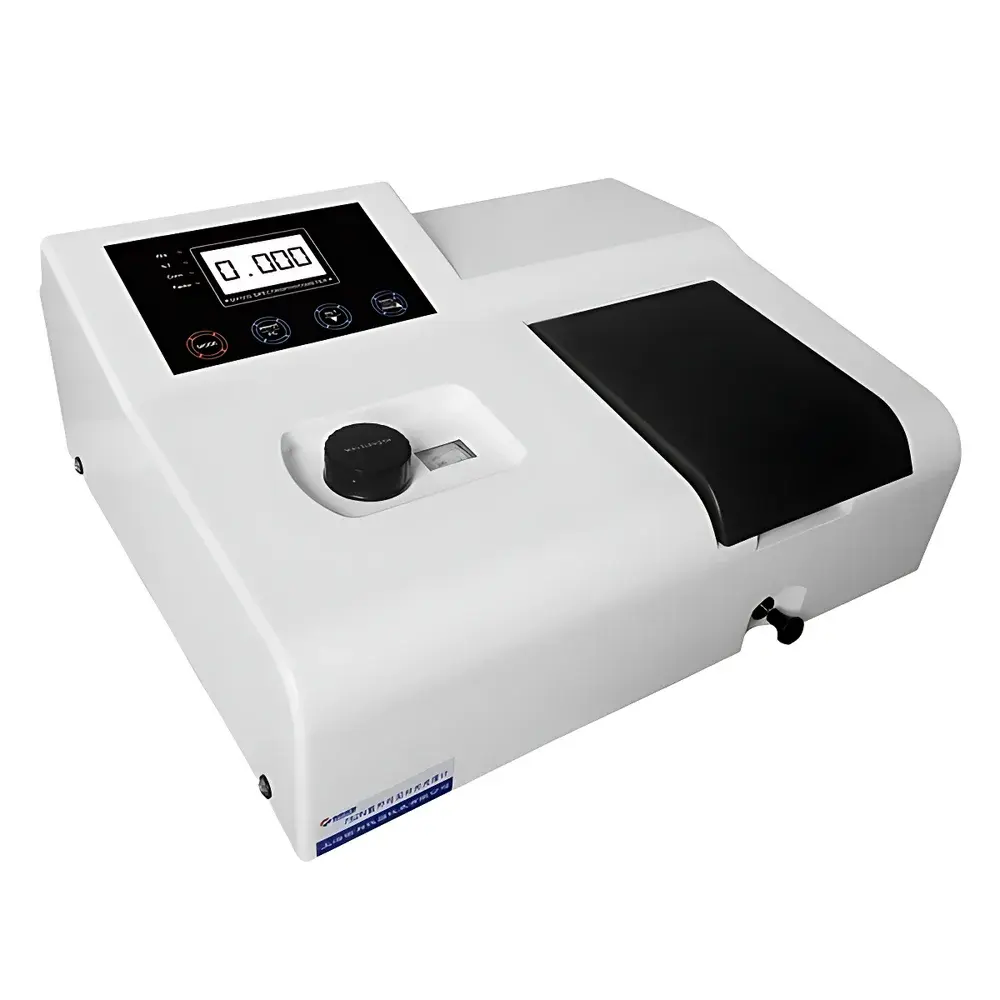
Yoke UV752 Ultraviolet-Visible Spectrophotometer
| Brand | Yoke |
|---|---|
| Origin | Shanghai, China |
| Manufacturer Type | Direct Manufacturer |
| Instrument Architecture | Single-Beam |
| Detector Type | Silicon Photocell |
| Wavelength Range | 195–1020 nm |
| Wavelength Selection | Manual (Mechanical Knob) |
| Spectral Bandwidth | 4 nm |
| Wavelength Accuracy | ±2 nm |
| Stray Light | ≤0.2% T |
| Wavelength Repeatability | 1 nm |
| Photometric Accuracy | ±0.5% T |
| Photometric Repeatability | ±0.2% T |
| Photometric Range | 0–200% Transmittance, –0.301 to 2.000 Absorbance |
| Baseline Drift | ≤0.1% T/h |
| Baseline Linearity | ±0.002 A/h @ 500 nm |
| Noise (100% T) | ≤0.2% T |
| Stability | ±0.002 A/h @ 500 nm |
| Light Sources | Imported Tungsten Lamp & Deuterium Lamp |
| Lamp Switching | Manual |
| Sample Compartment Dimensions | Accommodates Cuvettes from 5 mm to 100 mm Pathlength |
| Display | 4-Digit LED LCD |
| Interface | Parallel Port for Thermal Printer (Optional) |
| Net Weight | 12 kg |
Overview
The Yoke UV752 Ultraviolet-Visible Spectrophotometer is a precision single-beam optical instrument engineered for routine quantitative and qualitative analysis in academic laboratories, quality control environments, and industrial R&D settings. It operates on the fundamental principle of Beer–Lambert law-based absorption spectroscopy, measuring the attenuation of ultraviolet and visible light as it passes through a sample solution. The optical architecture employs a Czerny–Turner monochromator with a 1200 lines/mm holographic grating, optimized for spectral resolution and throughput across its full 195–1020 nm range. Designed for operational robustness and long-term stability, the UV752 integrates imported tungsten and deuterium lamps—ensuring continuous coverage from the deep UV (195 nm) through the near-infrared (1020 nm). Its manual wavelength selection mechanism reflects a deliberate design choice for cost-sensitive applications where programmability is secondary to reliability, ease of maintenance, and mechanical simplicity.
Key Features
- Single-beam optical path with high-stability Czerny–Turner monochromator and 1200 L/mm grating for consistent spectral separation
- Dual-lamp system: Imported deuterium lamp (195–350 nm) and tungsten lamp (340–1020 nm), manually switched to optimize signal-to-noise ratio per spectral region
- 4 nm spectral bandwidth ensures adequate resolution for most standard assays while maintaining sufficient radiant power for low-absorbance measurements
- Large sample compartment accommodating standard cuvettes from 5 mm to 100 mm pathlength—enabling flexibility for dilute or highly absorbing samples
- Automatic shutter mechanism protects the silicon photocell detector during idle periods, extending sensor lifetime and reducing baseline drift
- High-contrast 4-digit LED display with dual-mode readout (Transmittance %T and Absorbance A), supporting concentration (C) mode via user-entered extinction coefficients
- Parallel port interface for optional thermal printer integration—facilitating immediate hardcopy generation of calibration curves and sample results
Sample Compatibility & Compliance
The UV752 accepts standard rectangular quartz, glass, or plastic cuvettes (10 × 10 mm cross-section) with optical path lengths ranging from 5 mm to 100 mm. This accommodates both high-concentration samples requiring short pathlengths and trace analyte quantification using extended cells. The instrument meets foundational performance criteria aligned with ISO 8577:2016 (spectrophotometer verification) and ASTM E275–22 (standard practices for describing and measuring performance of UV–Vis spectrophotometers). While not inherently 21 CFR Part 11 compliant due to its manual operation and lack of electronic audit trail, the UV752 supports GLP-aligned workflows when used with documented SOPs, manual logbooks, and calibrated reference standards (e.g., NIST-traceable holmium oxide filters for wavelength verification and potassium dichromate solutions for photometric accuracy checks).
Software & Data Management
The UV752 operates without embedded microprocessor-based software or PC connectivity—reflecting its role as a dedicated benchtop analyzer for environments prioritizing minimal complexity and maximum uptime. All operations—including zeroing, blanking, wavelength setting, and mode selection—are performed via front-panel controls. Data output is limited to real-time display and optional thermal printouts. For laboratories requiring digital data capture, third-party analog-to-digital interfaces (e.g., USB voltmeter modules reading the analog A/T output signal) may be integrated externally. No proprietary drivers or cloud services are involved; this architecture eliminates firmware update dependencies and cybersecurity exposure vectors common in networked instruments.
Applications
- Quantitative determination of nucleic acids (A260) and proteins (A280, Bradford, Lowry)
- Enzyme kinetics monitoring (e.g., NADH/NADPH oxidation at 340 nm)
- Pharmaceutical assay validation per USP and EP 2.2.25 guidelines
- Water quality analysis (nitrate, phosphate, COD via colorimetric methods)
- Educational laboratory instruction in analytical chemistry and molecular spectroscopy
- Industrial QC of dyes, pigments, and polymer additives
FAQ
Is the UV752 compatible with GLP or GMP-regulated environments?
Yes—when operated within documented procedures, using calibrated reference materials and manual recordkeeping, it fulfills core instrumental requirements for non-critical QC testing. However, it does not provide electronic audit trails or user access controls required for full 21 CFR Part 11 compliance.
What is the recommended calibration frequency?
Wavelength accuracy should be verified quarterly using holmium oxide or didymium filters; photometric accuracy should be checked daily with neutral density filters or potassium dichromate standard solutions before critical measurements.
Can the instrument measure absorbance beyond 2.000 A?
No—the specified absorbance range is –0.301 to 2.000 A. Samples exceeding 2.000 A require dilution or use of shorter-path cuvettes to remain within linear response limits.
Does the UV752 support kinetic or scanning modes?
No—it is a fixed-wavelength or manually stepped instrument. It does not perform spectral scans or time-resolved kinetic profiling.
What maintenance is required for the lamps?
Deuterium lamps typically last 1,000–2,000 hours; tungsten lamps exceed 5,000 hours. Lamp replacement requires mechanical alignment verification using a known spectral line (e.g., mercury emission at 253.7 nm) and subsequent photometric recalibration.




