
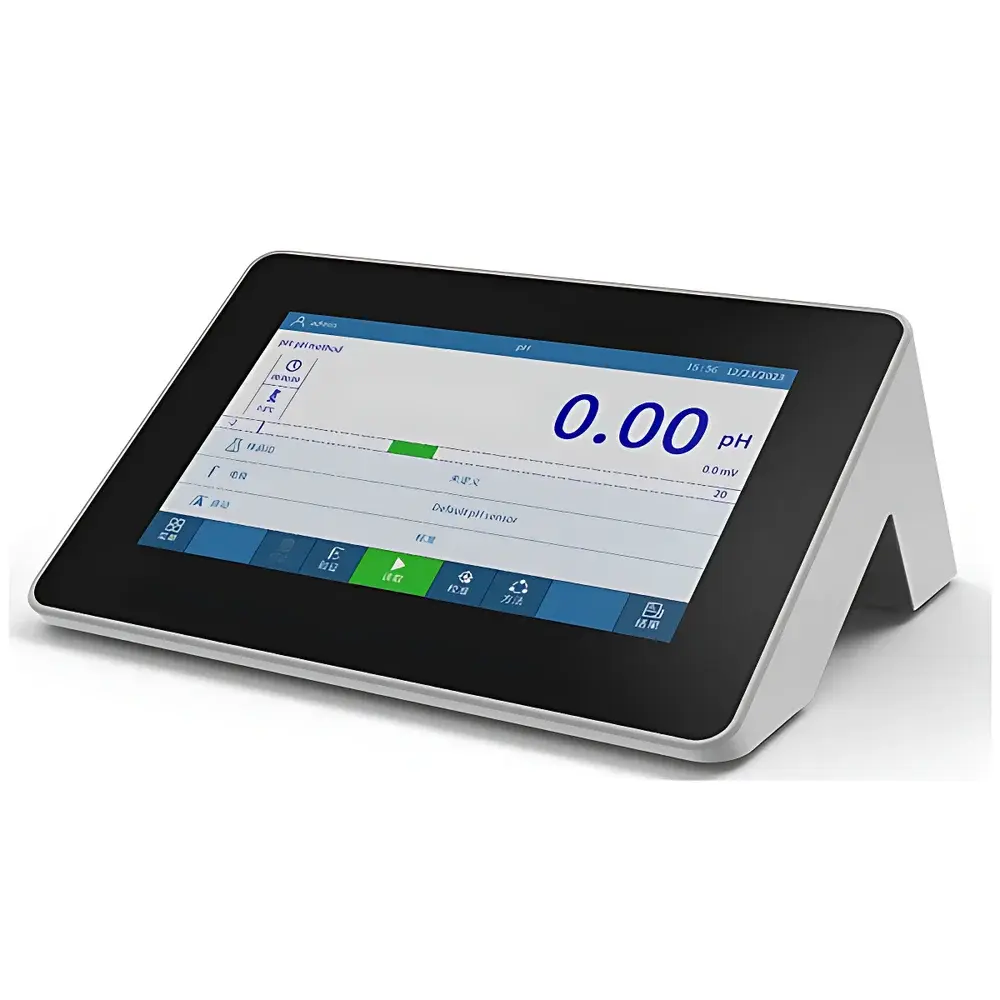
Yoke M902 High-Precision Benchtop Conductivity Meter
| Brand | Yoke |
|---|---|
| Model | M902 |
| Type | Benchtop Conductivity Meter |
| Measurement Range | 0.000 µS/cm to 2000 mS/cm |
| Resolution | 0.001 / 0.01 / 0.1 / 1 µS/cm |
| Display | 7-inch color capacitive touchscreen |
| Temperature Compensation | Automatic/manual with integrated high-stability temperature electrode |
| Calibration | Auto-identification of standard solutions |
| Data Compliance | GLP-compliant audit trail, method storage, and electronic signature support |
| Enclosure Rating | IP54 |
| Connectivity | USB host (for printer/U-disk), RS232, optional Ethernet |
| Sample Handling | Compatible with magnetic stirrer integration |
| Regulatory Alignment | Designed for ASTM D1125, ISO 7888, USP <645>, and FDA 21 CFR Part 11-ready data integrity workflows |
Overview
The Yoke M902 High-Precision Benchtop Conductivity Meter is an engineered solution for laboratory-grade electrical conductivity measurement in aqueous and low-conductivity media. Based on the fundamental principle of two-electrode or four-electrode AC conductivity measurement—employing a stable sinusoidal excitation signal to eliminate polarization effects—the M902 delivers traceable, reproducible results across an exceptionally wide dynamic range (0.000 µS/cm to 2000 mS/cm). Its architecture integrates real-time temperature compensation via a co-located, high-stability NTC thermistor electrode, supporting both automatic temperature detection and manual override for rigorous method validation. Designed explicitly for regulated environments—including pharmaceutical QC labs, environmental testing facilities, and university research cores—the instrument meets core functional requirements for accuracy, traceability, and operational transparency under GLP and GMP frameworks.
Key Features
- 7-inch full-color capacitive touchscreen interface with intuitive, icon-driven workflow navigation—guiding users through calibration, verification, and sample measurement without procedural ambiguity.
- Integrated temperature sensing with ±0.1 °C stability over 15–35 °C ambient range; configurable endpoint stabilization criteria (e.g., drift ≤0.02 µS/cm/30 s) to ensure measurement repeatability.
- Smart electrode lifecycle management: automatic logging of calibration dates, frequency, and solution IDs; visual and audible alerts upon expiry or performance deviation beyond user-defined thresholds.
- Multi-point calibration support (1–3 points) with auto-recognition of common KCl standards (e.g., 84 µS/cm, 1413 µS/cm, 12.88 mS/cm); selectable cell constant (K = 0.1, 1.0, 10.0 cm⁻¹) for optimal range matching.
- IP54-rated enclosure—dust-resistant and protected against water splashes from any direction—enabling reliable operation in shared lab spaces where incidental spills or particulate exposure occur.
- Built-in magnetic stirrer control interface (0–1200 rpm, adjustable torque) for homogeneous sample conditioning during low-conductivity measurements (<100 µS/cm).
Sample Compatibility & Compliance
The M902 accommodates standard conductivity cells (DIN/ISO-compliant 12-mm shaft diameter) and supports both aqueous electrolytes (e.g., NaCl, KCl, HCl) and low-ionic-strength matrices such as purified water, WFI, and ultrapure process streams. It complies with measurement principles defined in ASTM D1125 (Standard Test Methods for Electrical Conductivity of Water), ISO 7888 (Water quality — Determination of electrical conductivity), and USP (Electrical Conductivity of Water for Pharmaceutical Use). All data records include mandatory metadata: timestamp, operator ID, electrode serial number, calibration history, temperature reading, and raw analog-to-digital conversion values—ensuring full auditability per FDA 21 CFR Part 11 requirements when paired with validated software configuration.
Software & Data Management
Data handling conforms to Good Laboratory Practice (GLP) standards. Each measurement event is stored with immutable timestamps, user authentication (via PIN or optional LDAP integration), and full parameter context—including active method name, cell constant, temperature compensation mode, and stabilization criteria. Up to 5,000 measurement records can be retained onboard; export is supported via USB mass storage (CSV/Excel), direct RS232 printing, or networked transfer using secure FTP/SFTP protocols. Predefined test methods—including conductivity + TDS + salinity + resistivity calculations—can be saved, version-controlled, and recalled without reconfiguration. Audit trails record all critical actions: method edits, calibration overrides, data deletions, and user logins.
Applications
- Pharmaceutical water system monitoring (PW, WFI, pure steam condensate) per USP and EU Annex 1.
- Environmental analysis of surface water, groundwater, and wastewater effluents per EPA Method 120.1 and ISO 7888.
- Quality control of electroplating baths, semiconductor rinse water, and battery electrolyte formulations.
- Academic research involving ion transport kinetics, membrane permeability studies, and colloidal stability assessments.
- Food & beverage production—monitoring cleaning-in-place (CIP) rinse conductivity to verify detergent removal.
FAQ
Does the M902 support four-electrode conductivity measurement?
Yes—when used with a compatible four-electrode cell (e.g., Yoke K=0.1 or K=10.0 models), the M902 eliminates polarization and cable capacitance errors, enabling accurate measurement below 1 µS/cm and above 100 mS/cm.
Can calibration data be exported for external audit review?
All calibration events—including date/time, standard used, measured value, deviation, and operator ID—are embedded in CSV exports and retain full traceability without post-processing.
Is the instrument compatible with LIMS integration?
Via RS232 or optional Ethernet module, the M902 supports ASTM E1384-compliant bidirectional communication for automated result ingestion into laboratory information management systems.
What temperature compensation algorithms are available?
Linear (default), non-linear (NaCl curve per ISO 7888), and user-defined polynomial coefficients—configurable per method to match matrix-specific behavior.
How is data security enforced during multi-user operation?
Role-based access control (RBAC) restricts calibration, method editing, and data deletion to authorized personnel; all privileged actions generate time-stamped, non-erasable entries in the system audit log.
Related Products







