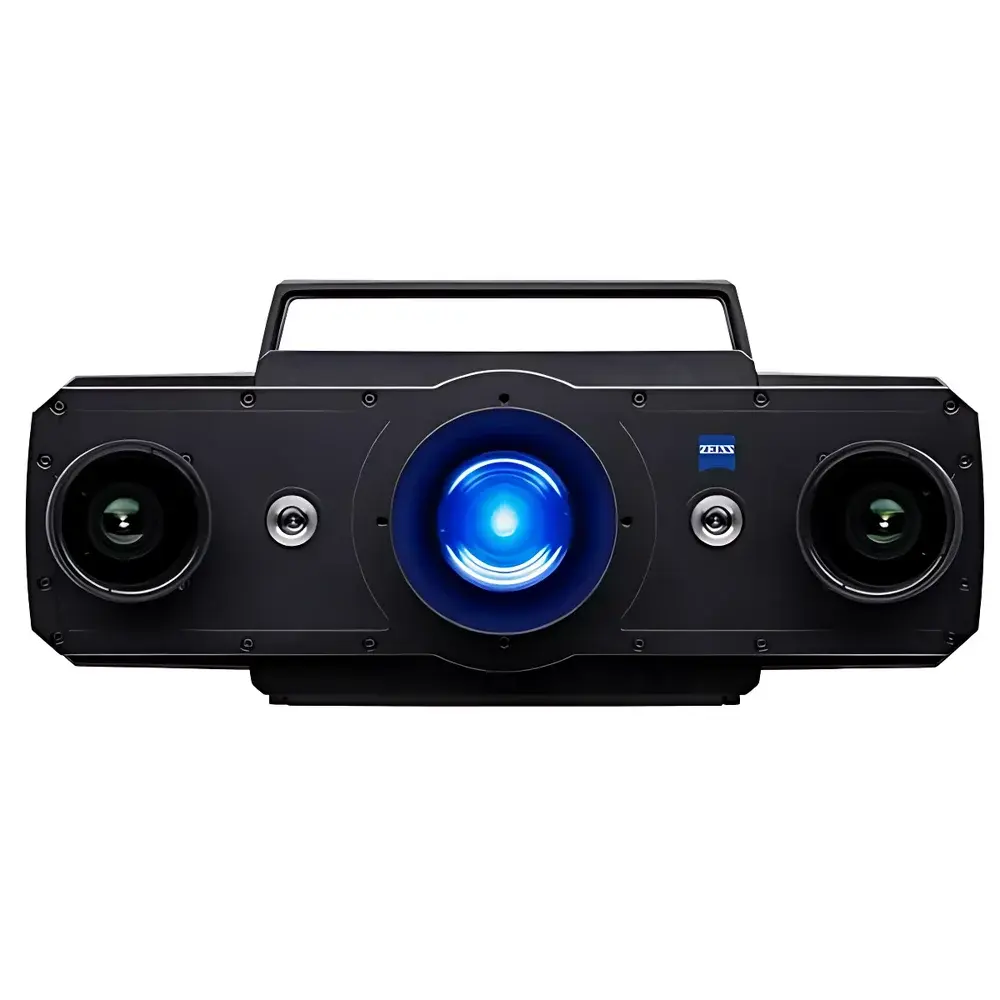
ZEISS ATOS 5 High-Accuracy Optical 3D Scanning System
| Brand | ZEISS |
|---|---|
| Origin | Shanghai, China |
| Manufacturer Type | Original Equipment Manufacturer (OEM) |
| Country of Origin | China |
| Model | ATOS 5 |
| Instrument Category | Structured Light 3D Scanner (Stereo Photogrammetry-Based) |
| Maximum Scan Volume | 880 mm (diagonal field of view) |
| Operating Software | ZEISS INSPECT |
| Integrated Photogrammetry Module | TRITOP (optional) |
| Calibration Traceability | ISO/IEC 17025-compliant metrological validation framework |
Overview
The ZEISS ATOS 5 is a high-precision, industrial-grade optical 3D scanning system engineered for full-field geometric metrology in demanding production and quality assurance environments. Based on fringe projection (structured light) stereo photogrammetry, the ATOS 5 captures dense point clouds with sub-micron-level repeatability across large-volume measurement fields—up to 880 mm diagonal field of view—without physical contact. Its dual high-resolution CMOS cameras and precision-calibrated LED light projector enable robust acquisition on challenging surfaces, including glossy, dark, or textured materials, via adaptive exposure control and real-time surface reflectivity compensation. The system’s core architecture integrates metrological traceability to national standards through ZEISS-certified calibration protocols aligned with ISO 10360 and VDI/VDE 2634 Part 2, ensuring data integrity under variable workshop conditions—including temperature fluctuations, vibration, and ambient lighting changes.
Key Features
- Full-field structured light scanning with simultaneous capture of up to 12 million 3D points per scan, delivering high-density topology data for GD&T analysis, reverse engineering, and tool wear monitoring.
- Integrated reliability monitoring: Real-time feedback on calibration status, environmental drift (e.g., thermal expansion), sensor stability, and part motion during acquisition—enabling automatic rejection of compromised measurements.
- GPU-accelerated processing in ZEISS INSPECT software: Leverages parallel computing on modern NVIDIA/AMD graphics hardware to reduce single-scan post-processing time by up to 60% compared to CPU-only workflows.
- Modular design supporting both manual operation (tripod-mounted or handheld probe mode) and automated integration into ZEISS ScanBox metrology cells for inline or offline 100% inspection in high-volume manufacturing.
- Built-in stereo camera geometry with active triangulation baseline optimization, ensuring consistent depth resolution across the entire measurement volume without mechanical recalibration.
Sample Compatibility & Compliance
The ATOS 5 accommodates a broad spectrum of industrial components—from injection-molded plastic housings and die-cast aluminum brackets to large composite airframe sections and turbine blades. Its non-contact methodology eliminates deformation risks associated with tactile probing, making it suitable for thin-walled, thermally sensitive, or easily damaged parts. Surface finish independence is achieved through dynamic fringe frequency adjustment and multi-exposure HDR fusion. All measurement data comply with ISO 9001, IATF 16949, and AS9100 quality management requirements. When deployed in regulated environments (e.g., aerospace or medical device manufacturing), the system supports audit-ready documentation per ISO/IEC 17025, including full calibration history, uncertainty budgets, and GLP-aligned measurement reports.
Software & Data Management
ZEISS INSPECT serves as the unified platform for acquisition, alignment, comparison, and reporting. It provides native support for GD&T evaluation per ASME Y14.5 and ISO 1101, including profile, position, concentricity, and surface texture analysis. Measurement workflows are fully scriptable via Python API, enabling integration with MES, PLM, and SPC systems. Audit trails record all user actions, parameter modifications, and software versioning—meeting FDA 21 CFR Part 11 requirements for electronic records and signatures when configured with role-based access control and digital certificate authentication. Raw scan data is stored in vendor-neutral formats (e.g., STL, PLY, ASCII XYZ) alongside metrologically annotated project files (.zcp).
Applications
- Tool & die verification: Rapid detection of cavity wear, shrinkage, or machining deviations in molds prior to production ramp-up.
- First-article inspection: Comprehensive dimensional validation against CAD models for aerospace structural components and automotive body-in-white assemblies.
- Reverse engineering: Generation of accurate NURBS surfaces from legacy parts lacking original design data.
- Deformation analysis: Comparative assessment of thermal or load-induced distortion in composite laminates or welded structures.
- Automated quality gates: Integration into robotic cells for cycle-time-optimized, unattended inspection of machined castings and forged parts.
FAQ
Is the ATOS 5 certified for use in ISO/IEC 17025-accredited laboratories?
Yes—the system’s calibration procedures, uncertainty quantification methods, and traceability documentation meet the technical requirements of ISO/IEC 17025:2017 for dimensional metrology.
Can ATOS 5 perform measurements in shop-floor environments with ambient light and vibration?
Yes—its adaptive illumination control, real-time motion compensation algorithms, and rigid optomechanical housing ensure stable performance even in non-climate-controlled production areas.
What is the role of the integrated TRITOP photogrammetry module?
TRITOP establishes a global coordinate frame for large-part scanning by capturing reference point fields; it enables seamless stitching of multiple ATOS 5 scans with metrological confidence, extending effective measurement volume beyond 2 meters.
Does ZEISS INSPECT support automated reporting for SPC compliance?
Yes—customizable report templates export statistical process control metrics (Cp/Cpk, Pp/Ppk, capability histograms) directly to Excel or PDF, with embedded traceable measurement data and operator audit logs.
How is system accuracy maintained over time and across temperature variations?
Through continuous self-monitoring of lens distortion, sensor pixel response, and projector focus—combined with periodic recalibration using ZEISS-certified ceramic reference artifacts traceable to PTB and NIST standards.