
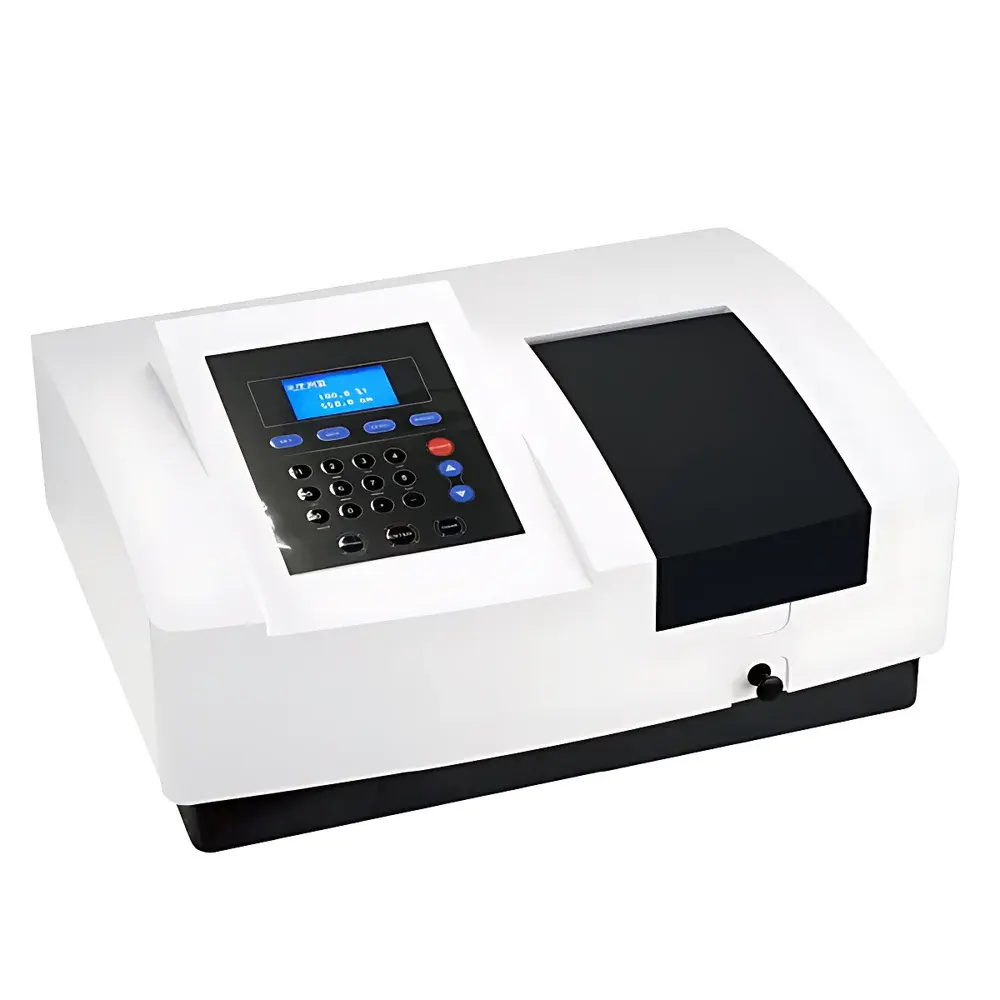
Yoke UV756 Scanning Ultraviolet-Visible Spectrophotometer
| Brand | Yoke |
|---|---|
| Origin | Shanghai, China |
| Manufacturer Type | Direct Manufacturer |
| Regional Classification | Domestic (China) |
| Model | UV756 |
| Instrument Architecture | Pseudo-Double-Beam |
| Detector Type | Photodiode Array (PDA) |
| Wavelength Range | 190–1100 nm |
| Automation Level | Automatic Wavelength Scanning |
| Spectral Bandwidth | 2 nm |
| Wavelength Accuracy | ±0.5 nm |
| Stray Light | 0.05%T at 220 nm and 360 nm |
| Wavelength Repeatability | ±0.2 nm |
| Photometric Accuracy | ±0.5%T |
| Photometric Repeatability | ±0.2%T |
| Transmittance Range | 0.0–200%T |
| Absorbance Range | −0.30 to 3.0 A |
| Concentration Range | 0–1999 units |
| Baseline Stability | ±0.001 A/h at 500 nm |
| Interface | USB |
| Software Compatibility | Yoke UV Analysis Suite |
| Optional Accessories | Thermal Printer Module |
| Warranty | 12 months standard, lifetime technical support and calibration guidance |
Overview
The Yoke UV756 Scanning Ultraviolet-Visible Spectrophotometer is a precision-engineered pseudo-double-beam instrument designed for routine and research-grade quantitative and qualitative analysis in pharmaceutical QC labs, environmental testing facilities, academic chemistry departments, and industrial R&D centers. Operating on the principle of absorption spectroscopy, the UV756 measures the attenuation of ultraviolet and visible light as it passes through a sample solution—enabling determination of analyte concentration via the Beer–Lambert law, identification of chromophores through spectral profiling, and evaluation of purity or degradation kinetics. Its 190–1100 nm wavelength coverage spans deep UV (e.g., nucleic acid detection at 260 nm), near-UV (aromatics, proteins), visible (dye quantification, colorimetric assays), and NIR-adjacent regions (e.g., certain transition metal complexes). The instrument employs a high-efficiency 1200 lines/mm holographic grating and a thermally stabilized photodiode array detector, ensuring high photon capture efficiency and low-noise signal acquisition across the full spectral range.
Key Features
- Pseudo-double-beam optical architecture with real-time reference beam correction, minimizing drift from source intensity fluctuations and environmental thermal shifts.
- Fixed 2 nm spectral bandwidth—optimized for resolution and signal-to-noise balance in compliance with ISO 9001 and ASTM E275-22 guidelines for spectrophotometric performance verification.
- Wavelength accuracy of ±0.5 nm and repeatability of ±0.2 nm—validated using NIST-traceable holmium oxide and didymium filters per ISO/IEC 17025 requirements.
- Stray light performance ≤0.05%T at critical wavelengths (220 nm and 360 nm), meeting USP and EP 2.2.25 specifications for high-absorbance measurements (e.g., concentrated APIs or turbid samples).
- Integrated 128×64 dot-matrix LCD display supporting direct visualization of absorbance spectra, calibration curves (linear, quadratic, multi-point), and raw transmittance data—no PC required for basic operation.
- Onboard memory stores up to 200 measurement sets; USB interface enables firmware updates, method transfer, and secure data export compatible with LIMS integration protocols.
Sample Compatibility & Compliance
The UV756 accommodates standard 10 mm pathlength quartz or UV-grade fused silica cuvettes (including matched pairs for ratio-based measurements), as well as microvolume adapters (e.g., 5 µL capillary cells) and optional fiber-optic probes for in-situ or flow-through applications. It supports both single-beam and double-beam measurement modes, enabling flexible workflows—from rapid screening of enzyme kinetics to high-precision assay validation. The system conforms to key regulatory frameworks: its photometric linearity, wavelength calibration traceability, and data integrity features align with FDA 21 CFR Part 11 readiness when used with validated Yoke UV Analysis Suite software (audit trail, electronic signature, user role management). Routine operation meets GLP and ISO/IEC 17025 documentation standards for accredited laboratories.
Software & Data Management
The optional Yoke UV Analysis Suite (v3.2+) provides full spectral scanning, kinetic time-course plotting, multi-wavelength quantitation, and derivative spectroscopy. Raw data are exported in CSV and XML formats—compatible with MATLAB, OriginLab, and laboratory information management systems (LIMS). The software implements ALCOA+ principles: attributable, legible, contemporaneous, original, accurate, complete, consistent, enduring, and available. All spectral acquisitions include embedded metadata (date/time, operator ID, lamp hours, calibration status), and changes to measurement parameters are logged with timestamps and user attribution—supporting GMP audit readiness and internal quality reviews.
Applications
- Pharmaceutical: Quantitative assay of active pharmaceutical ingredients (APIs) per USP monographs; excipient interference studies; stability-indicating methods for forced degradation products.
- Environmental: Nitrate/nitrite determination in water (EPA Method 353.2); COD estimation; heavy metal chelate analysis (e.g., Fe-phenanthroline).
- Life Sciences: DNA/RNA purity assessment (A260/A280, A260/A230); protein concentration via Bradford/Lowry/Biuret; enzyme activity monitoring (e.g., NADH oxidation at 340 nm).
- Materials Science: Thin-film optical density profiling; nanoparticle surface plasmon resonance characterization; dye adsorption isotherms.
- Food & Beverage: Color index (CIE L*a*b*) quantification; preservative (e.g., benzoic acid) and antioxidant (e.g., ascorbic acid) content analysis.
FAQ
Does the UV756 support GLP-compliant data handling?
Yes—when paired with the validated Yoke UV Analysis Suite, the system provides full audit trails, electronic signatures, and user-access controls aligned with GLP Annex 11 and FDA 21 CFR Part 11 expectations.
Can I perform kinetic measurements without external software?
No—kinetic mode requires connection to a host PC running Yoke UV Analysis Suite; however, fixed-timepoint absorbance readings (e.g., endpoint assays) are fully supported on the instrument’s standalone interface.
What maintenance is required for long-term wavelength accuracy?
Annual verification using NIST-traceable reference filters is recommended. The internal tungsten and deuterium lamps feature extended service life (>2000 h), and automatic lamp alignment routines minimize manual recalibration frequency.
Is the photodiode array detector cooled?
No—the PDA operates at ambient temperature, optimized for stability in controlled lab environments (15–30 °C, <70% RH). For ultra-low-noise applications requiring sub-picoamp detection, a cooled CCD variant is available under custom configuration (UV756-Cryo option).
How is stray light performance verified during installation qualification (IQ)?
IQ includes measurement of 0.05%T at 220 nm (using sodium iodide solution) and 360 nm (using acetone), per ISO 6326-1 and ASTM E387-20 protocols—documentation provided in the Factory Acceptance Test (FAT) report.






