
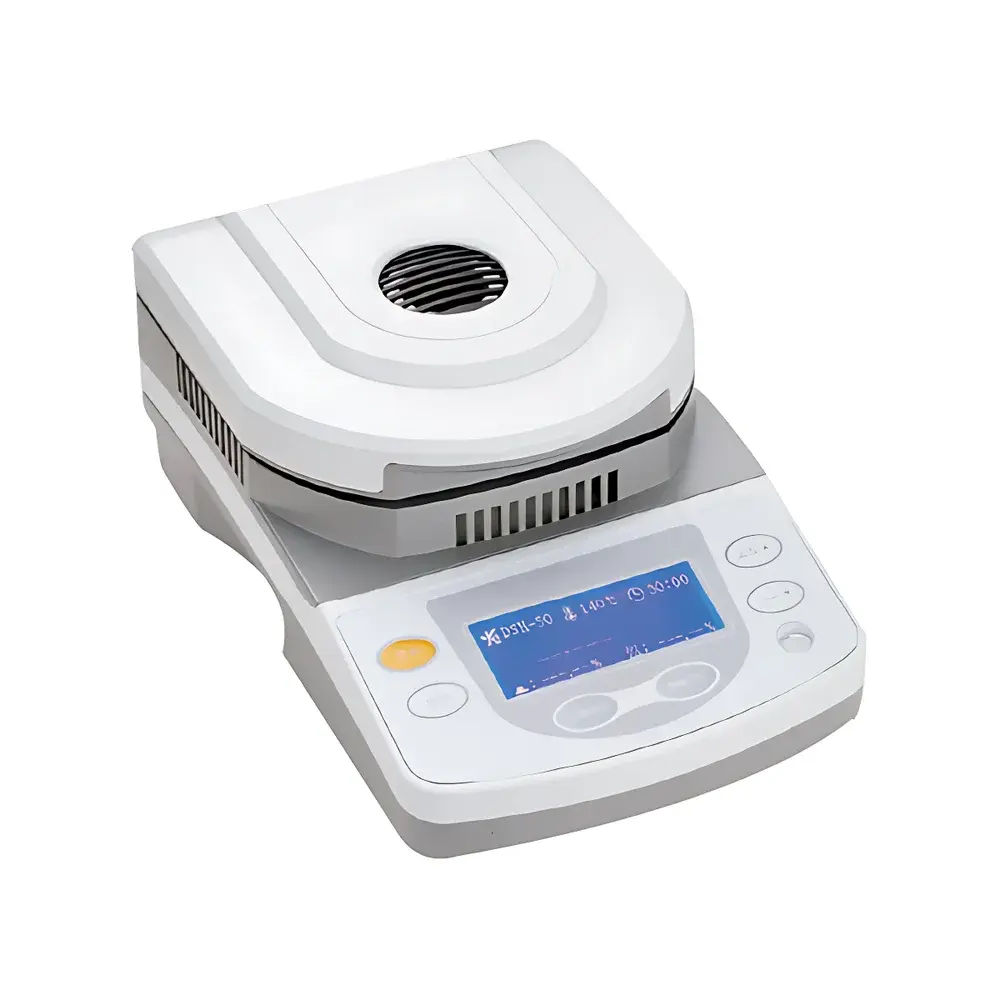
Yoke DSH-100A-1 Halogen Moisture Analyzer
| Brand | Yoke |
|---|---|
| Origin | Shanghai, China |
| Manufacturer Type | Original Equipment Manufacturer (OEM) |
| Product Category | Domestic Analytical Instrument |
| Model | DSH-100A-1 |
| Pricing | Upon Request |
| Weighing Range | 0–100 g |
| Readability | 1 mg |
| Repeatability (3 g sample) | ±0.3% |
| Recommended Sample Mass | 3–10 g |
| Minimum Sample Mass | 0.5 g |
| Heating Duration | 1–99 min (adjustable in 1-min increments) |
| Temperature Range | 50–180 °C |
| Heating Source | Halogen Lamp |
| Display Content | Moisture %, Solid %, Sample Weight (g), Elapsed Time (min:s), Date & Time |
| Pan Diameter | 100 mm |
| Dimensions (W×D×H) | 265 × 160 × 150 mm |
| Net Weight | 5 kg |
| Gross Weight | 6 kg |
| Communication Interface | RS232 |
| Endpoint Detection Modes | Timed Mode, Auto-Termination Mode |
| Heating Profile | Standard Ramp |
Overview
The Yoke DSH-100A-1 Halogen Moisture Analyzer is a precision thermal gravimetric instrument engineered for rapid, reliable determination of moisture content in solid and semi-solid samples across quality control, pharmaceutical, food, chemical, and academic laboratories. It operates on the principle of loss-on-drying (LOD), where a precisely weighed sample is subjected to controlled halogen lamp heating, and real-time mass loss is continuously monitored until stabilization—enabling calculation of moisture percentage based on initial and final dry mass. Unlike conventional infrared or convection ovens, the DSH-100A-1’s focused halogen heating delivers uniform thermal energy with faster ramp rates (reaching setpoint temperatures in under 60 seconds), reduced thermal inertia, and minimal sample oxidation risk—critical for heat-sensitive materials such as polymers, botanicals, and active pharmaceutical ingredients (APIs).
Key Features
- High-resolution backlit dot-matrix LCD display with adjustable contrast—optimized for low-light environments and extended operator use without visual fatigue.
- Tactile membrane keypad with logical layout for intuitive navigation through weighing, method setup, and data review functions—no touchscreen dependency ensures long-term reliability in humid or dusty lab settings.
- High-stability, thermally isolated load cell design with 1 mg readability and <0.3% repeatability (tested per ASTM D4442 and ISO 712)—minimizes drift from ambient temperature fluctuations and mechanical vibration.
- Adjustable halogen heating system with 50–180 °C range and 1 °C resolution—supports method development for diverse matrices including powders, granules, pastes, and thin films.
- Dual endpoint logic: user-defined timed drying (1–99 min) and automatic termination based on mass change threshold (e.g., ≤0.1 mg/10 s), ensuring consistent endpoint detection independent of operator interpretation.
- RS232 serial interface compliant with standard laboratory data acquisition protocols—enables direct integration with LIMS, ERP systems, or custom scripting environments for audit-trail generation and automated report export.
Sample Compatibility & Compliance
The DSH-100A-1 accommodates samples ranging from 0.5 g to 100 g, with optimal performance observed at 3–10 g—aligning with USP <921> and AOAC 952.07 recommendations for representative sampling in LOD assays. Its 100 mm stainless-steel weighing pan provides ample surface area for even sample distribution and facilitates easy cleaning between analyses. The instrument conforms to general safety requirements outlined in IEC 61010-1 for electrical equipment used in laboratory environments. While not pre-certified for GMP/GLP validation out-of-the-box, its deterministic heating profile, traceable calibration routine (using certified weight standards), and RS232 audit-log capability support full 21 CFR Part 11-compliant validation when deployed with appropriate SOPs and electronic signature controls.
Software & Data Management
Data output includes moisture %, residual solids %, absolute weight loss (g), elapsed time, and timestamp—all displayed simultaneously during analysis and stored internally for up to 99 methods and 200 result records. Export via RS232 supports ASCII-formatted text files compatible with Microsoft Excel, LabArchives, and ELN platforms. No proprietary software installation is required; terminal emulation (e.g., Tera Term, PuTTY) suffices for raw data capture. All parameters—including temperature ramp rate, hold time, and auto-stop sensitivity—are fully programmable and password-protected to prevent unauthorized modification, supporting documented method consistency across shifts and operators.
Applications
- Pharmaceutical QC: Verification of residual solvents in lyophilized products, moisture content in excipients (e.g., lactose, microcrystalline cellulose), and stability-indicating assays per ICH Q5C guidelines.
- Food & Agriculture: Rapid assessment of moisture in grains, dairy powders, coffee beans, and pet food—supporting compliance with Codex Alimentarius standards and shelf-life modeling.
- Chemicals & Polymers: Monitoring hygroscopicity of catalysts, resins, and battery electrode materials prior to processing or packaging.
- Academic Research: Method development for novel drying kinetics studies, comparative evaluation of desiccation efficiency across thermal sources (halogen vs. IR vs. microwave), and teaching gravimetric analysis principles.
FAQ
What calibration standards are recommended for routine verification?
Certified Class M1 or Class F1 stainless-steel weights (e.g., 10 g, 50 g) traceable to NIST or equivalent national metrology institutes should be used weekly for linearity and repeatability checks.
Can the DSH-100A-1 be validated for regulated GMP environments?
Yes—when paired with documented IQ/OQ/PQ protocols, environmental monitoring logs, and electronic record controls (e.g., user access levels, audit trail export), it meets baseline requirements for Annex 11 and FDA guidance on computerized systems.
Is halogen heating suitable for volatile organic compounds (VOCs)?
Halogen lamps emit minimal UV radiation and operate below pyrolysis thresholds for most VOCs; however, method optimization (e.g., lower temperature, shorter duration) is advised—and complementary headspace-GC analysis may be necessary for full speciation.
How often does the halogen lamp require replacement?
Typical service life exceeds 5,000 hours under normal usage; lamp degradation manifests as prolonged heating times or inconsistent endpoint detection—both detectable during daily performance verification.
Does the instrument support multi-step heating programs?
No—the DSH-100A-1 implements a single-stage heating profile (standard ramp); advanced multi-zone thermal programming requires the DSH-200 series or higher-tier models.





