
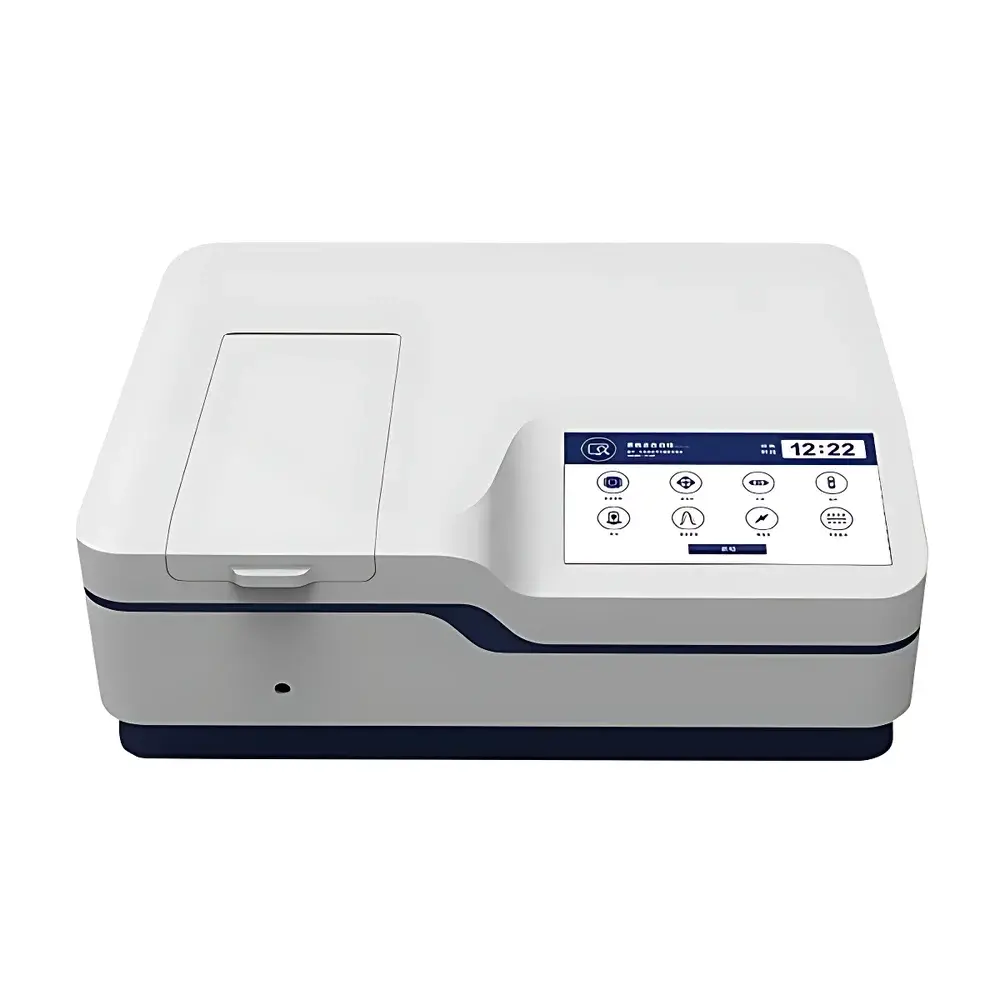
Yoke U7 Dual-Beam UV-Vis Spectrophotometer with Photomultiplier Tube (PMT) Detection
| Brand | Yoke |
|---|---|
| Origin | Shanghai, China |
| Manufacturer Type | Original Equipment Manufacturer (OEM) |
| Model | U7 |
| Optical System | Dual-beam |
| Detector | Photomultiplier Tube (PMT) |
| Wavelength Range | 190–1100 nm |
| Wavelength Accuracy | ±0.3 nm (full range), ±0.1 nm at 656.1 nm |
| Spectral Bandwidth | 2 nm |
| Stray Light | ≤0.01% at 220 nm |
| Auto-wavelength Scanning | Yes |
| Display | 10.1″ capacitive color touchscreen (1024 × 800) |
| Data Storage | Internal 16 GB + USB HOST support |
| Interface | RS-232C, USB Drive, USB HOST |
| Photometric Modes | Transmittance (%T), Absorbance (A), Energy, Concentration |
| Baseline Stability | ±0.0002 A at 500 nm (2 h) |
| Photometric Accuracy | ±0.3% T |
| Light Source | Pulsed Xenon Lamp (lifetime ≥ 7 years) |
| Optical Design | Suspended optical bench with reinforced aluminum baseplate |
| Compliance | ISO/IEC 17025-aligned design |
Overview
The Yoke U7 Dual-Beam UV-Vis Spectrophotometer is an advanced absorption spectrometer engineered for high-sensitivity quantitative and qualitative analysis across the ultraviolet, visible, and near-infrared spectral regions (190–1100 nm). It employs a dual-beam optical architecture with real-time reference beam compensation, minimizing drift caused by source instability or environmental fluctuations. Unlike conventional instruments relying on deuterium/tungsten lamp combinations requiring frequent alignment and replacement, the U7 utilizes a solid-state pulsed xenon lamp — delivering stable, broadband output without warm-up delay and eliminating routine lamp maintenance for ≥7 years of continuous operation. Detection is performed using a high-gain, low-noise Hamamatsu photomultiplier tube (PMT), ensuring exceptional signal-to-noise ratio (SNR) and enabling reliable measurement of low-concentration analytes down to sub-micromolar levels in demanding applications such as enzyme kinetics or trace metal analysis. The instrument’s core optical path follows Czerny-Turner monochromator geometry with CT-ratio detection, optimized for minimal aberration and high photometric linearity.
Key Features
- 10.1-inch capacitive color touchscreen (1024 × 800 resolution) with intuitive graphical user interface — enables full instrument control, spectrum visualization, and data analysis without external PC dependency.
- Suspended optical bench architecture mounted on a thickened, vibration-damped aluminum baseplate — isolates optical components from mechanical perturbations and thermal expansion effects.
- Dual-layer internal layout physically separates optical and electronic subsystems — mitigates electromagnetic interference and improves long-term baseline stability (±0.0002 A at 500 nm over 2 hours).
- Patented optoelectronic signal detection module (Chinese Patent No. ZL 2010 2 0562320.3) — enhances dynamic range and reduces system noise floor.
- Onboard data management: stores up to 5,000 absorbance scans or 500 calibration curves internally; supports direct export to USB flash drives in CSV, QUA, TXT, and BMP formats — compatible with Excel and standard image viewers without proprietary software.
- ARM12-based embedded computing platform — ensures deterministic response time, real-time spectral acquisition, and robust multitasking during concurrent measurement and data processing.
Sample Compatibility & Compliance
The U7 accommodates standard 10-mm square cuvettes (glass, quartz, or plastic), micro-volume adapters (down to 50 µL), and optional fiber-optic probes for remote or in-situ measurements. Its optical design meets critical performance benchmarks required for regulated environments: stray light ≤0.01% at 220 nm satisfies ASTM E275 and ISO 9001 verification criteria for UV-range accuracy; wavelength accuracy (±0.3 nm across full range, ±0.1 nm at hydrogen D-line) aligns with USP and EP 2.2.25 specifications. While not pre-certified for FDA 21 CFR Part 11, the firmware supports timestamped, user-authenticated data logging with immutable audit trails — enabling laboratories to configure compliant workflows per GLP/GMP requirements through documented SOPs and third-party validation protocols.
Software & Data Management
The embedded operating system provides native support for photometric measurement modes (absorbance, transmittance, energy, concentration), kinetic time-scans, wavelength scanning (full spectrum or user-defined ranges), and multi-point quantitative analysis with linear/nonlinear regression. All data files include embedded metadata: date/time stamp, operator ID, instrument serial number, lamp usage hours, and calibration history. Exported CSV files contain wavelength-absorbance pairs with SI-unit headers; BMP exports retain full 16-bit intensity resolution. USB HOST port accepts FAT32-formatted drives up to 128 GB. Optional PC software (available separately) extends functionality to spectral deconvolution, derivative spectroscopy, and method transfer between instruments — with version-controlled method libraries and electronic signature support for regulated labs.
Applications
The U7 serves as a primary analytical tool in academic research laboratories, pharmaceutical QC units, environmental monitoring agencies, and food safety testing centers. Typical use cases include: quantification of nucleic acid purity (A260/A280 ratios), protein concentration via Bradford/Lowry assays, dissolution testing of solid dosage forms, heavy metal speciation using colorimetric chelation reagents, chlorophyll-a determination in water samples, and enzymatic reaction monitoring (e.g., NADH/NADPH kinetics at 340 nm). Its PMT sensitivity and low stray light enable accurate measurements of highly absorbing or turbid samples where silicon photodiode-based systems exhibit nonlinearity or saturation.
FAQ
Does the U7 require lamp replacement during normal operation?
No — the pulsed xenon lamp has a rated lifetime exceeding 7 years under typical usage (≥2,000 hours), eliminating scheduled lamp changes and associated recalibration downtime.
Can the U7 perform kinetic measurements with time resolution?
Yes — it supports programmable time-scan mode with adjustable sampling intervals from 0.1 s to 60 s, suitable for monitoring rapid enzymatic or photochemical reactions.
Is method validation documentation available for regulatory submissions?
Yoke provides IQ/OQ protocol templates and performance qualification test procedures aligned with ISO/IEC 17025 and USP general chapters; final PQ must be executed in the end-user’s operational environment.
What cuvette materials are supported for UV measurements below 220 nm?
Quartz (fused silica) cuvettes are mandatory for measurements below 240 nm; standard optical glass absorbs strongly in deep UV and is unsuitable.
How is photometric accuracy verified post-installation?
Certified neutral density filters (NIST-traceable) and holmium oxide solution (for wavelength verification at 241.2, 279.4, 287.5, 333.7, and 360.9 nm) are recommended for routine performance checks per ASTM E927.




