
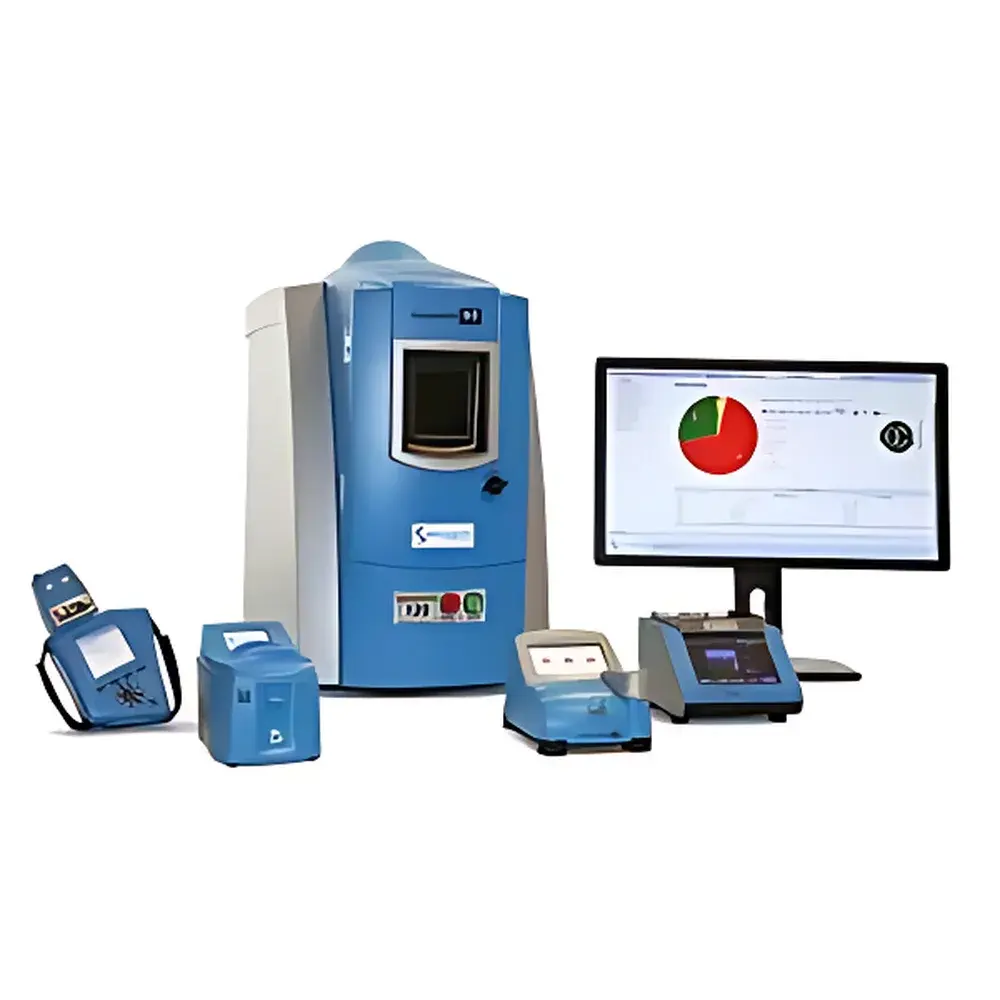
Spectro Scientific MiniLab EL Advanced Engine Oil Analysis System
| Brand | Spectro Scientific |
|---|---|
| Origin | USA |
| Manufacturer Type | Manufacturer |
| Origin Category | Imported |
| Model | MiniLab EL |
| Product Category | Laboratory Instrument |
| Test Capabilities | Elemental Analysis, Particle Quantification, Viscosity, Oxidation/Nitration, Water Content |
| Detection Method | Rotating Disc Electrode (RDE) Atomic Emission Spectrometry, Ferrographic Particle Analysis, Miniaturized Capillary Viscometry, FTIR Spectroscopy, Coulometric Karl Fischer Titration |
Overview
The Spectro Scientific MiniLab EL is an integrated, field-deployable engine oil analysis system engineered for precision condition monitoring of high-performance reciprocating and turbine engines. It operates on a multi-physical principle architecture: elemental concentrations are quantified via Rotating Disc Electrode (RDE) atomic emission spectrometry (ASTM D6595); ferrous and non-ferrous wear particles are differentiated and sized using quantitative ferrography (ASTM D7690); kinematic viscosity is measured by miniaturized capillary viscometry (ASTM D445); oxidation, nitration, and sulfation states are assessed via Fourier Transform Infrared (FTIR) spectroscopy (ASTM E2412); and water content is determined using coulometric Karl Fischer titration (ASTM D6304). This concurrent multi-parameter measurement capability enables comprehensive tribological assessment without sample dilution or external lab dependency—delivering laboratory-grade data in under 20 minutes at the point of use.
Key Features
- Five-in-one modular analytical platform: simultaneous elemental spectroscopy, particle quantification, viscosity, oxidation/nitration index, and water content analysis
- Field-ruggedized design with IP54-rated enclosure, shock-absorbing chassis, and temperature-compensated optical and fluidic subsystems
- No consumables beyond standardized reagents and disposable sample cells—no gases, high-voltage sources, or cryogenic coolants required
- Calibration traceability to NIST-traceable reference oils and certified metal standards per ISO/IEC 17025 guidelines
- Embedded diagnostics with real-time sensor health monitoring, automatic baseline correction, and drift compensation algorithms
- Integrated barcode/RFID reader for asset ID capture and automated sample chain-of-custody logging
Sample Compatibility & Compliance
The MiniLab EL accepts undiluted used engine oils—including mineral, synthetic, and semi-synthetic formulations—across SAE viscosity grades from 0W-20 to 60, as well as aviation turbine oils (MIL-PRF-23699, MIL-PRF-6081), diesel engine oils (API CK-4, FA-4), and gas engine lubricants (API SP, ILSAC GF-6). All test methods comply with relevant ASTM International standards (D6595, D7690, D445, E2412, D6304) and support regulatory alignment with FAA Advisory Circular 120-96, ISO 4406:2017 (contamination code reporting), and SAE ARP5563 (oil analysis program requirements for aircraft operators). The system supports full audit trails compliant with FDA 21 CFR Part 11 when deployed with validated MiniLab LIMS configurations.
Software & Data Management
MiniLab software comprises two interoperable components: the MiniLab Device Console (MDC) and MiniLab LIMS. MDC runs locally on Windows-based host systems and handles instrument control, method execution, raw data acquisition, and metadata tagging (asset ID, operator, location, sampling date/time). MiniLab LIMS is a browser-accessible, role-based platform supporting on-premise, LAN-hosted, or cloud-deployed architectures. It provides configurable alarm thresholds per asset class, automated trend analysis across multiple parameters (e.g., Fe/Cu ratio, oxidation slope, viscosity delta), customizable PDF/Excel report generation, SMTP-triggered email alerts, and centralized management of geographically distributed MiniLab EL units. All data transactions include electronic signatures, immutable audit logs, and revision-controlled method templates—enabling GLP/GMP-aligned workflows.
Applications
The MiniLab EL serves as a core diagnostic tool in predictive maintenance programs across sectors where engine reliability directly impacts safety, availability, and lifecycle cost. In aerospace, it supports engine health monitoring for commercial and military turbine fleets during line maintenance and depot overhauls. In automotive R&D, it accelerates validation cycles for new lubricant formulations and aftertreatment-compatible oils. Rail operators deploy it for real-time assessment of diesel-electric locomotive crankcase oils under variable load profiles. Marine propulsion teams use it to monitor slow-speed crosshead engines operating on heavy fuel oil blends. Power generation facilities rely on its consistency for continuous monitoring of gas turbine and reciprocating generator sets—reducing unplanned outages and optimizing oil drain intervals based on actual degradation kinetics rather than fixed time-based schedules.
FAQ
What sample volume is required per test sequence?
A single analysis requires 8 mL of undiluted oil—distributed across five dedicated modules with no cross-contamination risk.
Can MiniLab EL data be integrated with existing CMMS or ERP platforms?
Yes—via RESTful API and CSV/XML export protocols; pre-built connectors exist for SAP PM, IBM Maximo, and Honeywell Asset Manager.
Is method validation documentation available for regulatory submissions?
Spectro provides IQ/OQ/PQ protocols, method verification reports per ASTM D7720, and validation packages aligned with ISO 17025 accreditation requirements.
How frequently does the system require calibration verification?
Daily verification using certified reference oil is recommended; full recalibration is performed annually or after 1,000 analyses, whichever occurs first.
Does MiniLab EL support remote firmware updates and diagnostics?
Yes—secure over-the-air updates and remote troubleshooting are enabled through encrypted TLS 1.2 communication channels with optional VPN integration.





