
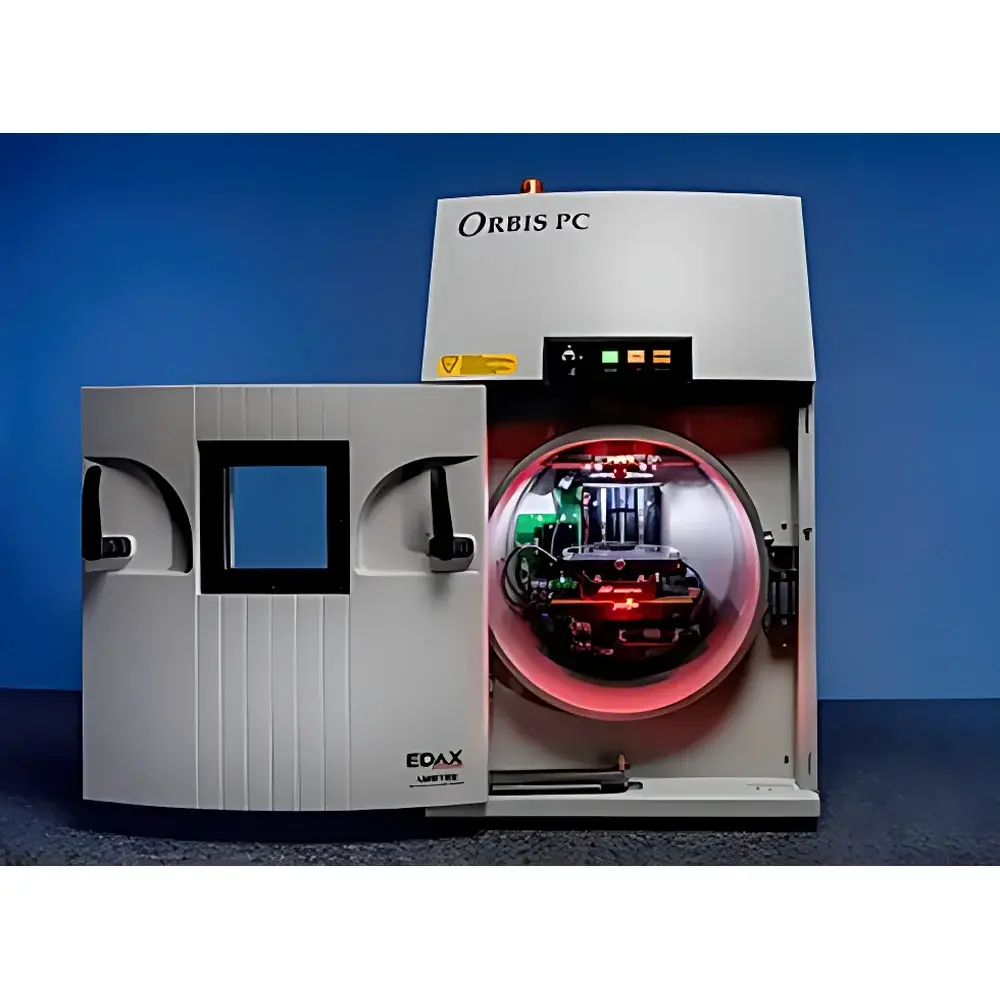
EDAX Orbis Micro-XRF Analyzer
| Brand | EDAX |
|---|---|
| Origin | USA |
| Model | Orbis |
| Detector Type | Energy-Dispersive X-ray Fluorescence (EDXRF) |
| Operating Environment | Air or Low Vacuum |
| Elemental Range | Na (11) to Bk (97) |
| Sample Chamber Capacity | Up to 300 mm × 300 mm × 150 mm (W×D×H) |
| Beam Spot Size | Adjustable down to <30 µm |
| Software Platform | Vision™ v5.x |
| Compliance | ASTM E1621, ISO 8256, USP <232>/<233>, GLP/GMP-ready audit trail support |
Overview
The EDAX Orbis Micro-XRF Analyzer is a benchtop energy-dispersive X-ray fluorescence (EDXRF) spectrometer engineered for high-spatial-resolution, non-destructive elemental analysis of heterogeneous solid samples. Unlike scanning electron microscopy–energy dispersive spectroscopy (SEM-EDS), which relies on electron-induced excitation and requires conductive coating and high vacuum, the Orbis utilizes focused primary X-ray excitation in ambient or low-vacuum conditions—enabling direct analysis of insulating, hydrated, or irregularly shaped specimens without sample preparation. Its core architecture integrates polycapillary X-ray optics that deliver a micro-focused beam (<30 µm nominal spot size) with high photon flux, coupled to a high-resolution silicon drift detector (SDD) optimized for light-element sensitivity (down to sodium) and heavy-element detection (up to berkelium). The system operates on fundamental parameter (FP) quantification principles, supported by matrix-matched standards and empirical calibration libraries, ensuring traceable, reproducible results compliant with ASTM E1621 (Standard Test Method for Determining Elements in Waste Samples by Instrumental Neutron Activation Analysis and X-Ray Fluorescence Spectroscopy) and ISO 8256 (X-ray fluorescence analysis — General requirements and guidelines).
Key Features
- True “see-what-you-analyze” optical geometry: Co-axial video camera aligned perpendicular to the X-ray optic axis enables real-time visual confirmation of beam position and sample topography—eliminating shadowing artifacts common in oblique-geometry systems.
- Adjustable micro-beam optics: Motorized collimators and polycapillary lenses allow rapid switching between spot sizes (30 µm to 1 mm) for flexible analysis of inclusions, particles, coatings, or large-area mapping.
- Large-chamber design: Accommodates samples up to 300 mm × 300 mm × 150 mm without sectioning—ideal for PCBs, geological slabs, forensic evidence, and industrial components.
- Ambient/low-vacuum operation: Eliminates need for carbon/metal coating; preserves sample integrity for subsequent analysis (e.g., FTIR, Raman) or archival storage.
- Dual-model platform: Orbis MC (multi-channel mapping) and Orbis PC (point-and-shoot compositional analysis) share identical hardware architecture and Vision™ software—ensuring method transferability across labs.
Sample Compatibility & Compliance
The Orbis supports diverse sample types—including powders, thin films, bulk metals, ceramics, polymers, biological tissues, and geological matrices—without destructive preparation. Its ability to analyze elements from Na (Z=11) to Bk (Z=97) under air or low vacuum satisfies regulatory requirements for restricted substance screening (RoHS, REACH, ELV), pharmaceutical elemental impurities (USP /), and forensic trace evidence characterization. All quantitative workflows include full audit trail logging per FDA 21 CFR Part 11 requirements, with electronic signatures, user access controls, and data integrity validation reports. System performance verification follows ISO/IEC 17025 guidelines, and routine calibration checks are traceable to NIST SRM reference materials.
Software & Data Management
Vision™ v5.x software provides an integrated environment for acquisition, quantification, spectral deconvolution, spatial mapping, and statistical reporting. It features automated peak identification using library-matched spectra (including mineral, alloy, and polymer databases), FP-based quantification with optional standardless mode, and customizable report templates compliant with ISO 14284 (metallic materials — X-ray fluorescence spectrometry). Hyperspectral imaging datasets are stored in vendor-neutral HDF5 format, supporting third-party analysis via Python-based tools (e.g., PyMca, HyperSpy). Raw spectra and metadata are archived with SHA-256 hashing to ensure data immutability during GLP/GMP audits.
Applications
- Materials science: Phase identification in multiphase alloys, inclusion analysis in steel, coating thickness and composition verification.
- Electronics: Lead-free solder verification, intermetallic compound mapping, contamination screening on wafers and PCBs.
- Geosciences: Mineral zoning studies, rare earth element distribution in monazite, volcanic glass geochemistry.
- Forensics: Gunshot residue (GSR) particle classification, paint chip layer-by-layer analysis, soil provenance comparison.
- Quality control: Incoming raw material verification, finished product release testing, supplier qualification per IATF 16949.
FAQ
What is the minimum detectable limit (MDL) for light elements such as sodium or magnesium?
MDLs are matrix-dependent and vary with measurement time and beam size; typical values range from 10–50 ppm for Na and Mg in silicate matrices under 100 s acquisition at 30 µm spot size.
Can the Orbis perform depth profiling?
No—Orbis is a surface-sensitive technique (penetration depth ~1–10 µm depending on element and matrix); for true depth profiling, complementary techniques such as SIMS or GD-OES are recommended.
Is vacuum required for all analyses?
Vacuum is optional and only recommended for enhanced light-element sensitivity (e.g., F, O, C); most routine analyses—including Na through U—perform robustly in ambient air.
How does Orbis differ from SEM-EDS in terms of spatial resolution and quantification accuracy?
Orbis achieves comparable lateral resolution (~30 µm) but superior quantification accuracy for bulk composition due to reduced atomic number (Z), absorption (A), and fluorescence (F) corrections versus electron-excited EDS; it also avoids charging artifacts on insulators.
Does Vision™ software support automated pass/fail criteria for QC workflows?
Yes—users can define multi-parameter acceptance thresholds (e.g., concentration ± tolerance, peak intensity ratio, detection limit compliance) with configurable alerts and exportable compliance logs.



