
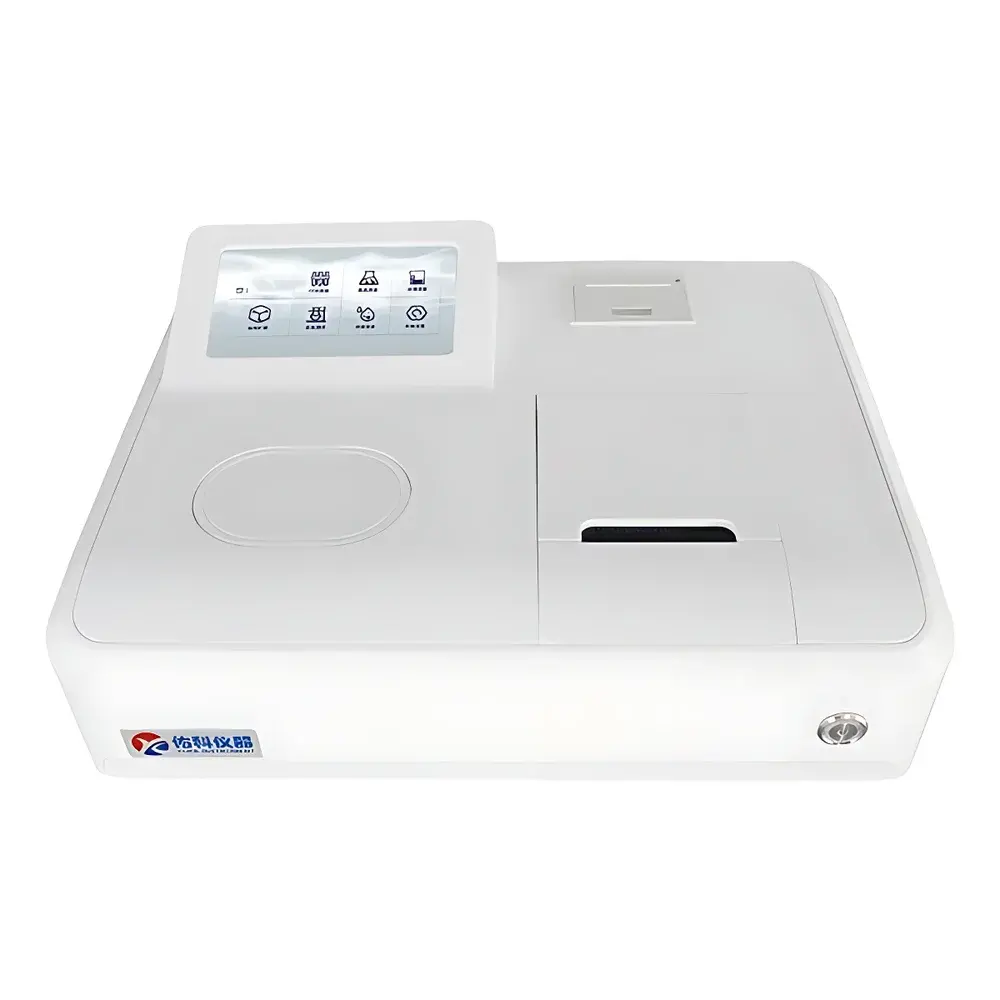
Yoke YKC-D1 Total Nitrogen Analyzer
| Brand | Yoke |
|---|---|
| Origin | Shanghai, China |
| Manufacturer Type | Direct Manufacturer |
| Region of Origin | Domestic (China) |
| Model | YKC-D1 |
| Pricing | Upon Request |
| Measurement Method | Alkaline Potassium Persulfate Digestion + UV Spectrophotometry (Standard Method per HJ 636-2012) |
| Measurement Range | 0.05–100 mg/L (multi-range auto-segmentation) |
| Accuracy | ≤ ±8% RSD at mid-range (10–50 mg/L), validated against certified reference materials (CRMs) |
| Display | 5.6-inch capacitive color touchscreen (800 × 480 resolution) |
| Data Storage | ≥5,000 measurement records with timestamp, sample ID, operator ID, and calibration metadata |
| Preloaded Curves | 5 factory-calibrated curves + 195 user-expandable curves |
| Light Source | Cold LED with narrow-band interference filters (center wavelength: 220 nm & 275 nm |
| bandwidth | <5 nm FWHM) |
| Processor | ARM9 core @ 400 MHz with 512 MB NAND flash + 128 MB DDR2 RAM |
| Connectivity | USB 2.0 host/device port, RS-232 serial interface (DB9) |
| Integrated Thermal Printer | 58 mm width, auto-cutter, supports real-time and batch printout of raw absorbance, concentration, curve ID, digestion time, and QC flags |
Overview
The Yoke YKC-D1 Total Nitrogen Analyzer is a benchtop laboratory instrument engineered for precise, compliant quantification of total nitrogen (TN) in surface water, wastewater, groundwater, and treated effluent samples. It implements the standardized alkaline potassium persulfate digestion method (HJ 636–2012, equivalent to ISO 11905-1 and EPA Method 351.2) followed by dual-wavelength ultraviolet spectrophotometric detection at 220 nm and 275 nm. This approach enables robust correction for nitrate interference and dissolved organic matter absorbance, delivering reliable TN results without requiring ion chromatography or high-temperature combustion. Designed for routine environmental testing laboratories operating under national monitoring programs or ISO/IEC 17025-accredited quality systems, the YKC-D1 integrates digestion control logic, spectral acquisition, and stoichiometric calculation into a single automated workflow — minimizing analyst intervention while maintaining traceability to NIST-traceable CRMs.
Key Features
- 5.6-inch capacitive color touchscreen with intuitive GUI navigation, supporting multi-language interface (English, Chinese) and context-sensitive help prompts
- Dual-channel UV photometric system featuring thermally stabilized cold LEDs and precision narrow-band interference filters (220 ± 2 nm and 275 ± 2 nm), ensuring long-term optical stability and minimal drift
- Onboard digestion protocol manager with programmable heating ramp profiles (up to 125 °C, 30 min hold), compatible with standard 16-mm borosilicate digestion tubes
- Embedded ARM9 processor with 512 MB flash memory and real-time OS enabling concurrent data acquisition, curve fitting, and report generation
- Integrated thermal printer (58 mm) with automatic timestamping, supporting immediate hardcopy output of measurement records, calibration logs, and QC summaries
- Comprehensive data integrity architecture: each stored record includes sample ID, operator code, digestion parameters, raw absorbance values (A220, A275), calculated TN concentration, curve identifier, and pass/fail QC status
- USB 2.0 and RS-232 interfaces support bidirectional data exchange with LIMS, Excel export, and firmware updates — fully compatible with Windows-based laboratory networks
Sample Compatibility & Compliance
The YKC-D1 accepts clarified aqueous samples with turbidity <5 NTU and suspended solids <20 mg/L. It complies with national regulatory requirements outlined in China’s HJ 636–2012 and supports alignment with international frameworks including ISO 11905-1 (Water quality — Determination of total nitrogen — Part 1: Guidance on methodology selection) and EPA Method 351.2 (Total Kjeldahl Nitrogen in Wastewater). All internal calibration and validation routines adhere to GLP principles: electronic audit trails log all parameter changes, curve modifications, and user authentication events. Instrument performance verification is supported via daily blank checks, CRM analysis (e.g., NIST SRM 1643e), and inter-laboratory comparison protocols.
Software & Data Management
Data handling follows ALCOA+ principles (Attributable, Legible, Contemporaneous, Original, Accurate, Complete, Consistent, Enduring, Available). The embedded database stores ≥5,000 records with full metadata: date/time stamp, operator ID, sample ID, digestion temperature/duration, measured absorbances, applied calibration curve, and calculated result. Preloaded curves are locked and version-controlled; user-defined curves require dual-operator authorization and are archived with creation timestamp and validation notes. USB export generates CSV files compliant with LIMS ingestion standards (including ISO/IEC 17025 Annex A.2 field definitions). No cloud connectivity is implemented — all data remains on-device unless explicitly exported, satisfying data sovereignty requirements common in municipal and industrial environmental labs.
Applications
- Regulatory compliance monitoring for municipal wastewater treatment plants (WWTPs) reporting to MEP (Ministry of Ecology and Environment)
- Surface water quality assessment in river basin management programs (e.g., Yangtze River Protection Initiative)
- Industrial effluent testing for textile, pharmaceutical, and food processing facilities subject to discharge permits
- Research applications in limnology and nutrient cycling studies requiring high-throughput TN screening
- QA/QC support for laboratories performing parallel analyses with TN analyzers based on TN combustion (e.g., Shimadzu TOC-L CN) or chemiluminescence (e.g., Teledyne TNI)
FAQ
What digestion reagents are required for operation?
The YKC-D1 requires alkaline potassium persulfate solution (prepared per HJ 636–2012) and hydrochloric acid for pH adjustment post-digestion. Lab-yy pre-filled digestion vials are recommended for consistency.
Is the instrument suitable for saline or high-chloride samples?
Samples with chloride >200 mg/L require matrix-matched calibration or dilution; no built-in chloride interference correction is implemented.
Can calibration curves be transferred between instruments?
Yes — curve parameters (slope, intercept, wavelength pair, range limits) can be exported/imported via USB in encrypted .ycf format, preserving traceability.
Does the analyzer meet FDA 21 CFR Part 11 requirements?
It supports electronic signatures, audit trails, and role-based access control — however, full Part 11 compliance requires site-specific validation documentation and IT infrastructure controls beyond the instrument itself.
What maintenance is required for long-term reliability?
Annual optical alignment verification and quarterly cleaning of the cuvette chamber and filter surfaces using lint-free wipes and isopropanol are recommended. LED source replacement is not user-serviceable and must be performed by authorized service centers.







