
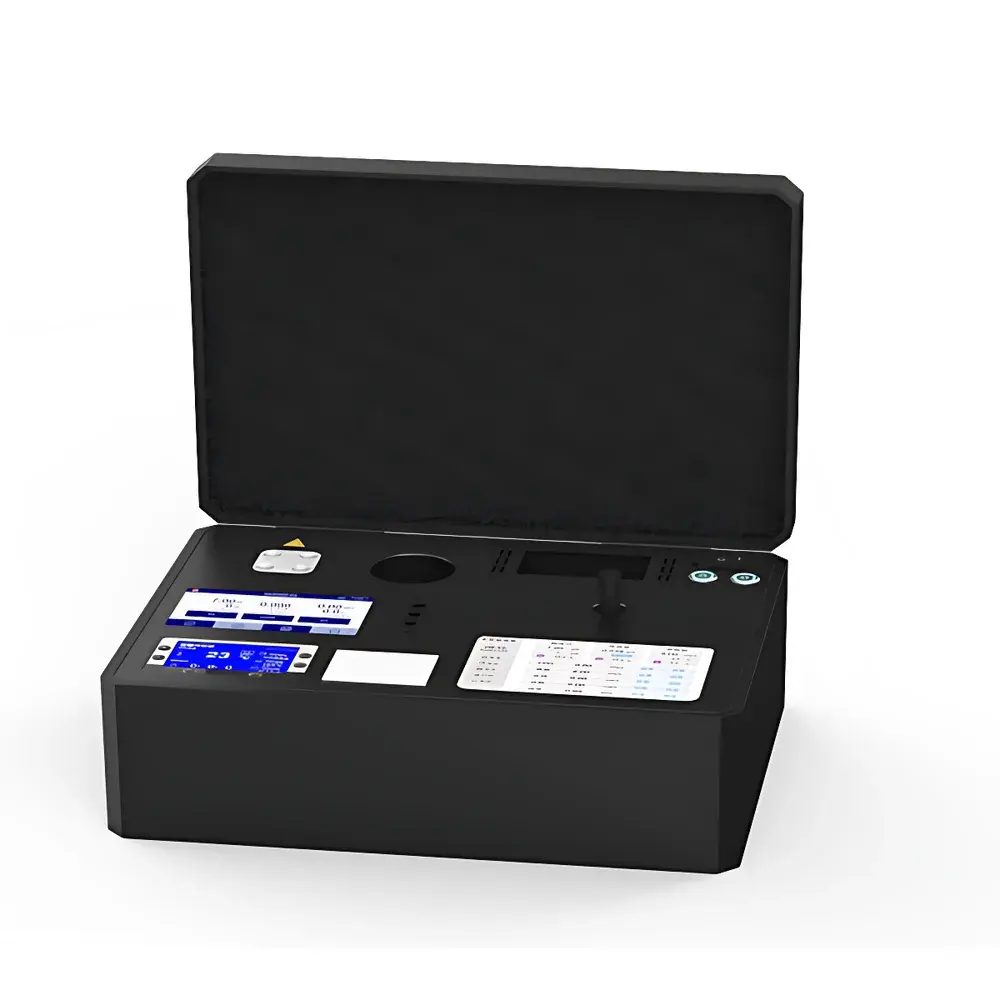
Yoke MIS1000 Series Portable Electrochemical Water Quality Analyzer
| Brand | Yoke |
|---|---|
| Origin | Shanghai, China |
| Manufacturer Type | OEM/ODM Manufacturer |
| Regional Category | Domestic (China) |
| Model | MIS1000 |
| Price Range | USD 2,800 – 11,200 |
| Instrument Type | Portable / Handheld Water Quality Analyzer |
| Measured Parameters | Dissolved Oxygen (DO), pH, Conductivity, TDS, Salinity, Resistivity, ORP, Temperature, plus optional photometric parameters including COD, NH₃-N, TP, TN, Turbidity, Cl₂, Cr⁶⁺, Fe, Cu, Pb, Cd, Ni, Mn, Zn, As, F⁻, CN⁻, SO₄²⁻, PO₄³⁻, NO₂⁻, NO₃⁻, Formaldehyde, Phenol, etc. |
| Optical System | Narrow-band Interference Filter + High-Precision Optical Filtering (380–800 nm) |
| Display | 7.0-inch Color Touchscreen or 5.6-inch Omron Keypad-integrated LCD |
| Data Storage | ≥5,000 measurement records + 200 built-in calibration curves |
| Power Supply | Dual-mode — Rechargeable Li-ion battery (3.7 V / 1800 mAh) + AC adapter (220 V ±10 %, 50 Hz) |
| Communication | USB 2.0, Bluetooth 4.0 |
| Enclosure Rating | IP54 |
| Dimensions | 160 × 190 × 70 mm |
| Weight | 0.88 kg (instrument only) |
| Operating Environment | 5–40 °C, ≤85 % RH (non-condensing) |
| Photometric Accuracy | ±8 % FS |
| Repeatability | ±5 % |
| Optical Stability | ≤0.001 A / 10 min |
| Light Source Lifetime | 100,000 h |
Overview
The Yoke MIS1000 Series Portable Electrochemical Water Quality Analyzer is an integrated field-deployable instrument engineered for simultaneous, real-time electrochemical and spectrophotometric analysis of freshwater, wastewater, groundwater, and surface water matrices. It combines potentiometric (pH, ORP), amperometric (dissolved oxygen), conductometric (conductivity, salinity, TDS, resistivity), and absorbance-based (380–800 nm) measurement modalities within a single ruggedized platform. The core electrochemical architecture employs factory-calibrated, temperature-compensated solid-state sensors—including a fluorescence-based DO probe with 30 analytes, utilizing narrow-band interference filters to suppress stray light and ensure optical stability ≤0.001 A/10 min—critical for trace-level detection in variable ambient lighting.
Key Features
- Multi-parameter electrochemical sensing: Simultaneous acquisition of pH, ORP, dissolved oxygen (mg/L and % saturation), conductivity, TDS, salinity, resistivity, and temperature—with automatic temperature compensation (0–100 °C) and configurable reference temperatures (18 °C, 20 °C, 25 °C).
- Narrow-band optical engine: 380–800 nm spectral range with precision interference filters and stabilized LED source (100,000 h lifetime), minimizing photometric drift and enabling accurate low-concentration measurements per ISO 7027 (turbidity) and ISO 6060 (COD).
- Dual-power architecture: Seamless switching between internal rechargeable Li-ion battery (3.7 V / 1800 mAh, ≥8 h field operation) and AC mains (220 V ±10 %, 50 Hz), ensuring continuity during extended monitoring campaigns.
- Onboard data integrity safeguards: Automatic power-fail recovery with non-volatile memory retention; full audit trail of measurement events including timestamp, ATC/MTC status, operator ID (optional), and environmental conditions.
- Preloaded calibration infrastructure: 200 user-configurable calibration curves stored in AMR9 high-density memory; factory-loaded method-specific curves eliminate manual standardization for regulated parameters (e.g., NH₃-N per ISO 7150-1, TP per ISO 6878).
- Field-ready interface: 7.0-inch capacitive touchscreen (or tactile Omron keypad variant) with intuitive icon-driven workflow; built-in thermal printer for immediate hard-copy documentation compliant with GLP record-keeping requirements.
Sample Compatibility & Compliance
The MIS1000 supports aqueous samples across municipal, industrial, agricultural, and natural water systems—including raw influent, treated effluent, drinking water distribution networks, aquaculture ponds, and stormwater runoff. Sample introduction is via standard 10–25 mm diameter glass or plastic cuvettes (for photometry) and direct immersion probes (for electrochemistry). All electrochemical modules comply with IEC 62255-1 (electrode safety), while photometric protocols align with ISO/IEC 17025:2017 technical requirements for testing laboratories. The instrument meets CE marking criteria under the EMC Directive 2014/30/EU and Low Voltage Directive 2014/35/EU. Optional firmware upgrades support FDA 21 CFR Part 11-compliant electronic signatures and audit trails for regulated QA/QC environments.
Software & Data Management
Data capture, export, and traceability are managed through Yoke’s proprietary AquaLink™ PC software (Windows/macOS compatible), which enables secure bidirectional communication via USB 2.0 or Bluetooth 4.0. Raw datasets include metadata such as GPS coordinates (when paired with external GNSS module), operator ID, sample ID, batch number, and environmental context (ambient T/RH, barometric pressure). Export formats include CSV, PDF reports (with embedded calibration certificates), and XML structured for LIMS integration. All stored records maintain immutable timestamps and checksum verification—supporting ISO 17025 clause 7.5.2 on data protection and integrity. Firmware updates are delivered via signed OTA packages, preserving cryptographic chain-of-custody.
Applications
- Regulatory compliance monitoring: Routine verification of discharge permits (e.g., EPA NPDES, EU Urban Wastewater Treatment Directive) for parameters including DO, pH, NH₃-N, TP, and heavy metals (Cr⁶⁺, Pb, Cd, As).
- Drinking water safety: Field validation of residual disinfectants (free/total chlorine, ClO₂), turbidity (<1 NTU), and emerging contaminants (formaldehyde, phenol) per WHO Guidelines for Drinking-water Quality.
- Environmental impact assessment: In-situ profiling of eutrophication indicators (TN, TP, chlorophyll-a proxy via COD/NH₃-N correlation) and redox-sensitive species (Fe²⁺/Fe³⁺, Mn²⁺, S²⁻) in wetlands and sediments.
- Industrial process control: Real-time tracking of boiler feedwater hardness, cooling tower conductivity, and electroplating bath metal ion concentrations (Ni²⁺, Cu²⁺, Cr⁶⁺) to prevent scaling or corrosion.
- Academic & research fieldwork: Multi-depth profiling in lakes/reservoirs using depth-compensated DO/pH/conductivity logging; method development for novel colorimetric assays validated against HPLC-ICPMS reference methods.
FAQ
Does the MIS1000 require daily recalibration for electrochemical sensors?
No. Factory-trimmed pH and DO electrodes maintain accuracy within ±0.02 pH and ±0.4 mg/L over 72 h under stable thermal conditions. Recalibration is recommended before each sampling campaign or after exposure to extreme pH (12) or sulfide-rich matrices.
Can photometric methods be validated against certified reference materials (CRMs)?
Yes. Each optical method includes CRM traceability documentation (NIST SRM or equivalent), with uncertainty budgets aligned to ISO/IEC 17025:2017 Annex A.3. Method detection limits (MDLs) are verified per EPA Method 40 CFR Part 136.
Is the instrument suitable for marine or brackish water analysis?
Yes. Conductivity and salinity modules support K = 0.1 / 1 / 10 cm⁻¹ electrode configurations with automatic salinity compensation (0–45 ppt) and pressure correction (0–200 kPa) for DO—enabling reliable use in estuarine and coastal zones.
How is data security ensured during Bluetooth transmission?
All wireless sessions employ AES-128 encryption with certificate-based device pairing. No raw sensor data is cached on mobile devices; transfer logs are retained exclusively in instrument memory with SHA-256 hash integrity checks.
What maintenance is required for long-term field deployment?
Electrode storage in manufacturer-specified electrolyte solution; quarterly optical path cleaning with lint-free wipes and isopropanol; annual verification of photometric linearity using NIST-traceable neutral density filters.
Related Products







