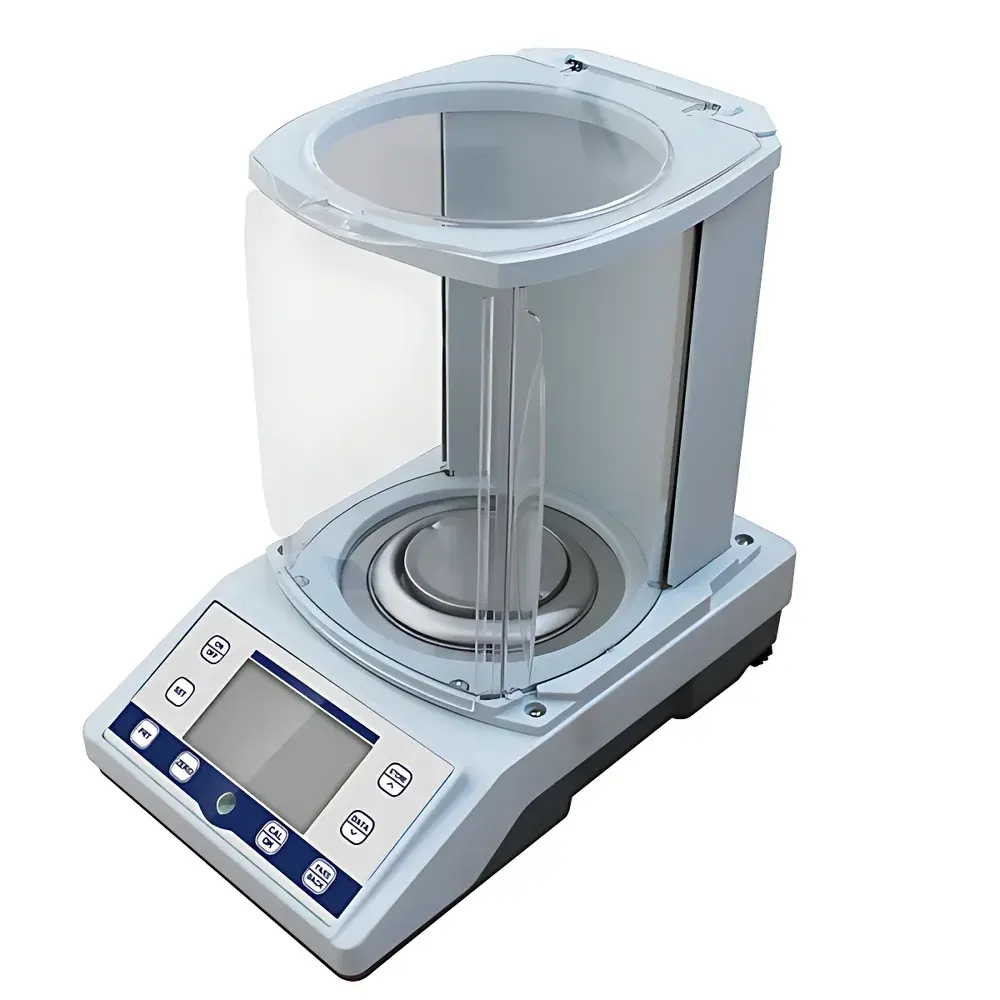
Yoke FB-C Series Analytical Balance (0.1 mg readability, 100–220 g capacity)
| Brand | Yoke |
|---|---|
| Origin | Shanghai, China |
| Manufacturer Type | Direct Manufacturer |
| Country of Origin | China |
| Model Series | FB-C |
| Instrument Type | Analytical Balance |
| Capacity Range | 100–220 g |
| Readability | 0.1 mg |
| Internal Calibration | Yes |
| Maximum Capacity | 220 g |
| Repeatability | 0.1 mg |
| Accuracy Class | OIML Class I |
| Power Supply | DC 9 V / 1 A |
| Pan Diameter | 80 mm |
| Dimensions (W×D×H) | 360 × 220 × 350 mm |
| Net Weight (incl. packaging) | 8 kg |
Overview
The Yoke FB-C Series Analytical Balance is a precision laboratory instrument engineered for high-accuracy mass measurement in regulated and research-intensive environments. Designed to meet OIML R 76-1 Class I accuracy requirements, this series delivers consistent 0.1 mg readability across its full range of capacities—from 100 g (FB104C) to 220 g (FB224C). The balance operates on electromagnetic force compensation (EMFC) principle, where the mass-induced displacement of the weighing pan is counteracted by a precisely controlled electromagnetic current; the resulting current magnitude is linearly proportional to the applied mass and digitally converted into a stable, traceable reading. This architecture ensures minimal drift, high long-term stability, and immunity to mechanical hysteresis—critical attributes for quantitative analysis in pharmaceutical QC, academic chemistry labs, and materials science applications.
Key Features
- Advanced ARM32-bit microprocessor core enabling real-time data processing, optimized filtering algorithms, and sub-second stabilization times under typical lab conditions.
- High-stability electromagnetic sensor assembly manufactured using CNC-machined components to ensure dimensional repeatability and thermal consistency across operating temperatures (10–30 °C).
- Integrated internal calibration system with motorized weight actuation—eliminates manual handling of calibration masses and supports scheduled or event-triggered recalibration (e.g., after temperature shift >2 °C or time interval ≥24 h).
- Sealed draft shield design with front sliding door and side access ports—meets ISO 9001-compliant environmental containment standards while maintaining ergonomic usability and visual clarity.
- Multi-function operation modes including piece counting, percentage weighing, density determination (with optional density kit), animal/dynamic weighing, and checkweighing—each mode fully configurable via intuitive button navigation.
- SMT-assembled PCB architecture with conformal coating for enhanced resistance to humidity, dust ingress, and electrostatic discharge—validated per IEC 61326-1 for electromagnetic compatibility in shared lab infrastructure.
- Backlit BTN black-on-gray LCD display (128 × 64 pixels) with adjustable contrast and auto-dimming—ensures legibility under variable ambient lighting without parallax error or viewing-angle dependency.
Sample Compatibility & Compliance
The FB-C Series accommodates standard laboratory sample containers—including weighing boats, crucibles, vials, and filter papers—within its 80 mm diameter stainless-steel weighing pan. The pan geometry and load distribution profile are optimized to minimize corner-loading errors and support off-center placement within ±15 mm tolerance. All models comply with international metrological standards: OIML R 76-1 (Class I), EN 45501, and ANSI/NCSL Z540-1. For regulated environments, the balance supports GLP/GMP documentation workflows through user-accessible audit trail logs (time-stamped calibration events, zero adjustments, and mode changes), and is compatible with external printers and LIMS integration via RS232 interface. While not natively 21 CFR Part 11 compliant out-of-the-box, firmware version 2.4+ enables electronic signature configuration and password-protected administrator access—facilitating validation readiness in FDA-audited laboratories.
Software & Data Management
Data output is supported via bidirectional RS232 serial communication (ASCII protocol, 9600 baud, no parity, 1 stop bit), enabling seamless transfer to Excel, LabArchives, or custom QA databases. Optional Yoke Balance Utility software (Windows 10/11 compatible) provides real-time graphing, statistical analysis (mean, SD, CV%, min/max), batch export, and PDF report generation—including calibration certificate templates aligned with ISO/IEC 17025 requirements. All internal memory retains ≥1,000 measurement records with timestamps, operator IDs (if configured), and environmental metadata (temperature, humidity if external sensor connected). No cloud storage or remote telemetry is implemented—ensuring full data sovereignty and alignment with institutional IT security policies.
Applications
- Pharmaceutical formulation: Active pharmaceutical ingredient (API) dispensing, excipient ratio verification, and tablet weight uniformity testing per USP .
- Chemical synthesis: Stoichiometric reagent weighing, yield calculation, and gravimetric titrant standardization.
- Materials characterization: Ash content determination (ASTM D3174), moisture loss on drying (AOAC 925.09), and catalyst loading quantification.
- Environmental testing: Filter mass gain analysis for PM2.5/PM10 particulate matter sampling (EPA Method 201A).
- Academic teaching labs: Fundamental metrology instruction, uncertainty budgeting exercises, and comparative studies of weighing methodology (e.g., tare vs. net weighing protocols).
FAQ
What does “0.1 mg readability” mean in practice?
It indicates the smallest increment the balance can display—equivalent to 100 µg. This resolution is appropriate for applications requiring ≤0.05% relative uncertainty at 200 g load, assuming proper environmental control and calibration.
Is internal calibration traceable to national standards?
Yes—the internal calibration mass is factory-adjusted against NIST-traceable reference standards and documented in the Certificate of Conformance supplied with each unit.
Can the balance be used in a fume hood?
Not recommended. Drafts, temperature gradients, and volatile solvent vapors compromise repeatability and may trigger automatic drift compensation. Use only in climate-stabilized, vibration-isolated benchtop locations.
Does the FB-C Series support external calibration with customer-provided weights?
Yes—external calibration mode accepts certified weights from 100 g up to 200 g (depending on model), with automatic verification of linearity and eccentricity per ISO 17025 clause 6.5.2.
How often should routine calibration be performed?
Per ISO/IEC 17025, calibration frequency must be risk-based: typically daily pre-use verification with a 100 g check weight, plus full internal calibration before first use, after relocation, or following significant ambient shifts (>2 °C).