
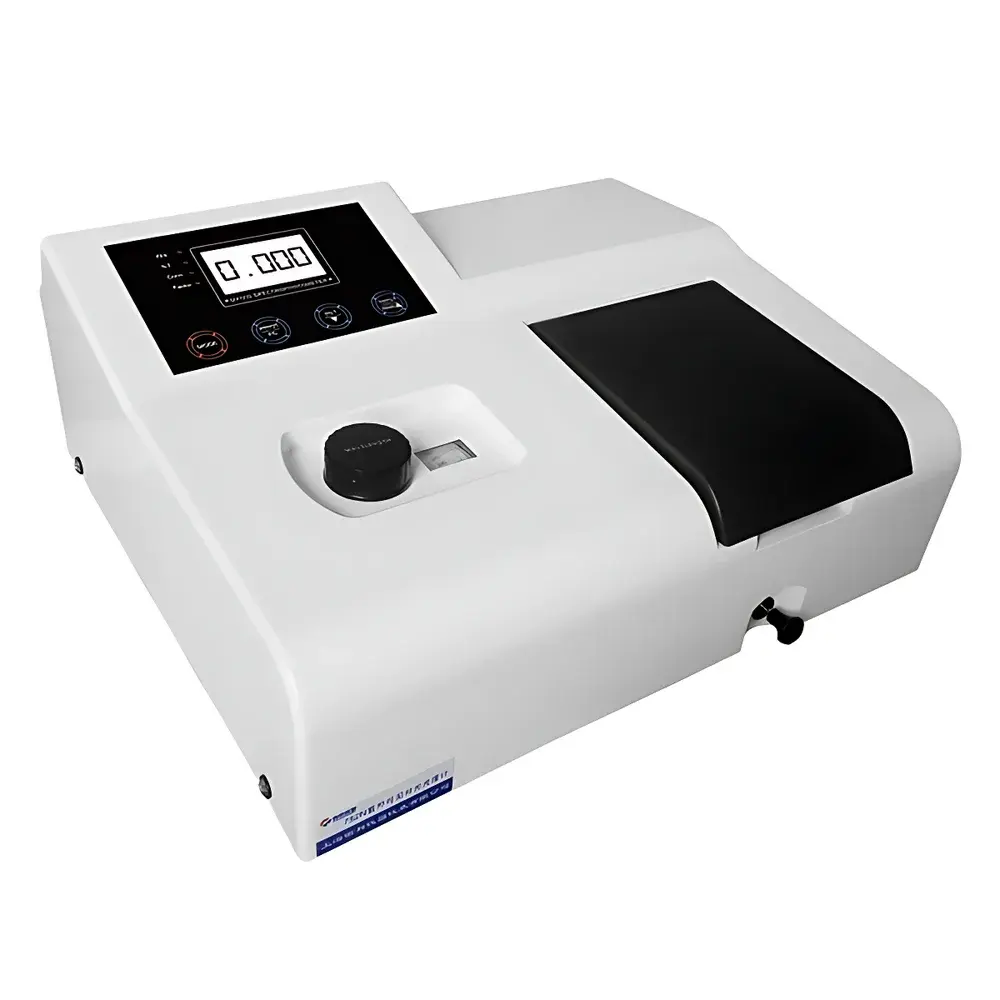
Yoke VIS-722N Single-Beam Visible Spectrophotometer
| Brand | Yoke |
|---|---|
| Origin | Shanghai, China |
| Manufacturer Type | Direct Manufacturer |
| Instrument Type | Domestic |
| Model | VIS-722N |
| Optical System | Achromatic Czerny-Turner with 1200 L/mm Grating |
| Wavelength Range | 320–1020 nm |
| Wavelength Accuracy | ±2 nm |
| Wavelength Repeatability | ≤0.5 nm |
| Spectral Bandwidth | 4 nm |
| Photometric Accuracy (Transmittance) | ±0.5% T |
| Photometric Linearity | 0–200% T, –0.3 to 3 A, 0–9999 C |
| Baseline Stability | ±0.002 A/h @ 500 nm |
| Drift | ≤0.1% T |
| Noise | ≤0.2% T |
| Stray Light | ≤0.2% T @ 360 nm |
| Detector Type | Silicon Photocell |
| Light Source | Imported Tungsten-Halogen Lamp |
| Sample Chamber Dimensions | Accommodates up to 10 cm pathlength cuvettes |
| Operating Modes | Transmittance (T), Absorbance (A), Concentration (C) |
| Zeroing Method | Automatic |
| Interface Options | Optional RS-232 Serial Port for Printer/PC Connectivity |
| Net Weight | 8 kg |
| Power Supply | AC 220 V ±10%, 50 Hz |
Overview
The Yoke VIS-722N is a precision-engineered single-beam visible spectrophotometer designed for routine quantitative and qualitative analysis in educational laboratories, quality control environments, and industrial R&D settings. Operating on the principle of Beer–Lambert law-based absorbance measurement, the instrument employs a fixed-wavelength manual scanning architecture optimized for the visible spectrum (320–1020 nm). Its optical layout features an achromatic Czerny–Turner monochromator equipped with a 1200 lines/mm holographic grating, delivering consistent spectral resolution and minimized chromatic aberration across the operational range. The system utilizes a stabilized tungsten-halogen lamp as its broadband source, selected for spectral continuity in the visible region and long-term radiometric stability—critical for reproducible photometric measurements over extended usage cycles.
Key Features
- Manual wavelength selection with digital display for real-time readout of transmittance (%T), absorbance (A), and concentration (C) values
- Integrated automatic zeroing and 100% transmittance calibration routines—eliminating manual mechanical adjustments and reducing operator-induced variability
- Robust optical bench design with temperature-compensated alignment, ensuring minimal baseline drift (≤0.1% T) and low noise performance (≤0.2% T)
- Spacious sample compartment accommodating standard 10 mm, 20 mm, 50 mm, and 100 mm pathlength cuvettes—supporting both routine assays and specialized dilution-series validation protocols
- Microprocessor-controlled operation with embedded firmware enabling stable photometric linearity across 0–200% T, –0.3 to 3 A, and 0–9999 C ranges
- Optional RS-232 serial interface compliant with EIA/TIA-232-E standards—enabling direct connection to external thermal printers or legacy laboratory PCs for audit-ready data export
Sample Compatibility & Compliance
The VIS-722N accepts standard rectangular quartz, glass, or plastic cuvettes with optical path lengths from 10 mm to 100 mm. It is compatible with aqueous, organic, and mildly corrosive solutions commonly used in colorimetric assays (e.g., phosphate, nitrate, iron, copper determinations per APHA Standard Methods). While not certified for GLP/GMP-regulated production environments, its photometric accuracy (±0.5% T), wavelength repeatability (≤0.5 nm), and stray light performance (≤0.2% T @ 360 nm) meet foundational requirements outlined in ISO 6223:2016 (spectrophotometer performance verification) and ASTM E275–22 (standard practices for describing and measuring performance of UV–Vis spectrophotometers). The instrument supports basic traceability via manual logbook entry; for regulated workflows requiring electronic audit trails, integration with third-party LIMS via RS-232 is feasible under user-defined SOPs.
Software & Data Management
The VIS-722N operates autonomously without proprietary software dependency. All measurement functions—including auto-zero, auto-100%T, and mode switching—are executed via front-panel controls. When equipped with the optional RS-232 interface, the device outputs ASCII-formatted data packets at 9600 baud, 8-N-1 configuration, compatible with generic terminal emulators (e.g., PuTTY, Tera Term) or custom Python/Excel VBA scripts for batch logging. No driver installation or cloud connectivity is required. Data export supports time-stamped %T/A/C values per wavelength point, facilitating post-acquisition regression analysis in MATLAB, OriginLab, or GraphPad Prism. The absence of embedded OS or firmware update mechanisms ensures deterministic behavior—critical for laboratories maintaining validated instrument configurations per FDA 21 CFR Part 11 Annex 11 principles (where electronic records are generated externally).
Applications
- Educational instruction in analytical chemistry: demonstration of Beer’s law, calibration curve construction, and method validation fundamentals
- Pharmaceutical QC labs: assay of dye concentrations, excipient purity checks, and dissolution profile monitoring (non-GMP use)
- Environmental testing: quantification of COD, ammonia-nitrogen, and heavy metals using standardized colorimetric reagents (e.g., Hach, Merck methods)
- Food & beverage labs: determination of color indices (e.g., Lovibond scale), antioxidant capacity (DPPH assay), and pigment content (chlorophyll, anthocyanin)
- Industrial process support: incoming raw material verification, cleaning validation residue testing, and catalyst activity screening
FAQ
What wavelength range does the VIS-722N cover, and why is it limited to visible light?
The instrument operates from 320 nm to 1020 nm, spanning near-UV through visible to near-infrared. This range is defined by the transmission cutoff of the silica-based optical components and the emission profile of the tungsten-halogen source—not by detector limitations. It excludes deep-UV (<320 nm) due to atmospheric oxygen absorption and quartz cell constraints.
Can the VIS-722N be used for kinetic measurements?
No. As a manually tuned single-beam system without time-resolved scanning capability or programmable wavelength stepping, it is unsuitable for real-time reaction monitoring. It supports only endpoint or multi-point discrete measurements.
Is the RS-232 interface standard or optional?
It is strictly optional and must be specified at time of order. No internal hardware is pre-installed; the port requires factory-level integration and firmware enablement.
Does the instrument comply with FDA 21 CFR Part 11?
The VIS-722N itself does not provide electronic signature, audit trail, or role-based access control. Compliance is achievable only when paired with validated third-party data acquisition software operating under documented SOPs.
What maintenance is required to sustain wavelength accuracy?
Annual verification using NIST-traceable holmium oxide or didymium filters is recommended. No user-accessible optical alignment is provided; recalibration requires authorized service personnel and factory-certified wavelength standards.





