
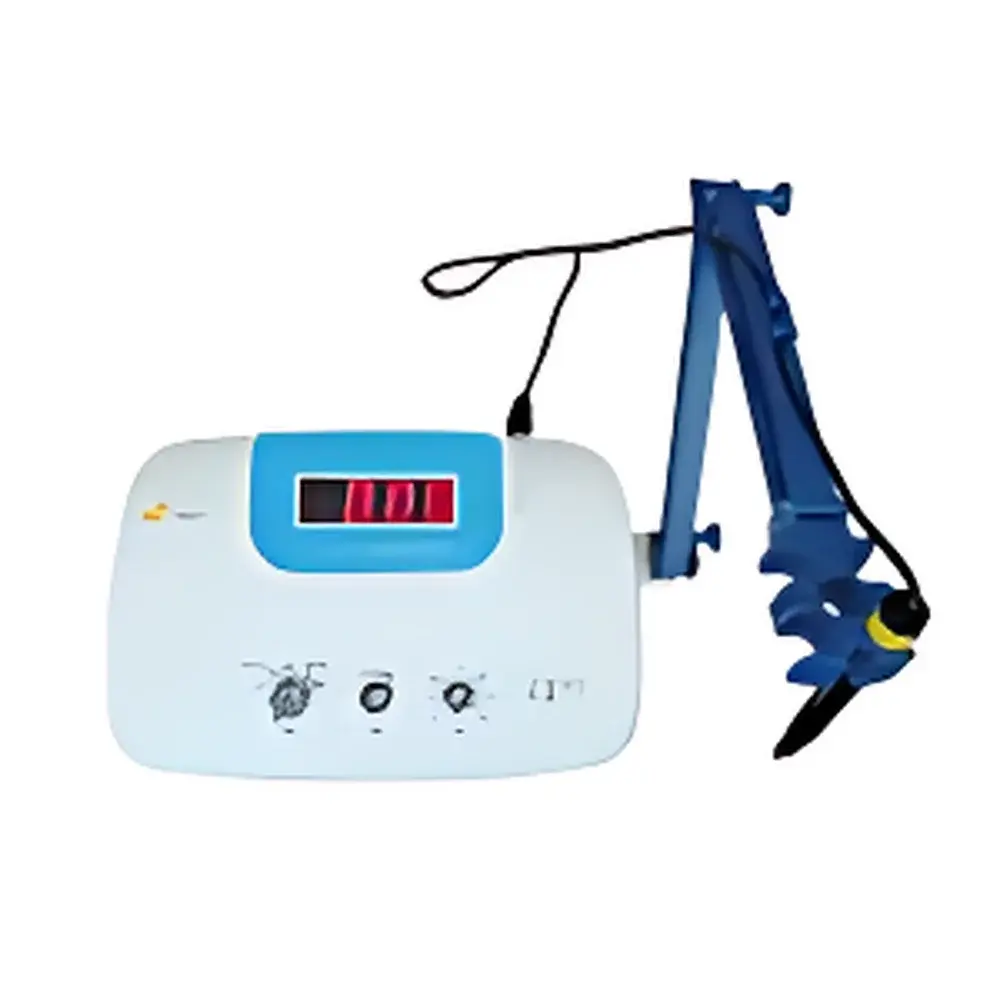
Yoke DDS-11A Benchtop Conductivity Meter
| Brand | Yoke |
|---|---|
| Model | DDS-11A |
| Type | Benchtop Conductivity Meter |
| Measurement Parameter | Single-parameter (Conductivity, TDS, Resistivity, Salinity) |
| Display | 3½-digit LED |
| Conductivity Range | 0.001–2×10⁵ µS/cm (5 manual ranges) |
| TDS Range | 0–100 g/L (ppm) |
| Resistivity Range | 0.5–1×10⁶ Ω·cm |
| Salinity Range | 0–100 ppt |
| Temperature Range | 0–60 °C |
| Temperature Compensation | Manual (5–35 °C) |
| Accuracy | ±1.5% FS ±1 digit |
| Resolution | 0.001 µS/cm (lowest range) |
| Electrode Constant Compensation | Yes |
| Output Signal | 0–10 mV analog output |
| Compliance | Designed for GLP-compliant lab environments |
Overview
The Yoke DDS-11A Benchtop Conductivity Meter is a precision-engineered electrochemical instrument designed for reliable, repeatable measurement of electrical conductivity in aqueous solutions. Based on the fundamental principle of two-electrode AC conductivity measurement—where a low-frequency alternating current minimizes polarization effects and electrode fouling—the DDS-11A delivers stable readings across five manually switched ranges (0.001–2×10⁵ µS/cm). Its architecture supports direct conversion to derived parameters including total dissolved solids (TDS), resistivity, and salinity using user-selectable conversion factors (e.g., NaCl or KCl equivalence). The instrument is calibrated per standard practices aligned with ASTM D1125 and ISO 7888, making it suitable for routine quality control in water treatment plants, pharmaceutical manufacturing, environmental field labs, and academic research settings where trace-level ionic quantification is required.
Key Features
- Benchtop form factor with robust ABS housing and front-panel wave-switch range selection for intuitive operation in shared lab environments
- 3½-digit LED display with high-contrast numerals ensuring readability under variable lighting conditions
- Manual temperature compensation (5–35 °C) with adjustable coefficient (α = 0.02/°C default, user-modifiable) to correct for solution viscosity and ion mobility changes
- Electrode constant compensation (K = 0.01–10.0 cm⁻¹) enabling accurate scaling across diverse sensor geometries—from microelectrodes for ultrapure water (K = 0.01) to high-conductivity industrial probes (K = 10)
- 0–10 mV analog output compatible with chart recorders, PLC interfaces, or legacy data acquisition systems for long-term trend monitoring
- Stable DC power supply with internal voltage regulation, minimizing drift during extended measurements (>8 h continuous operation)
Sample Compatibility & Compliance
The DDS-11A is validated for use with standard platinum or stainless-steel conductivity cells meeting IEC 60746-3 specifications. It accommodates samples ranging from deionized water (resistivity >1 MΩ·cm) to concentrated brines (up to 200 mS/cm when paired with K=10 electrodes). The instrument meets essential requirements for GLP (Good Laboratory Practice) documentation: all calibration events—including date, operator ID, standard used (e.g., KCl 0.01 mol/L, certified reference material NIST SRM 3198), and deviation logs—can be recorded externally via the analog output or manually archived. While not natively 21 CFR Part 11 compliant (lacking electronic signatures or audit trails), its design supports integration into validated workflows when combined with controlled procedural documentation and periodic verification per ISO/IEC 17025.
Software & Data Management
The DDS-11A operates as a standalone analog instrument without embedded firmware or digital connectivity. Data integrity relies on procedural rigor: users must log measurements manually or interface the 0–10 mV output with third-party DAQ hardware (e.g., National Instruments USB-6009) and software platforms such as LabVIEW or MATLAB for time-stamped acquisition, linearization, and statistical analysis. Calibration verification is performed using at least two NIST-traceable standards bracketing the expected sample range; linearity assessment across the full 5-range span is recommended quarterly per internal QC protocols. The absence of onboard memory eliminates risk of data corruption but necessitates disciplined external recordkeeping aligned with ISO 17025 clause 7.5.2.
Applications
- Environmental monitoring: Quantifying conductivity in surface water, groundwater, and wastewater effluents per EPA Method 120.1
- Pharmaceutical water systems: Routine checks of Purified Water (PW) and Water for Injection (WFI) conductivity against USP limits (e.g., ≤1.3 µS/cm at 25 °C)
- Power generation: Monitoring condensate purity in steam cycles to detect cooling tower leakage or resin breakthrough
- Academic teaching labs: Demonstrating Kohlrausch’s law, ion mobility trends, and temperature dependence of electrolyte conduction
- Food & beverage QA: Verifying rinse water conductivity post-CIP to confirm detergent removal before product contact
FAQ
What electrode constants are supported?
The DDS-11A accepts electrode constants from 0.01 to 10.0 cm⁻¹, selectable via front-panel potentiometer; K=0.01 is recommended for ultrapure water, K=1.0 for general lab use, and K=10.0 for high-salinity brines.
Does the instrument support automatic temperature compensation?
No—it provides manual temperature compensation only. Users must measure sample temperature separately (e.g., with a calibrated thermometer) and adjust the TC knob accordingly within the 5–35 °C range.
Can the DDS-11A measure conductivity below 1 µS/cm?
Yes, down to 0.001 µS/cm on the 2 µS/cm range; however, for sub-0.1 µS/cm measurements in ultrapure water, a dedicated low-conductivity meter with guarded cell design and air-tight cell housing is strongly advised to minimize ambient CO₂ interference.
Is calibration traceable to national standards?
Calibration accuracy depends on the reference standard used; when paired with NIST-traceable KCl solutions (e.g., 0.01 mol/L, conductivity = 1413 µS/cm at 25 °C), system-level uncertainty remains within ±1.5% FS as specified.
What maintenance is required for long-term stability?
Annual verification of zero offset (using air or dry cell) and gain accuracy with dual-point calibration (low- and mid-range standards) is recommended; electrode cleaning with dilute HNO₃ followed by DI water rinse preserves sensitivity over >5 years of typical use.




