
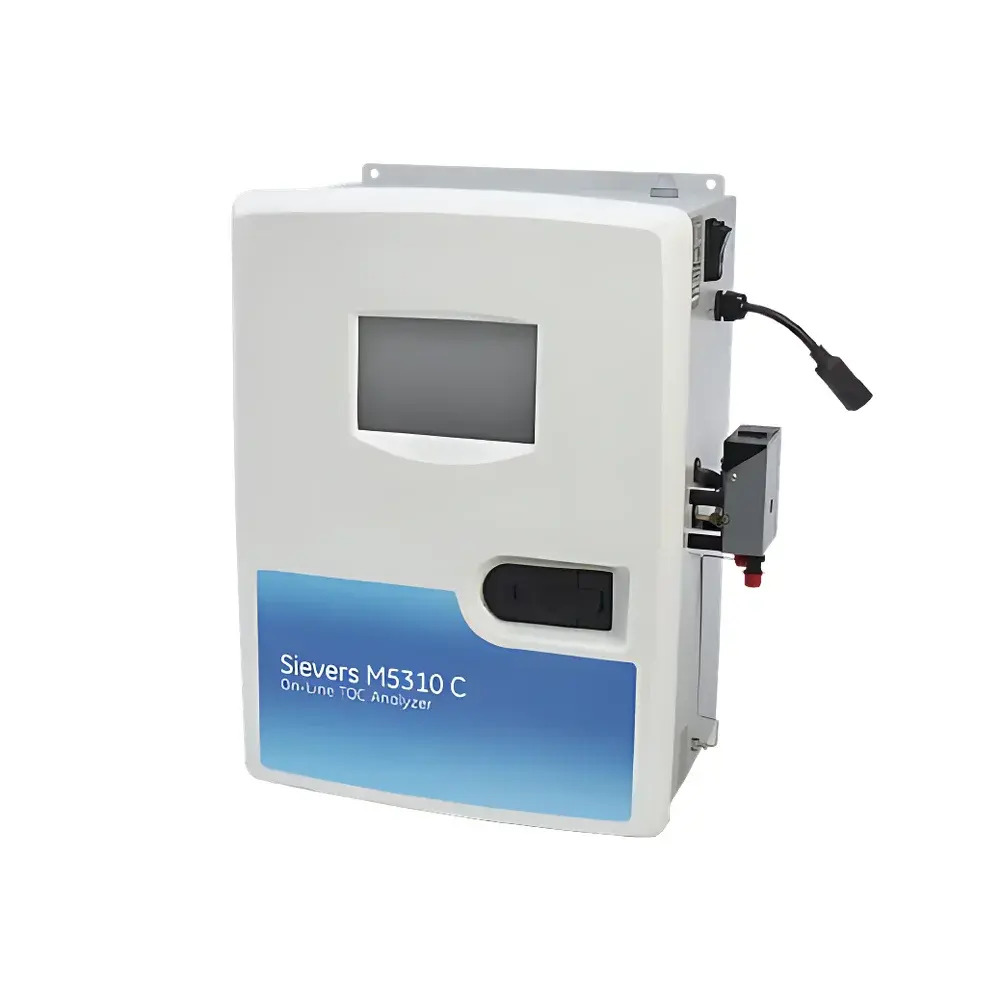
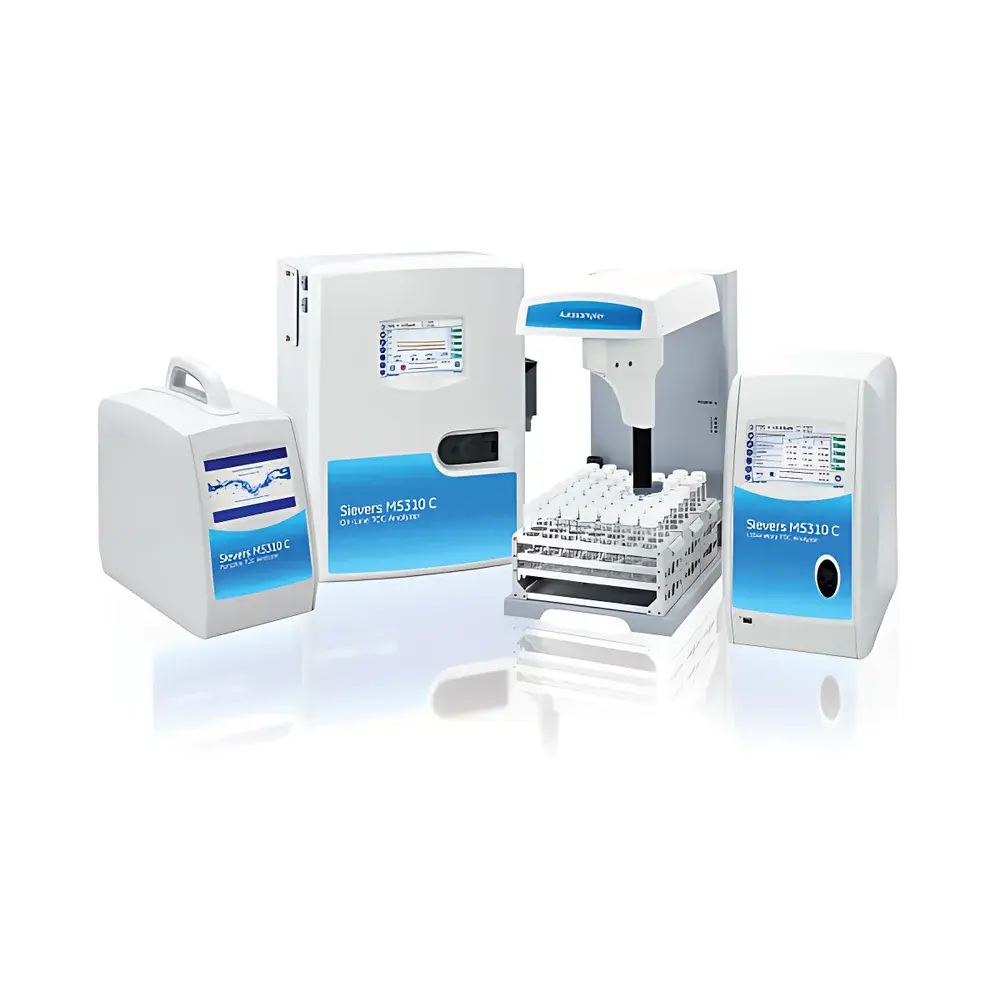
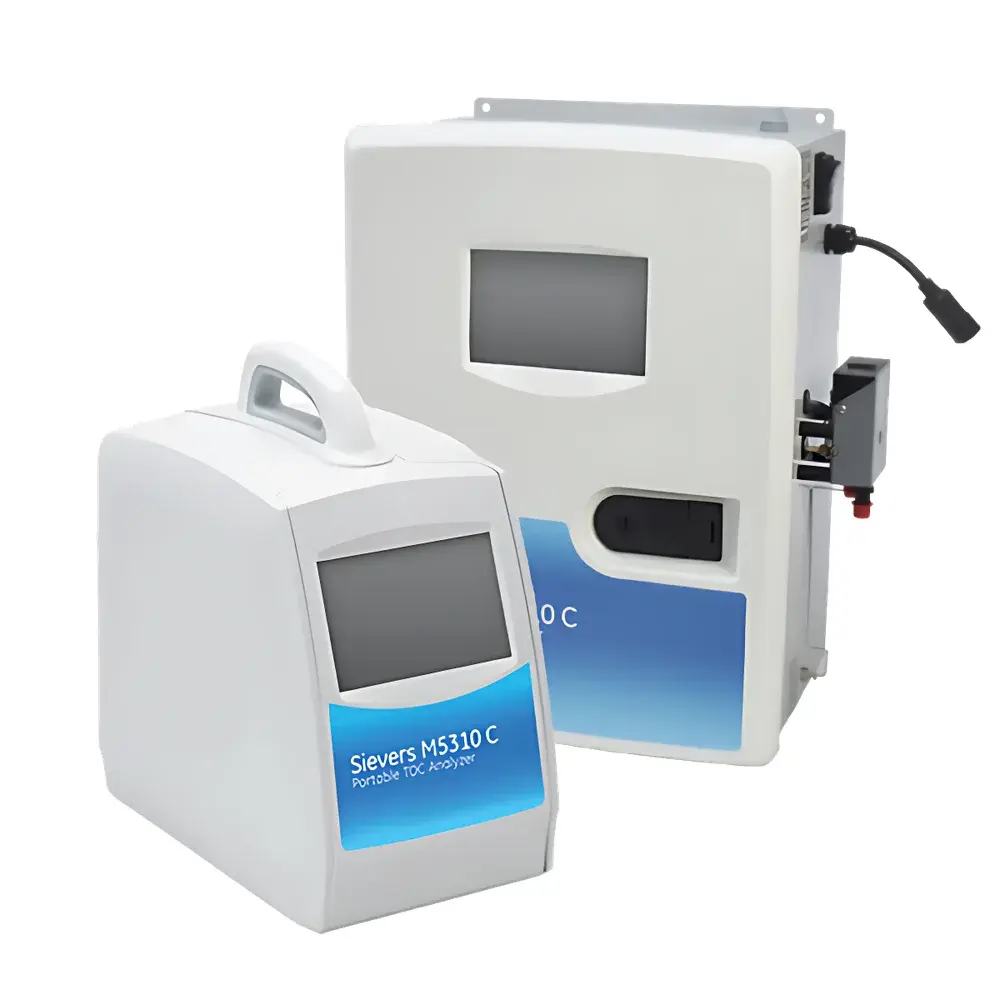
Sievers M5310 C Online Total Organic Carbon (TOC) Analyzer
| Brand | Sievers (Veolia) |
|---|---|
| Origin | USA |
| Manufacturer Type | Original Equipment Manufacturer (OEM) |
| Product Category | Imported Instrument |
| Model | M5310 C Online |
| Instrument Type | Online TOC Analyzer |
| Detection Principle | Membrane Conductivity Detection |
| Oxidation Method | UV/Persulfate Oxidation |
| Measurement Range | 4 ppb – 50 ppm |
| Accuracy | ±2% or ±0.5 ppb (whichever is greater) |
| Resolution | 0.1 ppb |
| Detection Limit | 4 ppb |
| Repeatability | <1% RSD |
Overview
The Sievers M5310 C Online Total Organic Carbon (TOC) Analyzer is an industrial-grade, real-time water quality monitoring system engineered for continuous, regulatory-compliant organic carbon quantification in critical water streams. Utilizing membrane conductivity detection following UV/persulfate oxidation, the instrument converts non-purgeable organic carbon (NPOC) into CO2, which is selectively permeated through a hydrophobic gas-permeable membrane and measured as a change in electrolytic conductivity. This principle ensures high specificity for TOC without interference from inorganic carbon species, chloride, or other ionic matrix components commonly present in pharmaceutical, semiconductor, power generation, and municipal water distribution systems. Designed to meet stringent requirements of US EPA Method 415.3, ASTM D7573, ISO 8245, and pharmacopeial standards (USP , EP 2.2.44), the M5310 C delivers trace-level sensitivity with robustness suitable for unattended 24/7 operation in plant-floor and distribution network environments.
Key Features
- Ultra-fast 2-minute analysis cycle—twice the throughput of prior-generation 5310 C platforms—enabling responsive process control and rapid event detection.
- Dual-stream sampling option supports simultaneous monitoring of two independent water sources (e.g., influent/effluent, feedwater/return loop) without hardware duplication or manual switching.
- Intelligent reagent management system automatically adjusts persulfate dosing and UV exposure time per sample stream to optimize oxidation efficiency across variable matrix conditions.
- Self-calibrating architecture with 12-month calibration stability reduces operational overhead and minimizes downtime associated with routine verification.
- 7-inch WVGA color touchscreen interface with intuitive graphical navigation, context-sensitive error diagnostics, and multilingual support (English, Chinese, Japanese, Korean, German, French).
- IP45-rated enclosure with ETL and CE certification ensures safe deployment in industrial environments with ambient humidity up to 95% RH (non-condensing) and altitudes up to 3,000 m.
Sample Compatibility & Compliance
The M5310 C accommodates a broad range of aqueous matrices—including ultrapure water (UPW), boiler feedwater, cooling tower water, reclaimed wastewater, and potable distribution system samples—within a temperature range of 5–95 °C (with optional PVDF iOS module required above 60 °C). Its pressure-tolerant inlet design accepts sample pressures up to 100 psig, while maintaining stable flow at ≥50 mL/min (online mode) and precise 0.5 mL/min internal injection. All wetted parts are constructed from high-purity PFA, PEEK, and quartz to prevent leaching and adsorption artifacts. The analyzer complies with FDA 21 CFR Part 11 requirements for electronic records and signatures when configured with audit-trail-enabled software; it also supports GLP/GMP data integrity frameworks through secure user authentication, method locking, and version-controlled protocol storage.
Software & Data Management
Built-in firmware includes embedded database architecture optimized for long-term trend analysis, alarm logging, and regulatory reporting. Data export options include CSV via USB host port, Modbus TCP over Ethernet, and analog 4–20 mA outputs (3 configurable channels). Optional Sievers Insight™ Software provides centralized fleet monitoring, remote diagnostics, automated report generation (PDF/Excel), and integration with SCADA, LIMS, and MES platforms. All calibration, validation, and maintenance events are timestamped and stored with operator ID, supporting full traceability during regulatory audits. Firmware updates are delivered via signed packages to ensure cryptographic integrity and version consistency across distributed installations.
Applications
- Pharmaceutical manufacturing: Real-time TOC monitoring of purified water (PW) and water for injection (WFI) per EU GMP Annex 1 and USP .
- Semiconductor fab UPW loops: Detection of low-level organic contamination affecting wafer yield and cleaning efficacy.
- Power plant cycle chemistry: Feedwater and condensate TOC surveillance to mitigate corrosion and deposition risks.
- Municipal drinking water: DBPR compliance tracking for disinfection byproduct precursor control.
- Biotechnology process water: Continuous verification of pretreatment and polishing system performance.
FAQ
What is the minimum detectable TOC concentration?
The instrument has a defined method detection limit (MDL) of 4 ppb under standard operating conditions, verified per EPA guidance protocols.
Does the M5310 C require daily maintenance or manual intervention?
No. With its 12-month calibration stability, self-optimizing reagent delivery, and predictive diagnostics, scheduled preventive maintenance is limited to quarterly filter replacement and annual lamp inspection.
Can the analyzer be integrated into existing plant automation systems?
Yes. Native support for Modbus TCP, 4–20 mA analog outputs, discrete alarm relays, and Ethernet-based remote command protocols enables seamless integration with DCS, PLC, and cloud-based IIoT infrastructure.
Is UV lamp disposal regulated?
Yes. The low-pressure mercury UV lamp contains regulated mercury content and must be recycled in accordance with local, state, and federal hazardous waste regulations (e.g., U.S. EPA 40 CFR Part 273).
Related Products







