
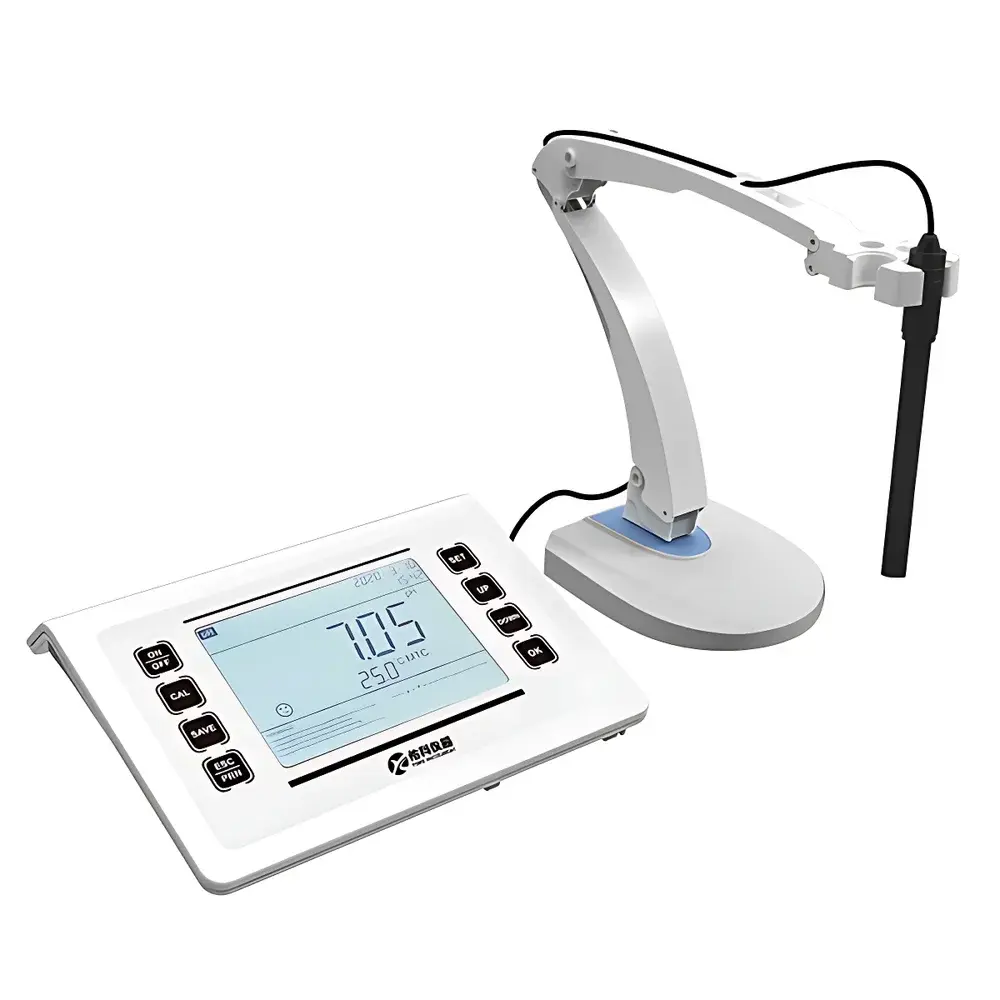
Yoke P912 Benchtop Conductivity Meter
| Brand | Yoke |
|---|---|
| Origin | Shanghai, China |
| Manufacturer Type | Direct Manufacturer |
| Instrument Type | Benchtop Conductivity Meter |
| Model | P912 |
| Measurement Parameters | Single-parameter (Conductivity/TDS/Resistivity/Salinity/Temp) |
| Form Factor | Benchtop |
| Intended Use | Laboratory |
| Conductivity Range | 0–2000 mS/cm (6 auto-ranging segments) |
| TDS Range | 0–100 g/L |
| Resistivity Range | 0–100 MΩ·cm |
| Salinity Range | 0–100 ppt |
| Temperature Range | 0–100 °C |
| Accuracy | ±0.5% FS (instrument), ±0.8% FS (with electrode) |
| Resolution | 0.01 / 0.1 / 1 µS/cm |
| Temperature Resolution | 0.1 °C |
| Temp Accuracy | ±0.5 °C |
| Data Storage | 2000 sets |
| Connectivity | USB-A port, micro-USB service port, optional Bluetooth 4.2 module |
| Enclosure Rating | IP54 |
| Power Supply | 12 V DC, 1 A (universal 110–220 V AC, 50/60 Hz adapter) |
| Dimensions | 160 × 190 × 70 mm |
| Weight | 880 g |
Overview
The Yoke P912 Benchtop Conductivity Meter is a precision-engineered, single-parameter electrochemical analyzer designed for routine and quality-controlled conductivity, total dissolved solids (TDS), resistivity, and salinity measurements in regulated laboratory environments. It operates on the principle of two-electrode AC conductometric measurement using a fixed-cell-constant (K = 1.0 cm⁻¹) conductivity sensor, enabling high reproducibility across six auto-ranging conductivity segments—from ultrapure water (0.00–20.00 µS/cm) to highly conductive industrial brines (200–2000 mS/cm). The instrument implements automatic temperature compensation (ATC) based on the widely adopted linear or non-linear (polynomial) algorithms per ISO 7888 and ASTM D1125, ensuring traceable accuracy across its full 0–100 °C operational range. Its architecture complies with core GLP (Good Laboratory Practice) requirements, supporting audit-ready workflows through timestamped data logging, calibration history retention, and system diagnostics.
Key Features
- 6.5-inch high-visibility LED display with intuitive icon-based navigation and real-time parameter overlay (conductivity, TDS, resistivity, salinity, temperature)
- Industrial-grade Omron tactile push-button interface rated for ≥100,000 actuations, optimized for gloved operation in QC labs
- Auto-ranging conductivity measurement across six decades (0.00 µS/cm to 2000 mS/cm), with selectable resolution (0.01 / 0.1 / 1 µS/cm or mS/cm)
- Integrated temperature sensor (±0.5 °C accuracy) with configurable ATC modes: linear (α = 2.0 %/°C default) or polynomial for non-aqueous or high-ionic-strength samples
- GLP-compliant data management: 2000 measurement records stored internally with date/time stamp, electrode ID, calibration status, and ambient temperature
- USB-A host port for direct export to USB flash drives; exported CSV files are natively compatible with Microsoft Excel, LibreOffice Calc, and LIMS ingestion pipelines
- Automatic recognition of eight standard conductivity solutions—dual-standard library support (US/NIST-traceable series and GB/T 6682–2008 Chinese series)
- Optional Bluetooth 4.2 module enables wireless printing to certified thermal printers and secure point-to-point data transfer to Windows/macOS PCs or Android/iOS devices via YokeLink companion software
- IP54-rated enclosure ensures resistance to dust ingress and water splashes during daily benchtop use in humid or reagent-handling environments
Sample Compatibility & Compliance
The P912 is validated for aqueous matrices including deionized water, boiler feedwater, wastewater effluents, pharmaceutical buffers (e.g., USP Purified Water, WFI), food & beverage extracts, and electroplating baths. It supports electrode configurations compliant with IEC 60746-3 for conductivity sensors and meets mechanical safety requirements per IEC 61010-1 (2010). While not FDA 21 CFR Part 11–certified out-of-the-box, its immutable audit trail (calibration logs, user actions, timestamps) and exportable raw data enable validation under GMP/GLP frameworks when deployed with documented SOPs. Calibration verification follows ISO/IEC 17025 principles, and all factory calibrations are traceable to NIM (National Institute of Metrology, China) standards.
Software & Data Management
Data acquisition and reporting are fully scriptable via USB mass-storage mode—no proprietary drivers required. Each saved record includes: measurement value, unit, temperature at time of reading, electrode serial number, calibration date, operator ID (manually entered), and system diagnostic flags. The internal clock maintains time integrity across power cycles. Optional Bluetooth connectivity allows remote configuration and live streaming of readings into third-party SCADA or ELN platforms via RFCOMM serial emulation. Firmware updates are delivered via signed .bin files over USB, preserving cryptographic integrity.
Applications
- Pharmaceutical water system monitoring (PW, WFI) per USP and EP 2.2.38
- Environmental lab analysis of surface water, groundwater, and wastewater per EPA Method 120.1 and ISO 7888
- Food & beverage QA/QC: conductivity profiling of dairy streams, brewing wort, and juice concentrates
- Academic teaching labs for fundamental electrochemistry experiments and calibration theory instruction
- Electronics manufacturing: rinse water purity verification in PCB cleaning lines
- Power generation: condensate and steam cycle purity assurance
FAQ
Does the P912 support multi-point conductivity calibration?
No—it uses a single-point calibration method optimized for K = 1.0 cm⁻¹ electrodes, sufficient for full-range accuracy per ISO 7888 when performed with certified reference standards.
Can the instrument store calibration curves for multiple electrodes?
Yes—up to four electrode profiles can be registered and recalled by ID, each retaining individual calibration date, slope, offset, and cell constant.
Is the Bluetooth module pre-installed or field-upgradeable?
The Bluetooth 4.2 module is an optional factory-installed accessory; retrofitting post-purchase requires authorized service due to antenna integration and firmware binding.
What file format is used for exported data?
CSV (comma-separated values) with UTF-8 encoding, including header rows and ISO 8601 timestamps (YYYY-MM-DD HH:MM:SS).
How is temperature compensation applied during resistivity calculation?
Resistivity is derived inversely from conductivity and temperature-corrected using the same polynomial algorithm selected for conductivity mode, ensuring thermodynamic consistency across all derived parameters.






