
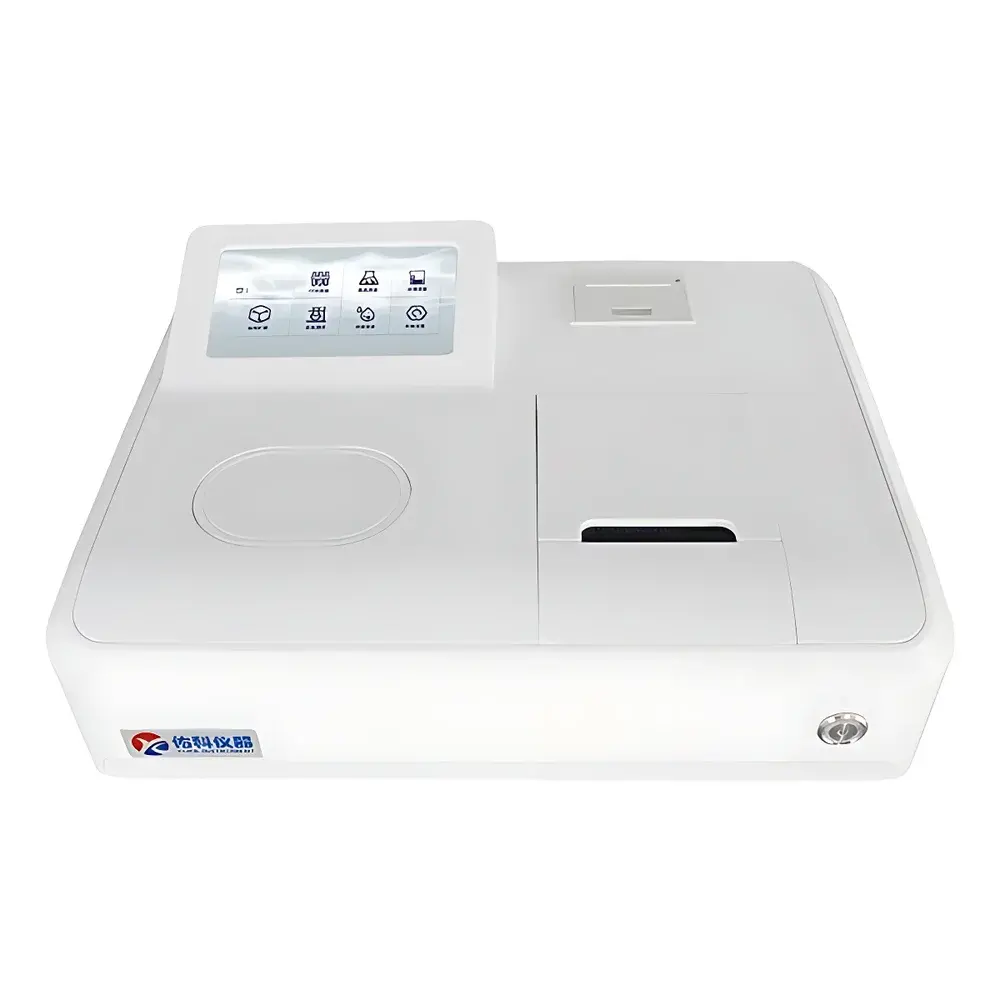
Yoke IT-1002 Ammonia Nitrogen Analyzer
| Brand | Yoke |
|---|---|
| Origin | Shanghai, China |
| Manufacturer Type | Direct Manufacturer |
| Product Category | Domestic |
| Model | IT-1002 |
| Instrument Type | Laboratory Benchtop Analyzer |
| Measurement Principle | Colorimetric Method (Nessler Reagent Spectrophotometry) |
| Measurement Range | 0.05–100 mg/L (multi-range segmented calibration) |
| Accuracy | ≤8% RSD |
| Measurement Time | 15–20 minutes per batch |
| Batch Capacity | 20 samples |
| Display | 5.6-inch color capacitive touchscreen |
| Data Storage | ≥5000 records (5 factory curves + 195 user-expandable curves) |
| Light Source | Cold LED with narrow-band interference filters (rated lifetime: 100,000 hours) |
| Processor | ARM9 core |
| Internal Memory | 512 MB |
| Connectivity | USB 2.0 port, RS-232 serial interface |
| Printer | Integrated thermal printer |
| Compliance Standard | HJ 535–2009 (Chinese EPA Standard for Ammonia Nitrogen in Water) |
Overview
The Yoke IT-1002 Ammonia Nitrogen Analyzer is a dedicated benchtop photometric instrument engineered for precise, reproducible quantification of ammonia nitrogen (NH₃-N) in environmental water samples—including surface water, groundwater, wastewater effluent, and treated drinking water. It operates on the Nessler reagent spectrophotometric method, as standardized in HJ 535–2009, wherein ammonia reacts with alkaline iodomercuric potassium iodide to form a yellow colloidal complex. Absorbance is measured at 420 nm using a stable cold LED light source and precision narrow-band optical filtering, ensuring high photometric stability and minimal spectral interference. Designed for routine laboratory use, the IT-1002 delivers robust performance under variable ambient conditions while maintaining traceability to national regulatory protocols.
Key Features
- 5.6-inch high-resolution color capacitive touchscreen with intuitive GUI navigation—optimized for glove-compatible operation and rapid method selection.
- Dual-mode calibration architecture: pre-loaded with 5 factory-certified calibration curves and expandable up to 195 user-defined curves for multi-matrix adaptation (e.g., saline, turbid, or colored waters).
- Segmented range measurement (0.05–100 mg/L NH₃-N) with automatic range switching and K-factor adjustment—enabling accurate low-level detection and high-concentration quantification without manual dilution.
- Integrated thermal printer supporting on-demand reporting of real-time results, historical data, and calibration logs—reducing transcription errors and streamlining audit preparation.
- Cold LED illumination system with <1 nm bandwidth interference filters and 100,000-hour rated lifetime—eliminating lamp drift, warm-up delays, and mercury-based hazards associated with traditional tungsten/halogen sources.
- ARM9-based embedded computing platform with 512 MB internal memory—supporting fast data processing, multi-parameter analysis (COD, total phosphorus, turbidity, etc.), and secure local storage of ≥5000 test records with timestamp, operator ID, and method version metadata.
- Comprehensive connectivity suite: USB 2.0 host port for flash drive export and firmware updates; RS-232 serial interface for integration into LIMS or centralized lab automation systems.
Sample Compatibility & Compliance
The IT-1002 is validated for use with clarified, filtered, or centrifuged aqueous matrices compliant with HJ 535–2009 sample pretreatment requirements. It accommodates standard 10–25 mm round cuvettes and supports compatibility with commercially available Lab-yy pre-dosed Nessler reagent kits—minimizing pipetting steps, reducing analyst exposure, and improving inter-laboratory reproducibility. All measurement workflows adhere to QA/QC principles outlined in ISO/IEC 17025:2017 for testing laboratories. While not FDA 21 CFR Part 11–certified out-of-the-box, the instrument’s audit-ready data structure (including immutable timestamps, user authentication logs, and version-controlled curve libraries) provides foundational traceability required for GLP and GMP-aligned environmental monitoring programs.
Software & Data Management
Data handling is managed via an embedded Linux-based OS with proprietary firmware. Each stored record includes sample ID, measurement date/time, operator code, selected calibration curve, raw absorbance value, calculated concentration, and pass/fail status against user-defined QC limits. Export formats include CSV and PDF—compatible with Excel, LabWare LIMS, and ELN platforms. USB mass storage mode enables drag-and-drop transfer of datasets without proprietary software. Firmware updates are delivered via signed binary packages, preserving cryptographic integrity. No cloud dependency or external subscription is required—ensuring full data sovereignty and compliance with institutional IT security policies.
Applications
- Regulatory compliance monitoring for municipal wastewater treatment plants (WWTPs) under China’s “Discharge Standards of Pollutants for Municipal Wastewater Treatment Plants” (GB 18918–2002).
- Environmental impact assessment (EIA) field labs conducting surface water quality surveys in rivers, lakes, and reservoirs.
- Drinking water utilities performing source water and finished water verification per GB 5749–2022.
- Educational laboratories teaching analytical chemistry fundamentals, including Beer–Lambert law validation and method validation parameters (LOD, LOQ, linearity, recovery).
- Industrial pretreatment facilities monitoring effluent prior to municipal sewer discharge.
FAQ
Does the IT-1002 support ASTM D1426 or ISO 7150-1 methods?
It is configured exclusively for HJ 535–2009; however, method equivalence can be established through comparative validation per ISO/IEC 17025 Annex B.
Can the instrument store custom calibration curves for non-ammonia parameters?
Yes—up to 195 user-defined curves may be imported or generated in situ for COD, total phosphorus, nitrate, and other compatible colorimetric assays.
Is thermal printer paper included with the unit?
A starter roll (57 mm width, 30 m length) is supplied; replacement rolls meet ISO 24711 specifications and are widely available from industrial consumables vendors.
What is the recommended maintenance interval for optical alignment?
No periodic optical recalibration is required; the fixed-pathlength cuvette holder and stable LED source ensure long-term photometric consistency—verified during annual performance qualification (PQ) per SOP.
How does the IT-1002 handle turbid or colored samples?
Turbidity compensation is achieved via dual-wavelength subtraction (420 nm/700 nm); users may also apply matrix-matched blanking or adopt HJ 535–2009’s recommended distillation pretreatment for highly interfering matrices.
Related Products







