
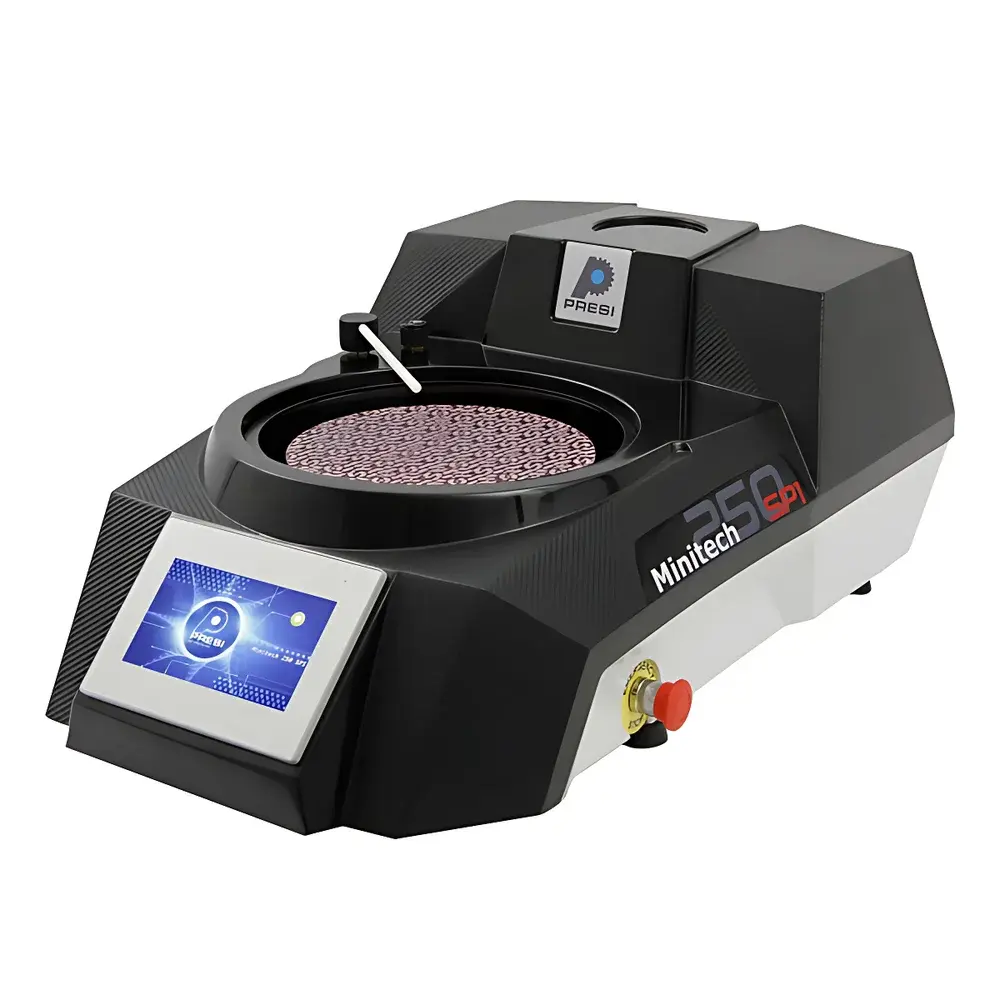
PRESI MINITECH 250 SP1 Manual Single-Disc Grinding and Polishing Machine
| Brand | PRESI |
|---|---|
| Origin | France |
| Model | MINITECH 250 SP1 |
| Disc Diameter | Ø200 mm or Ø250 mm |
| Speed Range | 20–700 rpm |
| Motor Power | 750 W |
| Dimensions (L×W×D) | 510 × 810 × 330 mm |
| Disc Quantity | 1 |
| Rotation Direction | Clockwise or Counterclockwise |
| Timing Mode | Forward/Reverse Countdown |
| Display | 7-inch color LCD touchscreen |
| Pressure Feedback | Real-time manual load indication |
| Safety | Dual emergency stop buttons, IP-rated enclosure, splash guard, tilted base with drainage |
Overview
The PRESI MINITECH 250 SP1 is a precision-engineered manual single-disc grinding and polishing machine designed for reproducible metallographic and materialographic sample preparation in academic, industrial, and quality control laboratories. Operating on the principle of controlled mechanical abrasion—where rotational kinetic energy, user-applied axial load, and abrasive media interact to progressively remove material—the MINITECH 250 SP1 delivers consistent surface conditioning across diverse specimen types including metals, ceramics, composites, and geological specimens. Its core architecture integrates a high-torque 750 W motor coupled with a vector-controlled frequency inverter, ensuring stable speed and torque output across the full 20–700 rpm range—even under variable manual loading conditions. Unlike automated systems, this manual platform emphasizes operator engagement and tactile process control, making it especially suited for R&D environments where iterative protocol development, small-batch validation, or failure analysis requires real-time adjustment of pressure, dwell time, and media selection.
Key Features
- Vector-controlled inverter drive for precise, load-compensated speed regulation—critical for maintaining consistent removal rates during manual grinding.
- Real-time manual load display via integrated force sensor: provides immediate visual feedback of applied axial pressure (in kgf or N), enabling inter-operator standardization and reducing subjectivity in manual preparation.
- 7-inch full-color LCD touchscreen interface mounted at ergonomic front-panel height: supports intuitive configuration of rotation direction (CW/CCW), timing mode (forward count-up or reverse countdown), water valve activation, and disc dry-spin function.
- Tilted stainless-steel base with integrated drainage channel and splash guard: prevents fluid accumulation around critical mechanical components and facilitates rapid cleanup between protocols.
- Elevated main shaft bearing housing with sealed IP54-rated protection: minimizes risk of coolant ingress and extends service life under high-humidity or wet-grinding conditions.
- Removable polymer composite support bowl: chemically inert, corrosion-resistant, and autoclavable—designed for long-term compatibility with acidic, alkaline, or solvent-based slurries.
- Dual redundant emergency stop buttons (left/right side): compliant with EN ISO 13850 and IEC 60204-1 safety standards for machinery.
- Disc dry-spin function: automatically rotates the platen at elevated speed post-cycle to centrifugally remove residual water, slurry, or lubricant from abrasive papers or polishing cloths—reducing drying time and preventing microbial growth during storage.
Sample Compatibility & Compliance
The MINITECH 250 SP1 accommodates specimens up to Ø50 mm (standard) or Ø75 mm (with optional holders), supporting both flat and slightly contoured surfaces. It is routinely deployed for ASTM E3, ISO 13009, and EN 10360-compliant metallographic preparation—including cross-sectioning welds, evaluating grain structure in aerospace alloys, and assessing coating adhesion in automotive components. The system’s manual operation allows direct adaptation to non-standard geometries (e.g., irregular castings, brittle ceramics, or embedded electronic substrates) where automated clamping may induce fracture or edge rounding. All electrical and mechanical subsystems conform to CE marking requirements (2014/30/EU EMC Directive, 2014/35/EU Low Voltage Directive), and its construction materials meet RoHS 2011/65/EU restrictions on hazardous substances.
Software & Data Management
While the MINITECH 250 SP1 operates without proprietary PC software, its embedded firmware supports hierarchical parameter management via password-protected access levels (Operator / Supervisor). Supervisors can predefine and lock critical protocols—including speed profiles, directional sequences, and timed steps—to enforce adherence to internal SOPs or external standards such as ISO/IEC 17025. All parameter changes, runtime logs, and emergency stop events are timestamped and stored locally in non-volatile memory for audit trail generation. Though not FDA 21 CFR Part 11-compliant out-of-the-box, the system is compatible with third-party laboratory information management systems (LIMS) via RS-232 or optional USB-to-serial interfaces for integration into GLP/GMP workflows requiring traceability.
Applications
- Metallographic specimen preparation for optical and electron microscopy (SEM/TEM cross-sections).
- Quality assurance of sintered powder metallurgy parts and additive-manufactured components.
- Failure analysis of fractured turbine blades, bearing races, and rail steel sections.
- Preparation of ceramic matrix composites (CMCs) and refractory materials prior to hardness testing (Vickers/Knoop).
- Geological thin-section production for petrographic analysis under polarized light.
- Surface finish evaluation of electroplated coatings, PVD/CVD layers, and thermal spray deposits.
FAQ
What disc sizes are supported by the MINITECH 250 SP1?
The machine accepts either Ø200 mm or Ø250 mm grinding/polishing discs—user-selectable at installation; no hardware modification required.
Is the pressure feedback system calibrated and traceable?
Yes—the load sensor is factory-calibrated against NIST-traceable reference masses and includes a built-in verification routine accessible via supervisor mode.
Can the unit be integrated into a networked lab environment?
It does not feature Ethernet or Wi-Fi, but serial communication (RS-232) enables connection to centralized control stations or data loggers for batch-level reporting.
What maintenance intervals are recommended?
Bearing inspection every 1,500 operating hours; belt replacement every 3,000 hours; touchscreen calibration annually or after impact exposure.
Does the machine support automatic media recognition or RFID tagging?
No—media identification remains manual; however, the touchscreen allows labeling of saved protocols with media type (e.g., “SiC P180 → Al₂O₃ 3µm → Diamond 1µm”) for procedural clarity.



