
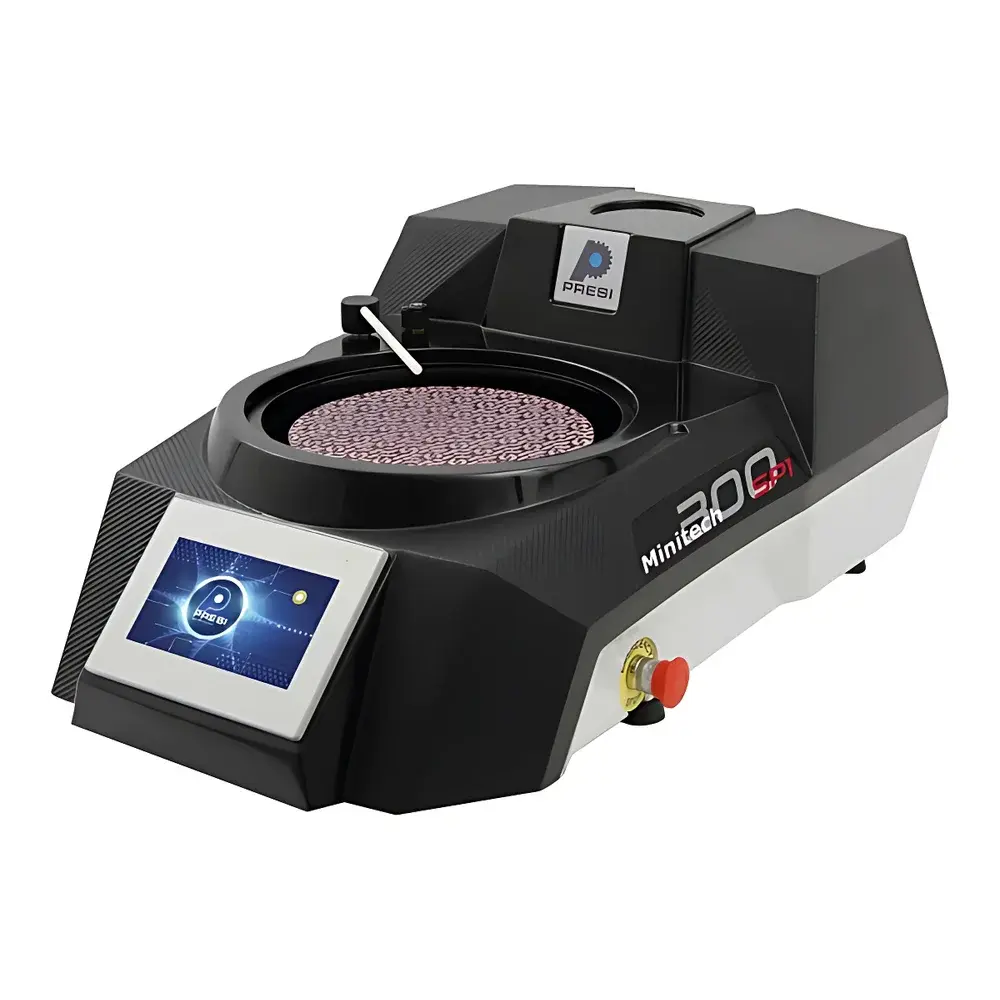
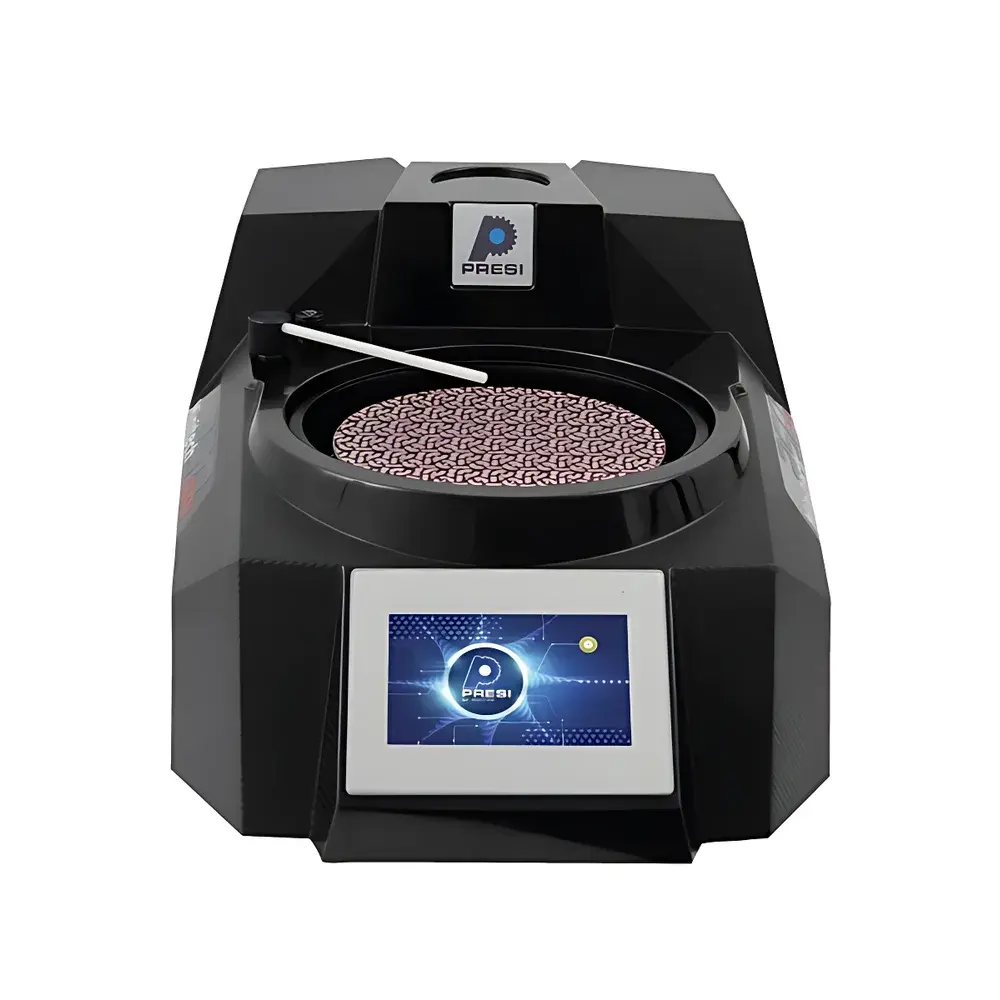
PRESI MINITECH 300 SP1 Manual Single-Disc Grinding and Polishing Machine
| Brand | PRESI |
|---|---|
| Origin | France |
| Model | MINITECH 300 SP1 |
| Motor Power | 900 W |
| Disc Diameter Options | Ø250 mm or Ø300 mm |
| Speed Range | 20–700 rpm |
| Dimensions (L×W×D) | 620 × 875 × 330 mm |
| Number of Grinding/Polishing Discs | 1 |
| Display | 7-inch color LCD touchscreen |
| Real-time load feedback | Yes |
| Safety | Dual emergency stop buttons |
| Base design | Tilted chassis with splash ring and elevated spindle bearing housing |
| Sample holder bowl | Removable polymer bowl, corrosion-resistant and cleanable |
| Spin-dry function | Yes |
| Software | Password-protected parameter management with user-level access control |
Overview
The PRESI MINITECH 300 SP1 is a precision-engineered manual single-disc grinding and polishing machine designed for consistent, reproducible metallographic and materialographic sample preparation in academic, industrial, and quality control laboratories. Built upon a robust mechanical architecture and integrated digital control system, it operates on the principle of controlled abrasive contact between rotating disc-mounted consumables (grinding papers, diamond discs, polishing cloths) and manually positioned specimens under operator-applied load. Its variable-speed AC motor—driven via vector-controlled frequency inverter—ensures stable torque delivery across the full 20–700 rpm operating range, critical for optimizing material removal rates and surface finish across diverse specimen geometries and hardness levels (e.g., steels, ceramics, composites, geological samples). Unlike fully automated systems, the MINITECH 300 SP1 preserves direct tactile feedback while augmenting process repeatability through real-time load monitoring and programmable operational parameters.
Key Features
- 900 W high-torque motor with vector-controlled inverter for constant speed and torque stability—even under variable load conditions typical of manual grinding.
- Real-time digital load display (in Newtons or kg-force equivalent) provides immediate visual feedback of operator-applied pressure, enabling precise load calibration and inter-operator consistency.
- 7-inch full-color LCD touchscreen interface located at ergonomic front panel height; supports intuitive navigation for setting rotational speed, direction (CW/CCW), water valve activation, timer-based operation, and spin-dry cycle initiation.
- Password-protected hierarchical software architecture allows lab managers to define, lock, and audit standard operating procedures (SOPs); user roles can be assigned with restricted editing rights to prevent unauthorized parameter changes.
- Tilted base chassis facilitates rapid drainage of coolant/lubricant fluids away from critical components; spindle bearing housing is elevated above the base plane to minimize fluid ingress risk.
- Integrated splash ring and removable polymer sample support bowl—chemically inert, non-corrosive, and autoclavable—enhance hygiene, simplify cleaning, and reduce cross-contamination during multi-material workflows.
- Automated spin-dry function engages post-cycle to remove residual moisture from abrasive papers, diamond discs, or polishing cloths—extending consumable life and preventing mold or adhesive degradation during storage.
- Dual emergency stop buttons mounted on left and right side panels comply with EN ISO 13850:2015 requirements for accessible, fail-safe shutdown in laboratory environments.
Sample Compatibility & Compliance
The MINITECH 300 SP1 accommodates specimens up to Ø300 mm in diameter when used with the optional Ø300 mm disc configuration, and supports standard mounting techniques including hot-press resin embedding, cold-mounting, and direct clamping. It is compatible with all major consumable formats: silicon carbide papers (SiC), alumina and diamond suspension-based polishing cloths, colloidal silica suspensions, and electrochemical polishing electrolytes (when used with appropriate containment). The system meets CE marking requirements per Machinery Directive 2006/42/EC and Electromagnetic Compatibility Directive 2014/30/EU. Its mechanical design and operational logic align with ASTM E3-22 (Standard Guide for Preparation of Metallographic Specimens) and ISO 16349:2014 (Metallographic specimen preparation — Grinding and polishing). While not inherently GLP/GMP-certified, its password-protected parameter logging and repeatable manual protocol execution support traceability in regulated environments where SOP adherence is audited.
Software & Data Management
The embedded firmware enables persistent storage of up to 20 user-defined protocols—including speed profiles, duration settings, directional preferences, and fluid control states—with timestamped execution logs accessible via USB export. No cloud connectivity or proprietary database is required; all data resides locally on the device’s internal flash memory. Audit trail functionality records user ID (via login), parameter modifications, and cycle start/stop timestamps—supporting compliance with internal quality systems and facilitating root-cause analysis during failure investigations. Exported .csv log files are compatible with common laboratory information management systems (LIMS) and statistical process control (SPC) platforms. Firmware updates are delivered via USB stick and validated using SHA-256 checksum verification to ensure integrity.
Applications
This instrument serves as a foundational tool in metallurgical laboratories for preparing cross-sections of welds, heat-affected zones, and coated substrates prior to optical microscopy (OM), scanning electron microscopy (SEM), or energy-dispersive X-ray spectroscopy (EDS) analysis. It is routinely deployed in failure analysis labs for evaluating fatigue cracks, corrosion pitting, and intergranular attack in aerospace alloys and power-generation components. In geoscience applications, it enables planar polishing of rock thin sections and mineral aggregates without inducing relief artifacts. Quality assurance teams in automotive and additive manufacturing facilities use it to validate powder bed fusion layer bonding integrity and porosity distribution. Its manual control paradigm remains preferred for low-volume, high-mix sample batches where rapid setup flexibility outweighs the throughput advantage of automated multi-station systems.
FAQ
Is the MINITECH 300 SP1 suitable for both grinding and polishing stages?
Yes—it supports interchangeable consumables across coarse grinding (e.g., SiC papers), fine grinding (diamond-impregnated discs), and final polishing (napless cloths with colloidal silica), all within a single disc station.
Can the machine be integrated into a networked lab environment?
No native Ethernet or Wi-Fi interface is provided; however, USB-exported logs may be ingested into centralized LIMS or MES platforms via standard file transfer protocols.
What maintenance intervals are recommended for the spindle bearings?
PRESI specifies inspection and re-lubrication every 1,500 operational hours or annually—whichever occurs first—using ISO VG 68 synthetic gear oil.
Does the system support automatic water flow control based on rotation?
Water valve activation is manually triggered or timer-controlled; no pressure-sensor–based closed-loop flow regulation is included in this model.
Are replacement touchscreens or firmware update packages available directly from PRESI?
Yes—authorized distributors provide certified spare parts and verified firmware releases aligned with the latest CE-compliant revisions.



