
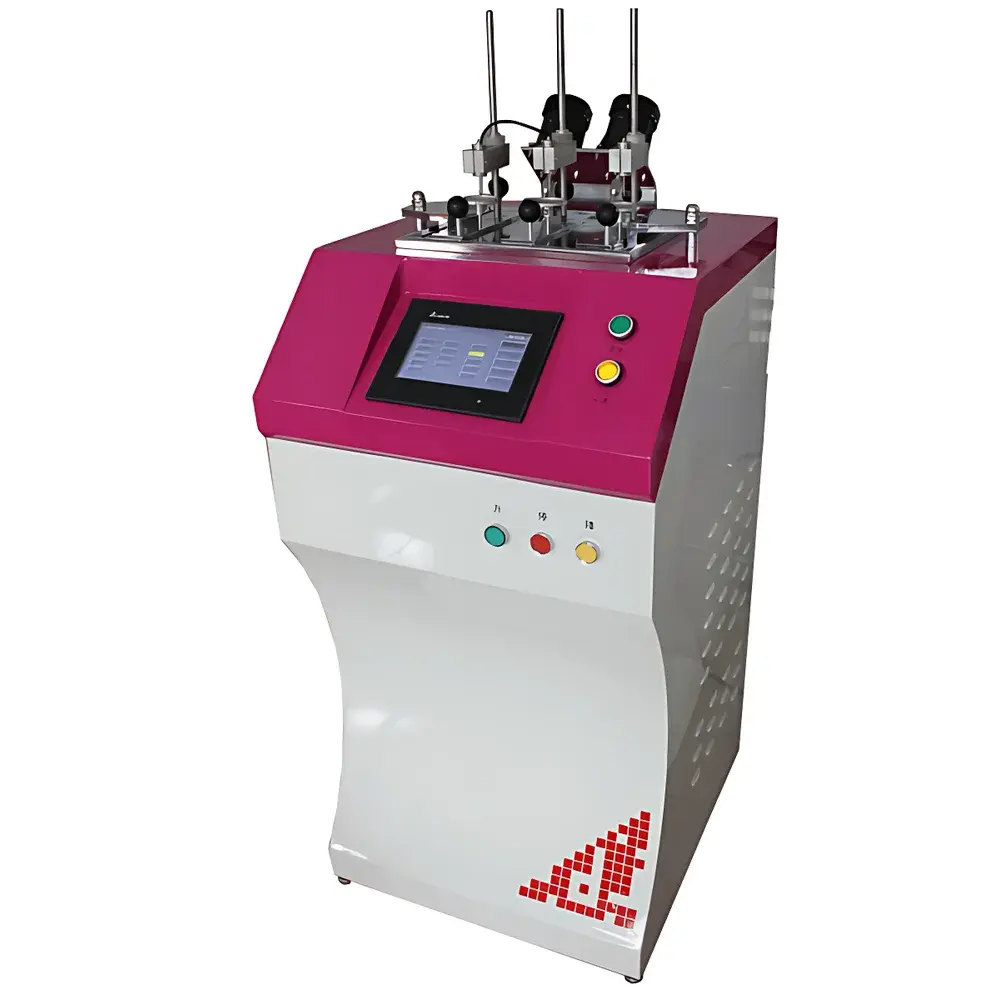
TianYuan TY-5006UB Heat Deflection Temperature (HDT) and Vicat Softening Point (VSP) Tester
| Brand | TianYuan |
|---|---|
| Origin | Jiangsu, China |
| Manufacturer Type | Direct Manufacturer |
| Country of Origin | China |
| Model | TY-5006UB |
| Temperature Control Range | RT–300 °C |
| Heating Rate Options | (120±10) °C/h, (12±1) °C/6 min, (50±5) °C/h, (5±0.5) °C/6 min |
| Temperature Accuracy | ±0.1 °C |
| Deflection Measurement Range | 0–1.5 mm |
| Deflection Resolution | ±0.001 mm |
| Sample Support Span | 64 mm or 100 mm |
| Thermal Expansion Coefficient of Sample Holder | <0.005 mm/100 °C |
| Heating Medium | Methyl Silicone Oil (200 cSt) or Transformer Oil |
| Heating Power | 2.4 kW |
| Dimensions | 540 mm × 520 mm × 970 mm |
| Test Stations | 3 independent stations |
| Load Rod Mass | 60 g (W-code) |
| Standard Weights | A (1000 g ×12), B (900 g ×3), C (500 g ×3), D (200 g ×6), E (100 g ×3), F (50 g ×3), G (20 g ×6), H (10 g ×3), I (5 g ×3), T (2 g ×6) |
Overview
The TianYuan TY-5006UB Heat Deflection Temperature (HDT) and Vicat Softening Point (VSP) Tester is a precision-engineered thermal characterization instrument designed for standardized evaluation of thermoplastic and thermosetting polymers under controlled mechanical load and thermal ramp conditions. It operates on two distinct ASTM/ISO-compliant test principles: (1) the Vicat Softening Temperature (VST) method, which measures the temperature at which a flat-ended needle penetrates 1 mm into a specimen under a defined axial load; and (2) the Heat Deflection Temperature (HDT) method, which determines the temperature at which a standardized cantilevered beam deflects by 0.25 mm under a specified flexural stress. These tests provide critical data for material selection, quality control, process validation, and regulatory compliance in polymer manufacturing, R&D laboratories, and third-party testing facilities.
Key Features
- Triple-station configuration enables concurrent testing of up to three specimens—maximizing throughput while maintaining inter-test consistency.
- Dual-mode thermal control system supports four programmable heating rates: (120±10) °C/h, (12±1) °C/6 min, (50±5) °C/h, and (5±0.5) °C/6 min—ensuring strict adherence to ASTM D1525, ISO 306, ASTM D648, and GB/T 1633–1634 series standards.
- High-stability temperature regulation with ±0.1 °C accuracy across the full 20–300 °C operating range, achieved via PID-controlled immersion heating in methyl silicone oil (200 cSt) or transformer oil.
- Integrated sample holder lifting mechanism allows precise vertical positioning before and after test cycles—eliminating manual handling errors and improving repeatability.
- Embedded real-time monitoring system based on ARM Cortex-M3 microcontroller (120 MHz, 32-bit) with 16-bit Σ-Δ ADC ensures noise-immune deformation acquisition and synchronized temperature–deflection logging.
- Comprehensive weight set (A–T codes) supports all standard VST and HDT load configurations per ISO 75-2, ASTM D648, and GB/T 1634.2—including 1.82 MPa and 0.45 MPa flexural stress levels—and accommodates both 64 mm and 100 mm support spans.
- Automated test termination, data archiving, and report generation—including printable deformation vs. temperature curves—reduce operator dependency and support GLP/GMP documentation requirements.
Sample Compatibility & Compliance
The TY-5006UB is validated for use with rigid and semi-crystalline thermoplastics (e.g., ABS, PC, PP, PA6/66), thermosets (e.g., epoxy, phenolic laminates), elastomers (hard rubber), fiber-reinforced composites, and electrically insulating materials. Its design conforms to multiple international and national standards: ISO 306 (VST), ISO 75-1/75-2/75-3 (HDT), ASTM D1525 and D648, GB/T 1633, GB/T 1634.1–1634.3, and GB/T 8802. All thermal and mechanical subsystems are calibrated traceable to NIST-equivalent reference standards. The instrument’s architecture supports audit-ready operation in regulated environments, including 21 CFR Part 11–compliant electronic record integrity when integrated with certified laboratory information management systems (LIMS).
Software & Data Management
The TY-5006UB employs an embedded PLC-based human-machine interface (HMI) with tactile keypad navigation and high-contrast LCD display. Real-time temperature and deflection values are continuously logged at user-defined intervals (default: 10 s) and stored in non-volatile memory. Post-test data export is supported via USB interface in CSV format for downstream analysis in Excel, MATLAB, or statistical process control (SPC) platforms. Built-in CRC-verified master–slave communication protocol ensures error-free data transfer between controller, sensor modules, and peripheral printers. Optional firmware updates maintain alignment with evolving standard revisions and add new test profiles without hardware modification.
Applications
- Quality assurance of incoming raw polymer pellets and compounded resins in automotive, electronics, and medical device supply chains.
- Thermal stability benchmarking during formulation development of flame-retardant, UV-stabilized, or reinforced polymeric compounds.
- Validation of processing parameters (e.g., injection molding temperature windows, annealing schedules) against end-use thermal performance thresholds.
- Regulatory submission support for ISO 9001, IATF 16949, and FDA 510(k) documentation packages requiring standardized HDT/VST evidence.
- Educational use in polymer science curricula for hands-on demonstration of viscoelastic transition behavior and structure–property relationships.
FAQ
What heating media are compatible with the TY-5006UB, and how is viscosity selected?
Methyl silicone oil (200 cSt) is recommended for full-range operation (RT–300 °C); transformer oil may be used for applications below 150 °C. Viscosity selection balances thermal conductivity, oxidation resistance, and low vapor pressure at elevated temperatures.
Does the instrument support automatic calibration verification?
Yes—the system includes built-in reference checks for temperature sensors (Pt100) and displacement transducers (digital micrometer), with calibration logs retained for audit purposes.
Can test data be exported to LIMS or ERP systems?
CSV export via USB enables seamless integration with external data management platforms. For direct network connectivity, optional RS-485 or Ethernet modules are available upon request.
Is the sample holder thermally compensated?
Yes—the support frame and load rod assembly feature a certified thermal expansion coefficient of <0.005 mm/100 °C, minimizing measurement drift across wide temperature ramps.
What safety features prevent overheating or uncontrolled thermal runaway?
Dual independent overtemperature cutoffs (hardware and firmware), oil-level detection, and automatic power-down upon test completion ensure operational safety and equipment longevity.




