
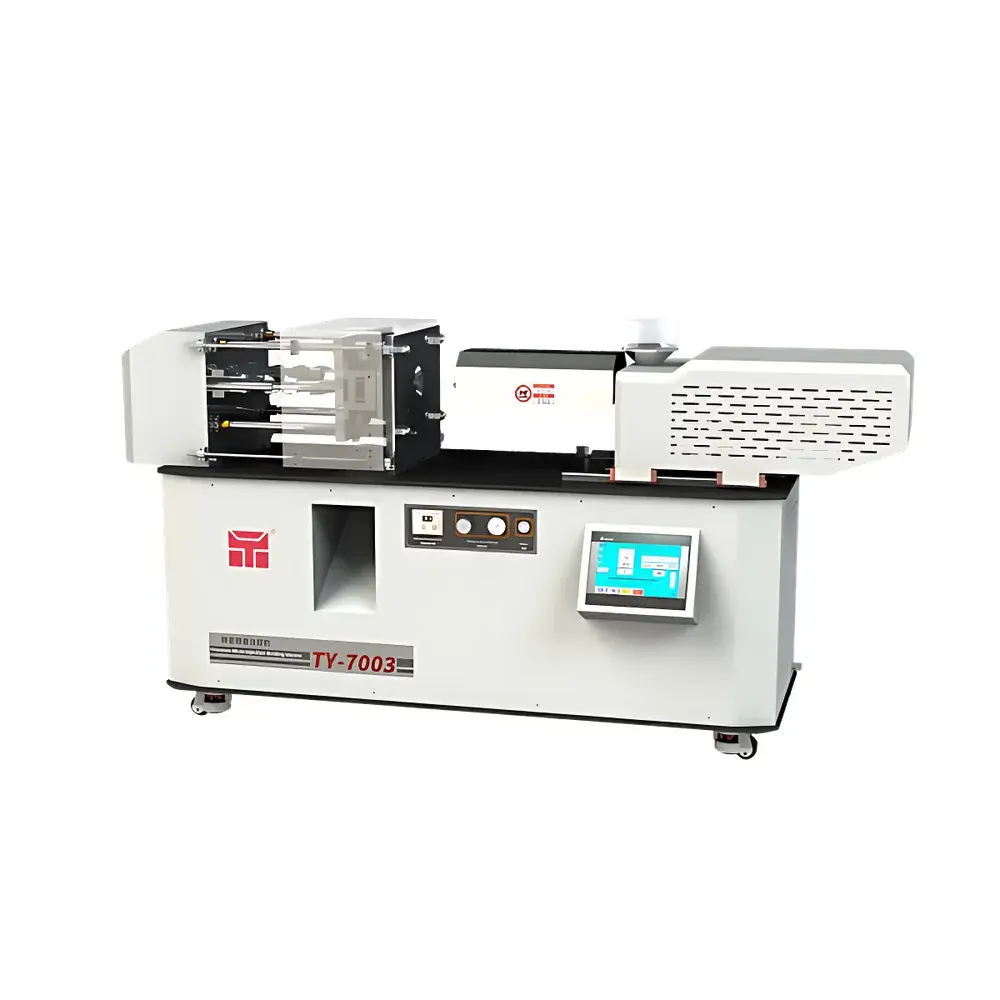
TianYuan TY-7003 Precision Micro Injection Molding Machine
| Brand | TianYuan |
|---|---|
| Origin | Jiangsu, China |
| Manufacturer Type | Direct Manufacturer |
| Region of Origin | Domestic (China) |
| Model | TY-7003 |
| Screw Diameter | 20 mm |
| Clamping Force | 3.6 T |
| Maximum Shot Volume | 25 cm³ |
| L/D Ratio | 1:20 |
| Overall Dimensions | 1700 × 500 × 950 mm |
| Heating Zone Max Temp | 360 °C (3-zone) |
| Temperature Control Accuracy | ±0.5 °C (steady-state) |
| Power Supply | Single-phase AC 220 V ±10%, 50 Hz, 2200 W |
| Injection Stroke Range | 0–80 mm |
| Injection Resolution | 0.1 mm |
| Plasticizing Speed | 0.1–60 rpm |
| Injection Force | ~1.8 T (up to 3.6 T with force-multiplying system) |
| Mold Opening Stroke | ~70 mm (excluding mold) |
| Mold Cavity Dimensions | 360 × 90 × 72 mm (L×W×H) |
| Tie-Bar Spacing | 280 × 186 mm (center-to-center) |
| Fixed Platen Ring OD | 50 mm |
| Hopper Torque | 105 N·m (servo motor + planetary gearbox) |
| Required Air Pressure | ≥0.8 MPa |
Overview
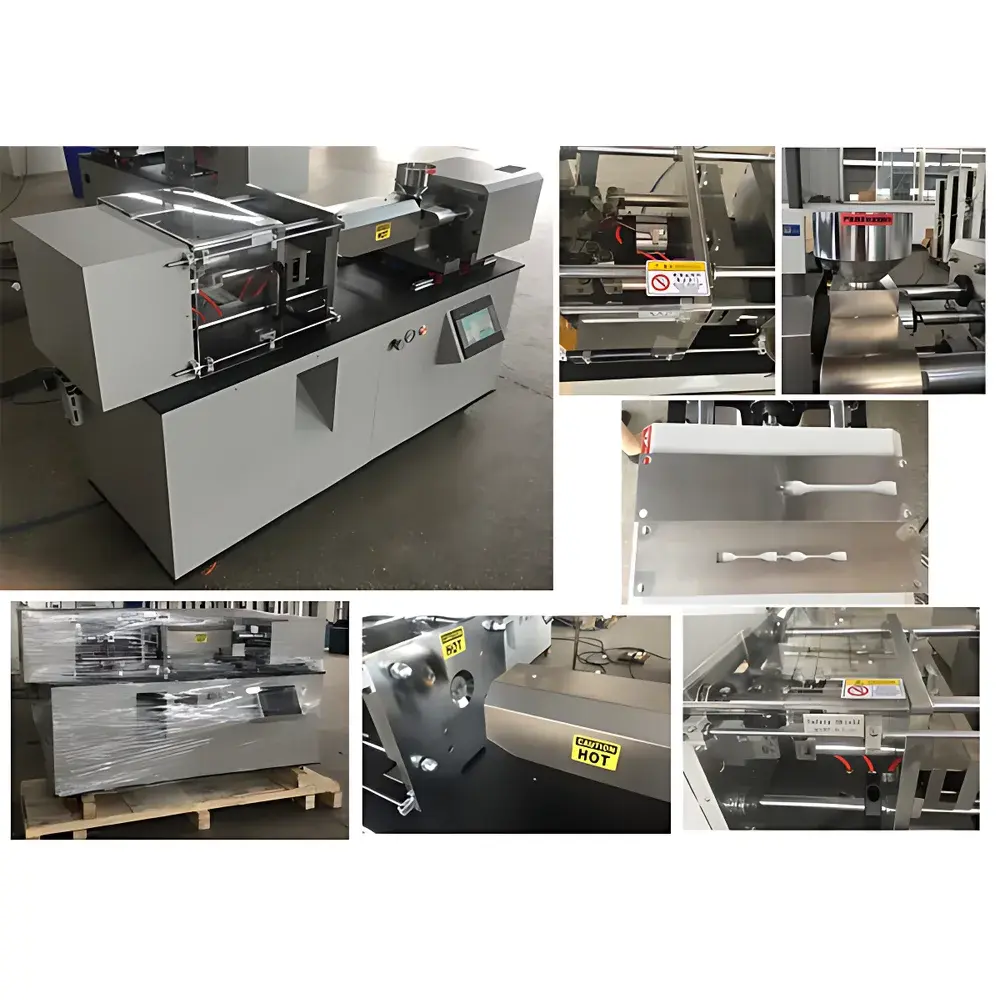
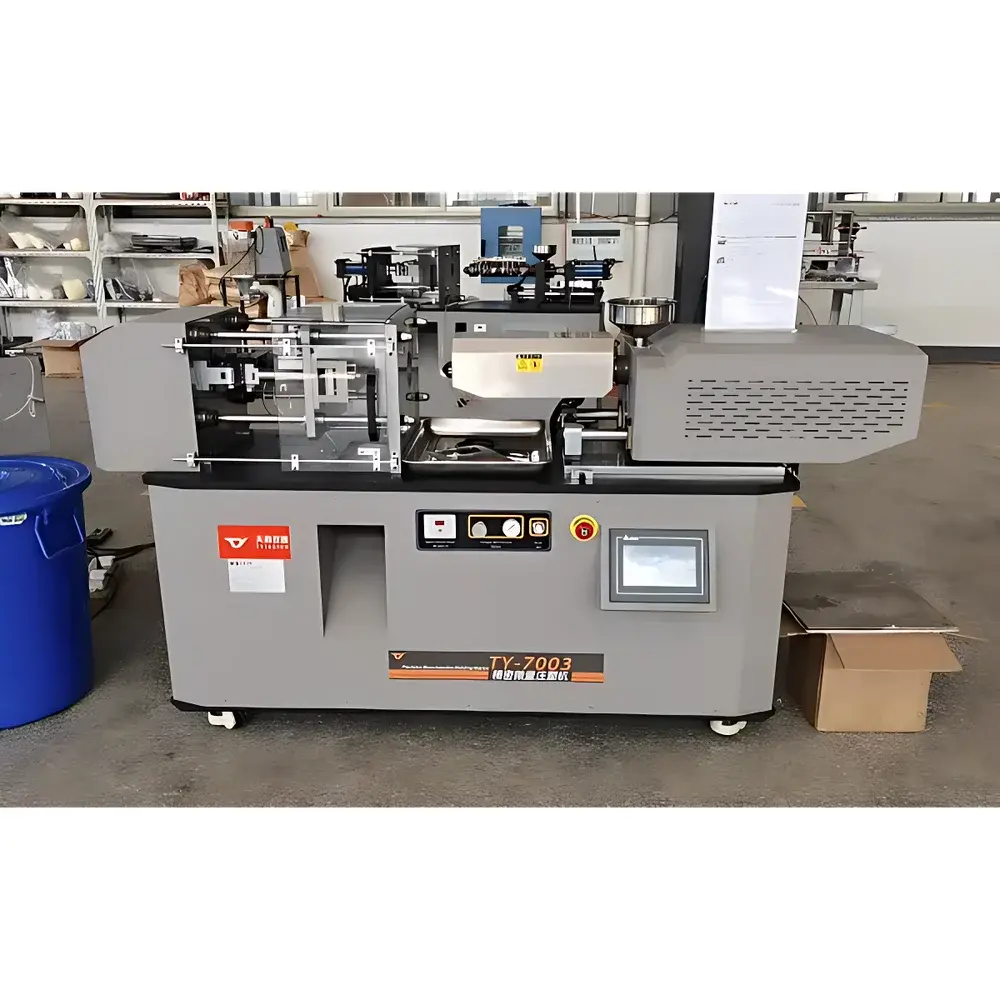
The TianYuan TY-7003 Precision Micro Injection Molding Machine is an engineered laboratory-scale platform designed for controlled thermoplastic processing under research-grade repeatability and thermal fidelity. Unlike industrial production machines, the TY-7003 implements a scaled-down yet fully functional injection molding architecture based on reciprocating screw technology—featuring a 20 mm diameter screw with a 1:20 length-to-diameter ratio, three independently controlled heating zones (up to 360 °C), and closed-loop temperature regulation with ±0.5 °C stability in steady-state operation. Its compact footprint (1700 × 500 × 950 mm) and single-phase 220 V AC power requirement enable deployment in academic labs, material development centers, and QC environments where access to three-phase industrial power or dedicated HVAC infrastructure is unavailable. The machine supports full process parameter logging—including plasticizing speed (0.1–60 rpm), injection stroke (0–80 mm at 0.1 mm resolution), clamping force (2 T standard, extendable to 3.6 T via mechanical leverage), and real-time pressure/temperature feedback—making it suitable for DOE-based polymer processing studies, small-batch prototype validation, and ASTM D3641-compliant tensile specimen fabrication.
Key Features
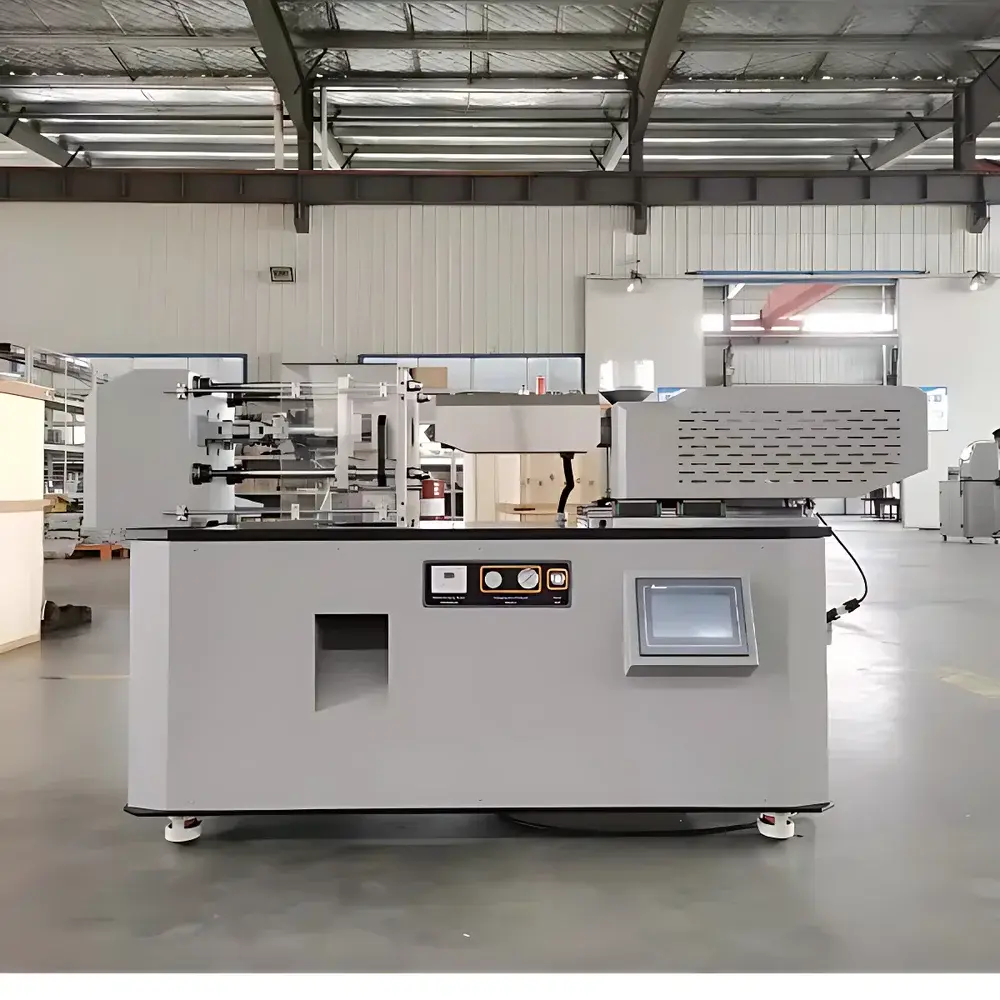
- Compact, mobile-ready design optimized for benchtop integration and classroom demonstration without requiring reinforced flooring or industrial utilities.
- Dual-protection safety architecture combining mechanical limit switches and electronic PLC-based interlocks compliant with IEC 61508 functional safety principles.
- Delta PLC controller with color touchscreen HMI featuring one-touch operational sequences (e.g., “Mold Close → Heat → Plasticize → Inject → Cool → Eject”) to minimize operator training time and procedural variability.
- Hybrid actuation system: servo-driven plasticization (105 N·m torque via Taiwan Sonko planetary gearbox) combined with pneumatic injection (≥0.8 MPa supply) and electro-mechanical clamping—eliminating hydraulic oil, noise, and heat dissipation concerns typical of larger systems.
- Thermal management with three-zone PID-controlled heaters (Omron SSRs) and embedded thermocouple feedback ensures uniform melt homogeneity across low-volume shots (0.1–25 cm³), critical for rheological consistency in micro-specimen production.
Sample Compatibility & Compliance
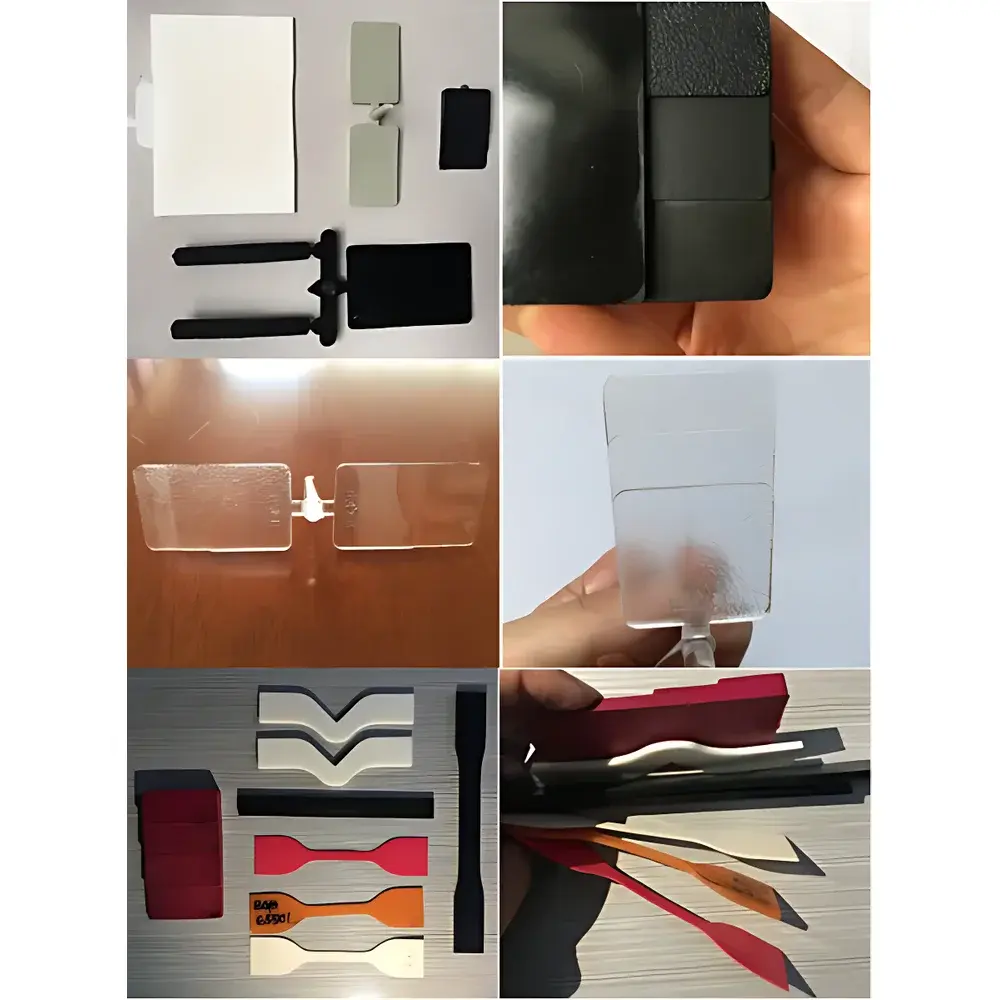
The TY-7003 accommodates a broad spectrum of engineering thermoplastics—including PP, PE, PA6/66, PVC, ABS, TPU, and biopolymers such as PLA—enabling formulation screening, additive dispersion studies, and thermal degradation profiling. Standard mold interface dimensions (360 × 90 × 72 mm cavity; 50 mm fixed platen ring OD; 280 × 186 mm tie-bar spacing) support ISO 527-2 and ASTM D638 Type I–V dumbbell molds, with optional quick-change modular tooling kits for rapid configuration switching. All electrical components meet CE marking requirements for low-voltage directive (2014/35/EU) and EMC directive (2014/30/EU). Firmware includes audit-trail-capable parameter logging aligned with GLP documentation practices, though formal 21 CFR Part 11 compliance requires optional third-party validation packages.
Software & Data Management
The integrated Delta DOP series HMI provides local data capture for cycle time, melt temperature, injection pressure profile, and screw position history. Exportable CSV logs (via USB port) retain timestamps and user IDs for traceability. While no cloud connectivity or remote monitoring is built-in, the PLC’s Modbus RTU interface allows integration into existing lab SCADA or LIMS platforms for centralized batch record aggregation. Firmware supports password-protected parameter groups to enforce SOP adherence—e.g., restricting novice users to pre-validated processing windows while granting advanced access to R&D personnel.
Applications
- Academic instruction in polymer processing fundamentals, including viscosity-shear rate relationships, thermal degradation onset analysis, and gate freeze behavior.
- Rapid prototyping of microfluidic device substrates, sensor housings, and medical component preforms (e.g., catheter hubs, micro-valve bodies) requiring sub-gram precision.
- Material qualification testing per ISO 1133 (melt flow rate correlation), ASTM D3835 (rheological property mapping), and UL 94 flame-retardant formulation screening.
- QC release testing for incoming resin lots using standardized tensile bars (ASTM D638) or impact specimens (ISO 179), minimizing material waste versus full-scale machines.
- Development of conductive or filled composites where shear-sensitive additives (e.g., carbon nanotubes, graphene flakes) require tightly constrained residence time and shear history.
FAQ
What is the minimum shot volume achievable with consistent repeatability?
Typical coefficient of variation (CV) for 5 cm³ shots is ≤1.2% (n=10) under stabilized thermal conditions; sub-2 cm³ shots are feasible but require optimized backpressure and dwell time calibration.
Can the machine process high-temperature polymers like PEEK or PEI?
Yes—the 360 °C maximum zone temperature and insulated barrel design support short-duration processing of semi-crystalline and high-Tg amorphous resins, though extended dwell times above 320 °C require periodic heater element inspection.
Is mold cooling integrated or externally supplied?
Cooling is external: the machine provides threaded ports (G1/4″) for connection to recirculating chillers or compressed-air blow-off manifolds; no internal water channels are present.
Does the system support multi-cavity or family molds?
Yes—provided total projected area remains within the 3.6 T clamping capacity and mold base dimensions conform to the 360 × 90 mm envelope; balance runner design must be verified for micro-scale flow symmetry.
What maintenance intervals are recommended for the servo-plasticizing system?
Gearbox lubrication every 1,000 operating hours; screw/barrel inspection every 5,000 cycles; thermocouple calibration verification annually or per ISO/IEC 17025-accredited lab schedule.
Related Products






