
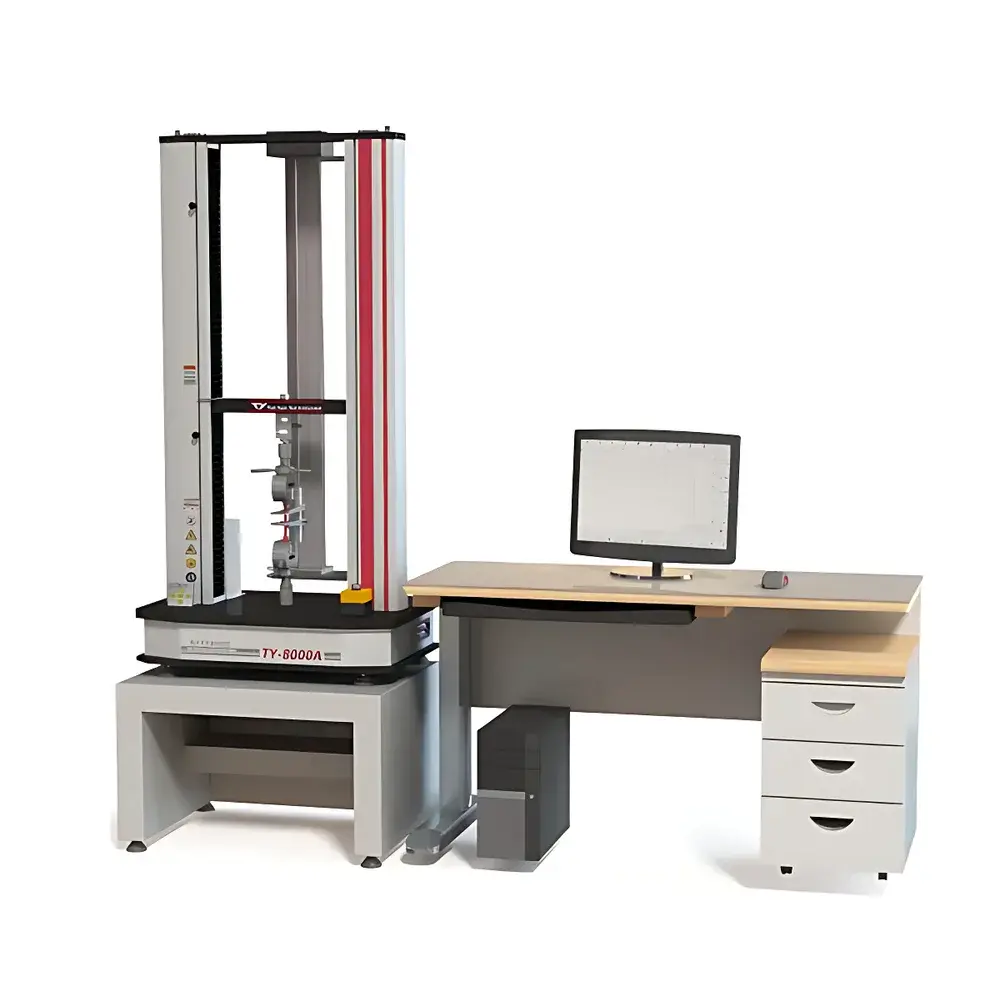
TianYuan TY8000-A 10 kN Electromechanical Universal Testing Machine
| Brand | TianYuan |
|---|---|
| Origin | Jiangsu, China |
| Manufacturer Type | Direct Manufacturer |
| Product Category | Domestic |
| Model | TY8000-A |
| Instrument Type | Electromechanical Universal Testing Machine |
| Load Capacity | 10 kN |
| Force Accuracy | ≤ ±0.5% FS |
| Force Resolution | 1/300,000 |
| Force Measurement Range | 0.4–100% FS |
| Displacement Resolution | 0.001 mm |
| Crosshead Speed Range | 0.001–1000 mm/min |
| Speed Accuracy | ≤ ±0.3% |
| Effective Width | 420 mm |
| Maximum Travel (Excl. Fixtures) | 1000 mm |
| Power Supply | 220 V AC, 50 Hz |
| Weight | 260 kg |
| Dimensions (W×D×H) | 800 × 500 × 1600 mm |
| Control System | Full-Digital Closed-Loop DSP+MCU Architecture |
| Compliance | GB/T 2611, GB/T 16491-2008, GB/T 12160, GB/T 16825, ASTM E4, ASTM E8, ISO 6892-1, ISO 7500-1, DIN 51221, JIS Z 2241 |
Overview
The TianYuan TY8000-A 10 kN Electromechanical Universal Testing Machine is a high-precision, servo-controlled materials testing system engineered for static mechanical characterization of metallic and non-metallic specimens under tension, compression, bending, shear, tear, peel, and puncture loading conditions. Based on the fundamental principles of Hooke’s law and quasi-static load-deformation equilibrium, the machine applies controlled axial forces via a high-rigidity planetary gear-reduced ball screw drive system coupled to a brushless AC servo motor. Its fully digital closed-loop control architecture—built around a dual-core DSP+MCU platform—ensures real-time synchronization of load, displacement, and strain signals with sub-millisecond latency. Designed in strict accordance with international metrological and mechanical integrity standards—including ISO 7500-1 (class 0.5), ASTM E4 (verification of force-measuring systems), and GB/T 16491-2008—the TY8000-A delivers traceable, repeatable, and auditable test results suitable for R&D laboratories, QC/QA departments, and third-party certification bodies operating under GLP or ISO/IEC 17025 frameworks.
Key Features
- High-fidelity force measurement with ≤ ±0.5% full-scale accuracy and 1/300,000 internal resolution, enabling reliable detection of subtle yield transitions and post-yield softening behavior.
- Multi-mode closed-loop control: programmable constant-rate loading (force, displacement, or strain), hold-to-load, cyclic loading (low-cycle fatigue up to 5 Hz), and multi-step ramp-hold sequences.
- Modular load cell options (1, 5, 10, 20, 50, 100, 200, 500 kg, 1, 2, 5, 10 kN) with automatic range switching and hardware-based signal amplification (×1 to ×100).
- Ultra-wide crosshead speed range (0.001–1000 mm/min) with ≤ ±0.3% speed fidelity across the entire span, critical for creep, stress-relaxation, and high-strain-rate compliance testing.
- Integrated high-resolution encoder feedback (0.001 mm displacement resolution) and optional extensometer interface compliant with GB/T 12160 (Class 1) and ISO 9513 (Class 1).
- Rigid C-frame construction (260 kg mass, 420 mm effective width, 1000 mm vertical travel) minimizes frame deflection and ensures geometric stability during high-force tests.
Sample Compatibility & Compliance
The TY8000-A accommodates standardized tensile bars (ASTM E8, ISO 6892-1), compression cylinders (ASTM C39, ISO 7500-1), three/four-point bend fixtures (ASTM D790, ISO 178), peel grips (ASTM D903), and puncture fixtures (ASTM F1306). All mechanical components—including load train, alignment guides, and grip interfaces—are designed to meet ISO 2740 (mechanical testing—general requirements) and GB/T 2611 (general technical requirements for testing machines). Calibration certificates are traceable to national metrology institutes (e.g., NIM China) and support audit readiness for FDA 21 CFR Part 11-compliant environments when paired with validated software modules.
Software & Data Management
The embedded Windows-based control and analysis suite provides real-time graphical display of up to six synchronized curves (e.g., Load vs. Displacement, Stress vs. Strain, Load vs. Time). Test protocols are pre-configurable per ASTM, ISO, or custom templates, with automatic pass/fail evaluation against user-defined limits. Raw data export is supported in ASCII, CSV, and native binary formats; all reports include metadata (operator ID, timestamp, environmental conditions, calibration status) and comply with ISO/IEC 17025 documentation requirements. Excel-integrated reporting enables direct generation of certified test certificates, including statistical summaries (mean, SD, CV%) and graphical overlays for comparative analysis across batches or material lots.
Applications
- Mechanical property quantification: tensile strength, yield strength (offset and upper/lower), elongation at break, modulus of elasticity, flexural modulus, compressive strength, Poisson’s ratio.
- Functional performance validation: seal peel strength (packaging films), adhesive bond integrity (automotive composites), textile tensile durability (ISO 13934-1), medical device wire pull-out force (ISO 11137).
- Process development support: extrusion line parameter optimization (film thickness vs. tensile anisotropy), heat treatment verification (temper condition mapping), additive manufacturing post-processing efficacy (annealing-induced ductility recovery).
- Regulatory submission preparation: mechanical test data packages for ISO 10993 biocompatibility dossiers, ASTM F2129 pitting corrosion correlation studies, and MDR Annex I essential requirements verification.
FAQ
Does the TY8000-A support ASTM E8/E21 high-temperature tensile testing?
No—the base configuration is rated for ambient-temperature operation only. High-temperature capability requires optional furnace integration (up to 1000 °C), which must be specified at time of order and validated separately per ASTM E220.
Can the system be integrated into a LIMS or MES environment?
Yes—via TCP/IP-based API (RESTful endpoints) and OPC UA server module, supporting bidirectional data exchange with LabWare LIMS, Thermo Fisher SampleManager, or Siemens Opcenter.
Is the force transducer calibrated and certified prior to shipment?
Yes—each unit ships with a factory calibration certificate traceable to NIM (China National Institute of Metrology), valid for 12 months under normal use conditions.
What extensometers are compatible with this model?
Standard compatibility includes clip-on axial extensometers (ISO 9513 Class 1, gauge lengths 10–50 mm) and video extensometry systems (DIC) with SDK-supported integration.
Does the software meet FDA 21 CFR Part 11 requirements?
Out-of-the-box functionality supports electronic signatures, audit trails, and role-based access control; full Part 11 compliance requires site-specific validation protocol execution and IQ/OQ/PQ documentation.



