
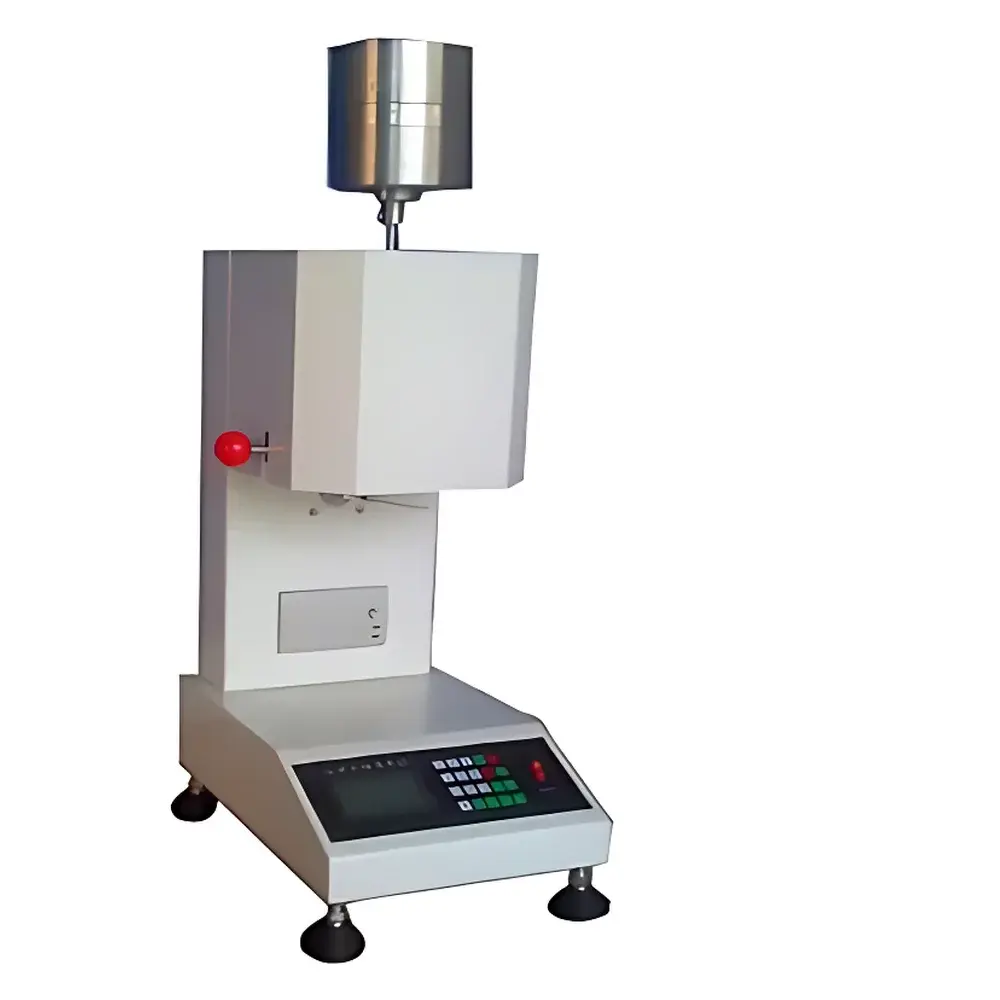
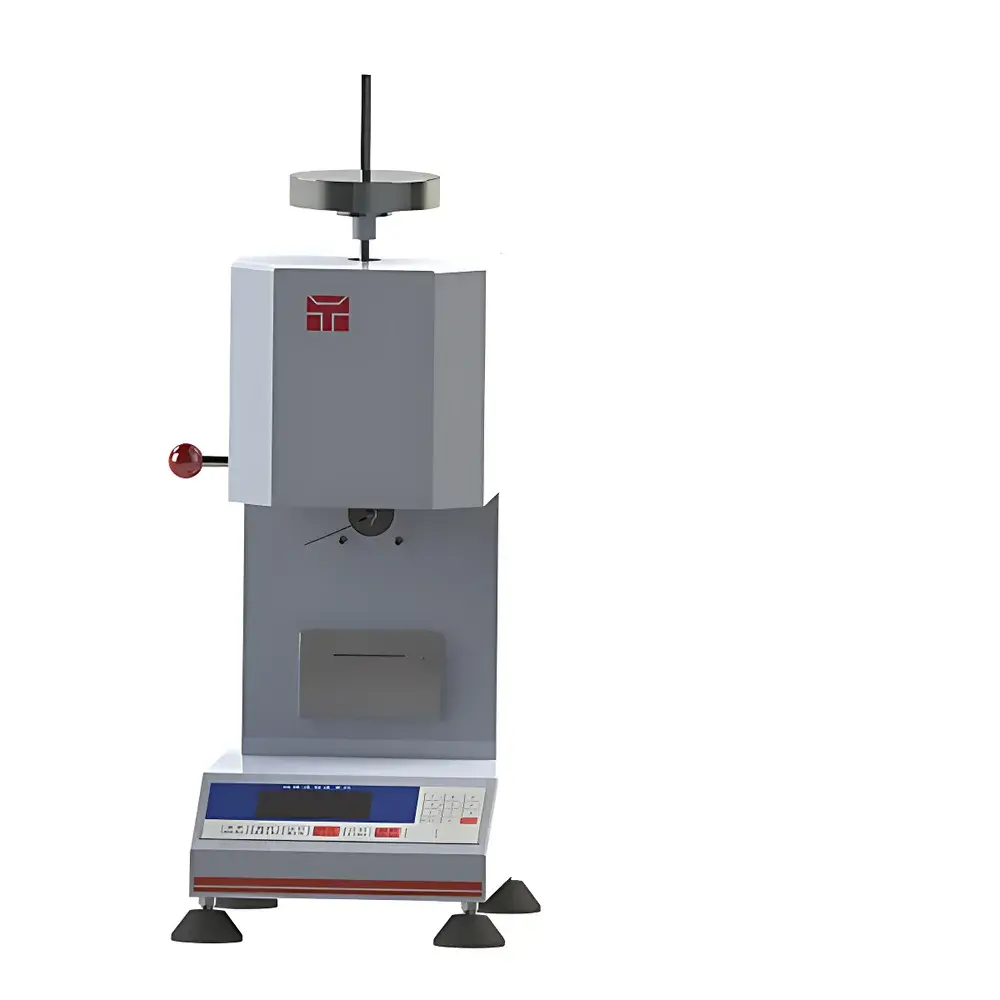
TianYuan TY-5005 Melt Flow Indexer
| Brand | TianYuan |
|---|---|
| Origin | Jiangsu, China |
| Manufacturer Type | Direct Manufacturer |
| Region Classification | Domestic (China) |
| Model | TY-5005 |
| Temperature Control Range | 100–450 °C |
| Temperature Accuracy | ±0.5 °C |
| Temperature Stability | ±0.5 °C over 4 h |
| Temperature Uniformity Across Barrel | ≤0.5 °C |
| Temperature Resolution | 0.1 °C |
| Die Inner Diameter | 2.095 ±0.005 mm |
| Barrel Inner Diameter | 9.550 ±0.025 mm |
| Load Accuracy | ≤±0.5% |
| Repeatability (PE Standard) | ≤2% |
| Accuracy (PE Standard) | ≤5% |
| MFR/MVR Range | 0.1–200 g/10 min |
| Cut Interval Setting | 2–1000 s (auto-timed), manual point-cut & full manual cut |
| Timer Range | 0–6000 s |
| Resolution | 1 s |
| Barrel Temperature Recovery Time After Loading | ≤4 min |
| Power Supply | AC 220 V / 50 Hz ±10%, 3 A |
| Dimensions | 300 × 500 × 600 mm |
| Net Weight | ~50 kg |
Overview
The TianYuan TY-5005 Melt Flow Indexer is a precision extrusion plastometer engineered for the standardized determination of melt mass flow rate (MFR) and melt volume flow rate (MVR) of thermoplastic polymers under defined temperature and load conditions. It operates on the principle of gravity-driven extrusion through a standardized capillary die, in strict accordance with ISO 1133, ASTM D1238, GB/T 3682, and JJG 878 metrological verification requirements. Designed for routine quality control laboratories and R&D facilities in polymer compounding, injection molding, and extrusion industries, the instrument delivers high reproducibility across repeated determinations—validated to ≤2% repeatability for polyethylene reference materials per national calibration standards.
Key Features
- Modular frame construction enables rapid disassembly and field-replaceable component maintenance—no specialized tools or technician dispatch required for common wear-part replacement.
- Critical thermal components—including barrel, piston rod, and die—are fabricated from high-temperature, low-coefficient-of-thermal-expansion alloy steel, followed by surface hardening treatment to ensure dimensional stability at temperatures up to 450 °C and long-term resistance to abrasive wear.
- Non-contact lever-type optical encoder system measures piston displacement with zero mechanical hysteresis. The balanced lever design eliminates spring-based bias or drift, ensuring traceable, repeatable MVR calculation independent of operator input or mechanical fatigue.
- Micro-stepper motor–driven automatic cutting unit supports programmable interval timing (2–1000 s), single-point manual trigger, and continuous manual override—enabling flexible sampling strategies for both standard and non-standard test protocols.
- Dedicated embedded microcontroller with color LCD interface provides real-time temperature monitoring, load status feedback, timer synchronization, and integrated data logging. Onboard thermal printer outputs fully traceable test reports including date/time stamp, test parameters, raw cut weights, calculated MFR/MVR values, and operator ID field.
Sample Compatibility & Compliance
The TY-5005 accommodates a broad spectrum of thermoplastic resins—including polyethylene (PE), polypropylene (PP), polycarbonate (PC), ABS, PET, and engineering-grade nylons—provided they exhibit measurable extrudability within the 0.1–200 g/10 min range. Its calibrated die (2.095 ±0.005 mm) and barrel (9.550 ±0.025 mm) conform precisely to ISO 1133 Annex A and ASTM D1238 Figure 1 geometry specifications. Temperature uniformity (≤0.5 °C axial gradient) and stability (±0.5 °C over 4 h) meet the stringent thermal validation criteria outlined in ISO/IEC 17025-accredited testing environments. While not inherently 21 CFR Part 11 compliant due to its standalone controller architecture, audit-ready printed reports support GLP documentation workflows when paired with laboratory logbook procedures.
Software & Data Management
The TY-5005 employs a deterministic real-time embedded OS with fixed-function firmware—optimized for reliability, electromagnetic immunity, and minimal maintenance overhead. All operational parameters (temperature setpoint, load selection, cut interval, dwell time) are stored in non-volatile memory with write-cycle protection. Test results—including individual cut masses, elapsed extrusion times, and final MFR/MVR values—are retained in internal flash storage (capacity: ≥1000 records) and exported via thermal printout. No PC connectivity or external software dependency is implemented; this design prioritizes regulatory simplicity, reduces cybersecurity exposure, and ensures uninterrupted operation in industrial settings where network isolation is mandated.
Applications
- Batch release testing of virgin and recycled polyolefin pellets against contractual MFR specifications.
- Process troubleshooting in extrusion lines—correlating MFR shifts with degradation indicators such as molecular weight distribution narrowing or thermo-oxidative scission.
- Raw material qualification for automotive interior trim, medical packaging films, and pipe-grade HDPE compounds.
- Stability assessment of polymer blends and filled composites during accelerated aging studies.
- Calibration verification of higher-tier rheometers using reference materials traceable to NIM (National Institute of Metrology, China) certified standards.
FAQ
Does the TY-5005 support automated data export to LIMS or Excel?
No—the instrument lacks USB, RS-232, or Ethernet interfaces. Data output is exclusively via built-in thermal printer. For digital integration, users must manually transcribe or scan printed reports into downstream systems.
Can it perform MVR measurements without manual weighing?
Yes—MVR is calculated in real time using the optical encoder’s displacement/time integral and the known die geometry. However, MFR requires off-line gravimetric measurement of cut specimens using an external analytical balance.
What is the recommended recalibration interval?
Per JJG 878-1994, annual metrological verification is mandatory. Critical checks—including temperature uniformity mapping, die dimensional inspection, and load verification with certified weights—should be performed before each shift when used in GMP-regulated environments.
Is the barrel assembly compatible with ISO 1133-2 multi-bore dies?
No—the TY-5005 is configured exclusively for single-capillary operation per ISO 1133-1 and ASTM D1238 Method A/B. Multi-bore configurations require dedicated instrumentation with independent pressure transducers and flow control valves.
How is temperature recovery time validated after sample loading?
Recovery is measured per GB/T 3682 Annex C: a Pt100 sensor inserted into the barrel centerline records time-to-stabilization within ±0.5 °C of setpoint following introduction of pre-dried resin—verified to be ≤4 minutes across the full 100–450 °C operating range.





