
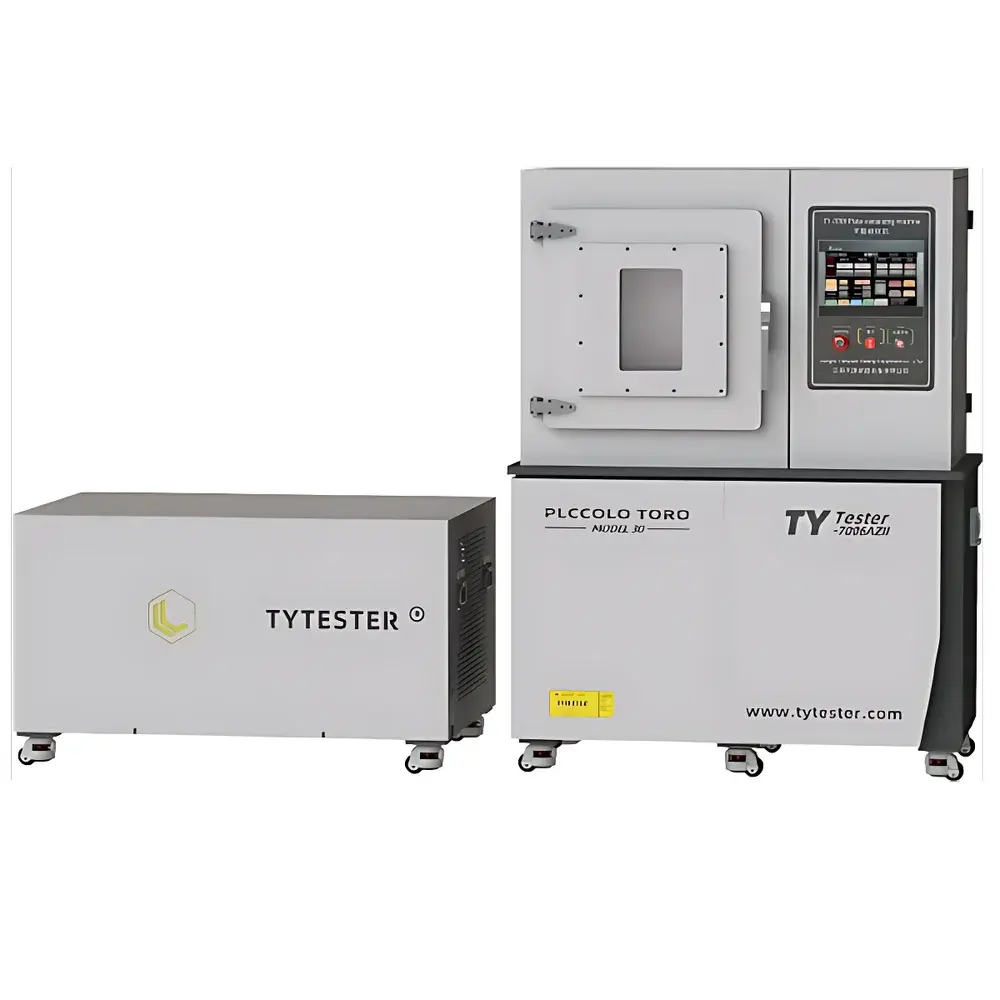
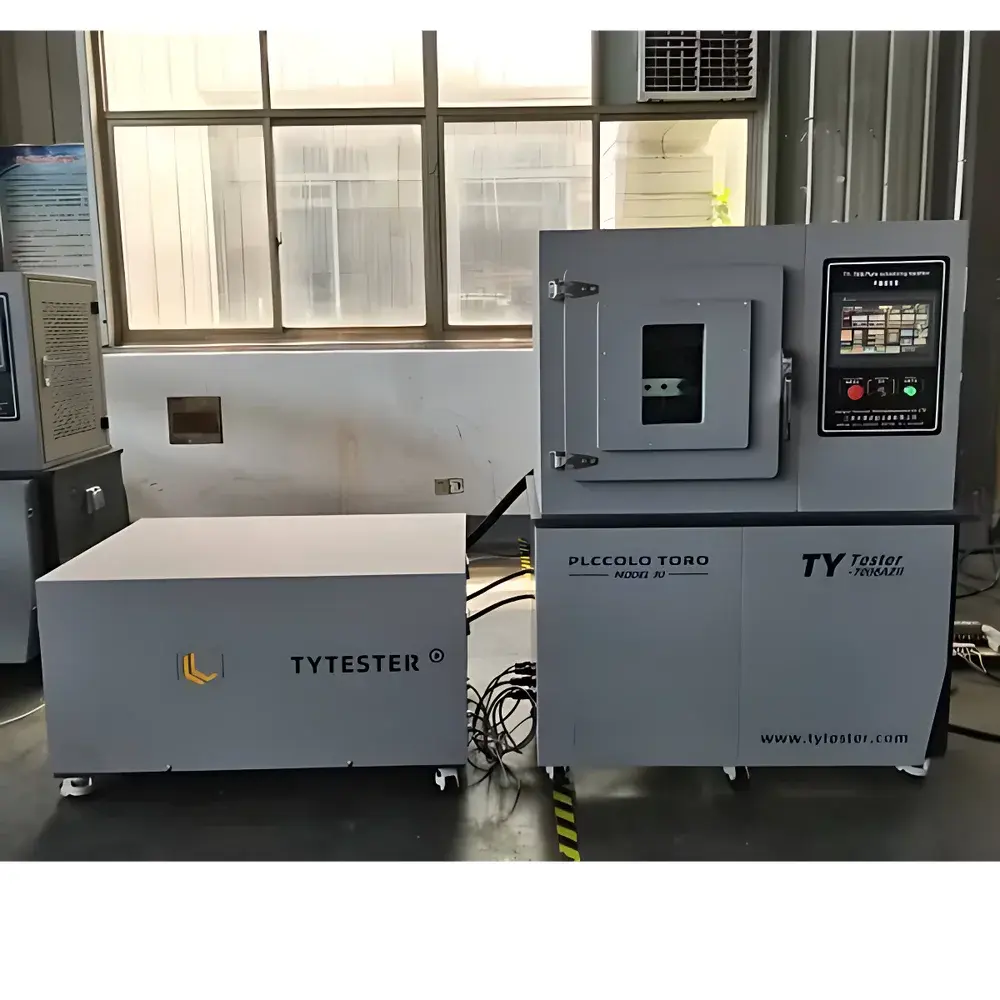
Lishumei TY-7006AZII Vacuum-Assisted Hydraulic Hot Press
| Brand | Lishumei |
|---|---|
| Origin | Jiangsu, China |
| Manufacturer Type | Authorized Distributor |
| Country of Origin | China |
| Model | TY-7006AZII |
| Instrument Type | Fully Automatic Pellet Press |
| Applicable Scope | Gel inspection (e.g., “fish-eye” defects), black specks, contaminants |
| Primary Function | Thermal compression molding of thermoplastic and thermosetting polymers |
| Nominal Clamping Force | 30 T / 50 T |
| Actuation Method | Hydraulic |
| Control System | PLC with 7-inch color touchscreen interface |
| Process Parameters | Programmable pressure, temperature (RT–300 °C), dwell time (0.1–9999.9 s), vacuum cycle count (0–9), and multi-stage排气 (degassing) sequences |
| Compliance | Designed to support GLP-compliant sample preparation workflows |
Overview
The Lishumei TY-7006AZII Vacuum-Assisted Hydraulic Hot Press is an engineered solution for reproducible thermal compression molding of polymeric, elastomeric, and composite specimens under controlled atmospheric and mechanical conditions. Based on the Couette–Poiseuille flow principle during melt consolidation and governed by time–temperature–pressure (TTP) superposition theory, the system enables precise control over polymer chain mobility, interfacial diffusion, and void elimination—critical for eliminating fish-eye defects, black specks, and micro-contaminants in raw resin batches. Its dual-force configuration (30 T or 50 T nominal clamping force) accommodates both routine QC pellet fabrication and advanced material development requiring high-isostatic consolidation. The integrated vacuum chamber (≤10 mbar residual pressure) operates synchronously with hydraulic actuation to evacuate entrapped air and volatiles prior to and during heat-up, significantly reducing porosity in final plaques and discs used for FTIR, DSC, tensile, or impact testing.
Key Features
- PLC-based control architecture with a 7-inch high-resolution color touchscreen HMI for intuitive programming of multi-step thermal cycles, pressure ramps, vacuum degassing sequences, and dwell profiles
- Hydraulic actuation system delivering stable, non-pulsating force application with real-time pressure feedback and closed-loop regulation
- Dual-range heating platens (ambient to 300 °C) featuring ±1.0 °C temperature uniformity across 150 × 150 mm active surface area
- Integrated vacuum manifold with digital vacuum gauge, programmable evacuation timing, and automatic venting sequence to prevent specimen distortion
- Interlocked safety enclosure with light-curtain protection, emergency stop circuitry, and over-temperature/over-pressure cut-off per IEC 61000-6-2 and ISO 13857 standards
- Modular platen design supporting interchangeable tooling (e.g., ASTM D1928-compliant 13-mm diameter die sets, ISO 178 three-point bending blanks, custom cavity molds)
Sample Compatibility & Compliance
The TY-7006AZII is validated for processing thermoplastics (PP, PE, PS, PC, ABS), thermosets (epoxy, phenolic), filled composites (glass-, carbon-, mineral-filled), and elastomers (EPDM, SBR). It supports preparation of specimens conforming to ASTM D1928 (for FTIR film analysis), ASTM D3800 (for density determination), ISO 178 (flexural testing), and ISO 527 (tensile bars). All operational logs—including setpoints, actual pressure/temperature/time/vacuum traces, and user authentication—are timestamped and stored locally for auditability. Optional data export via USB or RS-485 enables integration into LIMS environments compliant with FDA 21 CFR Part 11 requirements for electronic records and signatures.
Software & Data Management
The embedded control firmware records full-cycle process metadata with millisecond resolution. Each run generates a .CSV log file containing pressure vs. time, temperature vs. time, vacuum level vs. time, and operator ID. No proprietary software installation is required for data retrieval; files are readable in Excel, Python (pandas), or MATLAB. Audit trail functionality includes user login/logout events, parameter modification history, and system error codes—all retained for ≥12 months. For regulated labs, optional firmware upgrade adds electronic signature capability and role-based access control (RBAC) aligned with GLP and GMP documentation expectations.
Applications
- QC laboratories performing raw material release testing: detecting gel particles (“fish-eyes”), carbonized residues, and foreign contamination via visual or optical microscopy of transparent plaques
- R&D teams developing new polymer blends or masterbatches, where consistent dispersion quality and interfacial adhesion are evaluated via SEM-EDS or DMA after hot-pressed sample conditioning
- Standards laboratories preparing reference materials for mechanical testing (e.g., ASTM D638 tensile bars) or spectroscopic calibration films (e.g., 0.25 mm LDPE films for FTIR quantification)
- Academic polymer science programs conducting structure–property relationship studies requiring tightly controlled thermal history and morphology stabilization
FAQ
What is the maximum recommended operating temperature for continuous use?
The heating platens are rated for sustained operation up to 300 °C, with thermal stability maintained within ±1.0 °C over the central 100 × 100 mm zone.
Can the vacuum cycle be triggered automatically during heating, or only before compression?
Vacuum initiation, duration, and repetition count are fully programmable at any stage: pre-heat, mid-ramp, or post-compression hold—enabling multi-phase degassing protocols.
Is the system compatible with ASTM D1928 standard film preparation?
Yes; equipped with standardized 13-mm-diameter die sets and calibrated force delivery, it meets all dimensional and thickness consistency requirements specified in ASTM D1928-22 for infrared transmission film fabrication.
Does the PLC interface support recipe import/export via USB?
Yes; process recipes (.PRG files) and cycle logs (.CSV) can be transferred using standard FAT32-formatted USB flash drives.
What maintenance intervals are recommended for hydraulic oil and vacuum pump oil?
Hydraulic oil replacement is advised every 2,000 operating hours or biannually; vacuum pump oil should be changed every 500 hours or quarterly—whichever occurs first—using ISO VG 32 mineral oil (hydraulic) and FOMBLIN Y LVAC 10/6 (vacuum).



