
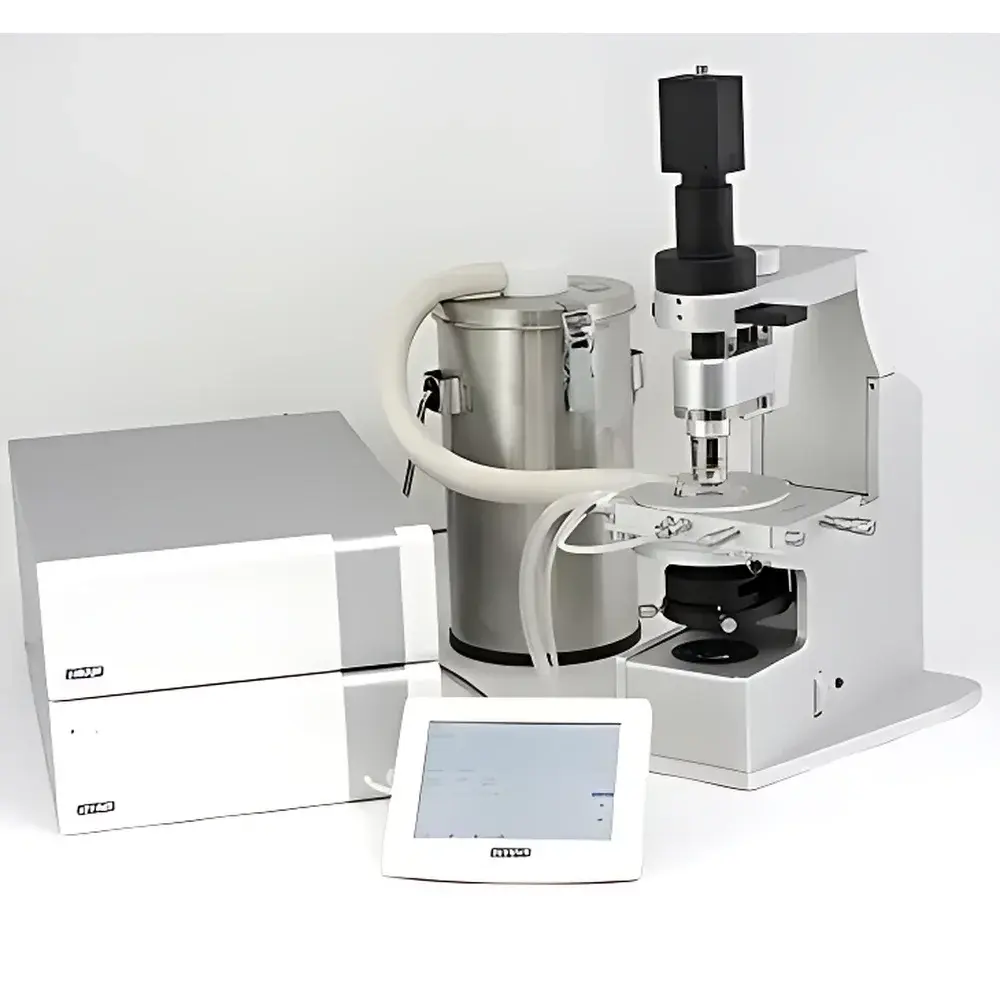
Linkam THMSE600 Cold Stage and Hot Stage for Polarized Light Microscopy
| Brand | Linkam |
|---|---|
| Origin | United Kingdom |
| Model | THMSE600 |
| Temperature Range | −196 °C to +600 °C (−196 °C requires optional liquid nitrogen cooling system) |
| Temperature Stability | < 0.01 °C |
| Temperature Accuracy | ±0.1 °C |
| Heating/Cooling Rate | 0.1–150 °C/min |
| Optical Aperture Diameter | 2.4 mm |
| Sample XY Translation Range | 15 × 15 mm |
| Sample Area | 22 mm diameter |
| Electrode Configuration | Standard dual-electrode |
| Electrode Integration | Embedded in sealed chamber, compatible with conductive glass LC cells |
| Chamber Environment Control | Vacuum, inert gas (N₂, Ar), or humidity-controlled atmosphere |
| Window Thickness | 0.17 mm |
| Minimum Objective Working Distance | 4.5 mm |
| Minimum Condenser Working Distance | 13.2 mm |
| Stage Dimensions | 137 × 92 × 22 mm |
| Compatible Sample Format | 16 mm diameter cover slips with capillary-filled LC cells (5 µm cell gap) |
Overview
The Linkam THMSE600 is a high-precision, electro-optically enabled temperature-controlled stage engineered for in situ polarized light microscopy (PLM) studies of thermotropic and lyotropic liquid crystals, polymer-dispersed liquid crystal (PDLC) systems, ferroelectric and antiferroelectric mesophases, and other anisotropic soft matter. Its core architecture integrates a fully sealed, gas-tight sample chamber with embedded electrical contacts—enabling simultaneous thermal control, electric field application, and optical observation under rigorously defined environmental conditions. The stage operates on the principle of resistive heating and cryogenic cooling (with optional LN₂ delivery), delivering exceptional thermal stability (< 0.01 °C) and programmable ramp rates from 0.1 to 150 °C/min. Designed for compatibility with standard upright and inverted optical microscopes, the THMSE600 features a 2.4 mm central optical aperture and ultra-thin 0.17 mm sapphire or fused silica windows—optimized for high-numerical-aperture objectives and minimal optical distortion across UV–VIS–NIR spectral ranges.
Key Features
- Sealed, gas-tight sample chamber supporting vacuum, inert gas purging (N₂, Ar), or controlled-humidity environments—critical for preventing oxidation, phase degradation, or moisture-induced transitions during thermal cycling.
- Integrated dual-electrode configuration (upgradeable to quad-electrode) enabling direct voltage biasing (DC or AC) across conductive-glass-based liquid crystal cells with 5 µm uniform gap thickness.
- Independent, closed-loop temperature control via PID-regulated programmable temperature controller with ±0.1 °C accuracy and sub-milliKelvin stability over extended dwell periods.
- Mechanically precise 15 × 15 mm XY translation stage with fine micrometer adjustment—allowing reproducible positioning of capillary-filled LC domains relative to optical focus and electrode alignment.
- Optimized optical path: 0.17 mm window thickness and minimal working distance requirements (4.5 mm objective / 13.2 mm condenser) ensure compatibility with high-magnification objectives including 100× oil-immersion and long-working-distance IR objectives.
- Modular design with standardized 16 mm cover-slip loading interface and dedicated LC cell holder—facilitating rapid sample exchange without realignment or chamber venting.
Sample Compatibility & Compliance
The THMSE600 accommodates standard conductive ITO-coated glass LC cells (e.g., EHC or Instec formats), custom-fabricated capillaries, and thin-film polymer composites. Its chamber sealing integrity meets ISO 14644-1 Class 5 cleanroom handling protocols when used with glove-box integration. For regulated laboratories, the temperature controller supports audit-trail logging (via optional Linkam TMS94 software) compliant with FDA 21 CFR Part 11 requirements when deployed with validated instrument qualification packages. All materials in contact with samples—including electrodes, gaskets, and chamber walls—are chemically inert (316 stainless steel, ceramic insulators, PTFE-sealed feedthroughs) and suitable for GLP/GMP-compliant thermal transition analysis per ASTM E2282 and ISO 11357 standards.
Software & Data Management
Control and synchronization are managed through Linkam’s proprietary TMS94 platform, which provides real-time temperature profiling, multi-channel voltage waveform generation (for dielectric spectroscopy coupling), and synchronized image capture triggers via TTL or USB interfaces. Data export conforms to HDF5 and CSV formats for downstream analysis in MATLAB, Python (NumPy/Pandas), or commercial rheo-optical suites. The system supports time-stamped metadata embedding—including ambient pressure, gas composition, and thermal history—for full experimental traceability. Optional LabVIEW and Python SDKs enable integration into automated characterization workflows, including closed-loop feedback control based on birefringence intensity or extinction angle tracking.
Applications
- Phase diagram mapping of nematic–smectic–isotropic transitions under variable electric fields.
- In situ dielectric relaxation spectroscopy of ferroelectric liquid crystals (FLCs) during thermal cycling.
- Thermally induced domain reorientation kinetics in polymer-stabilized cholesteric textures (PSCTs).
- Crystallization and polymorph screening of pharmaceutical mesogens using hot-stage PLM coupled with digital image correlation (DIC).
- Stability assessment of encapsulated liquid crystal emulsions under accelerated aging protocols (e.g., ICH Q1A).
- Calibration and validation of computational models for director field evolution under combined thermal–electrical stimuli.
FAQ
What cooling methods are supported for operation below 0 °C?
The THMSE600 achieves −196 °C using an optional liquid nitrogen cooling system with integrated auto-fill and vapor-phase temperature regulation. Peltier-based cooling is not available on this model.
Can the THMSE600 be used with fluorescence microscopy?
Yes—the 0.17 mm optical windows exhibit >90% transmission from 250 nm to 2.5 µm, making it compatible with widefield and confocal fluorescence setups, provided appropriate filter sets and low-autofluorescence chamber components are selected.
Is third-party software integration possible?
Yes—Linkam provides documented APIs for LabVIEW, Python, and MATLAB, enabling custom automation of temperature ramps, electrode biasing, and synchronized acquisition with cameras or spectrometers.
How is calibration verified for regulatory submissions?
Linkam offers IQ/OQ documentation packages aligned with ISO/IEC 17025, including NIST-traceable temperature sensor calibration certificates and uncertainty budgets for both heating and cooling modes.
What maintenance is required for long-term reliability?
Annual inspection of O-ring integrity, electrode contact resistance verification (<1 Ω), and window cleanliness validation using interferometric surface metrology are recommended per Linkam’s Service Protocol SP-THMSE600 Rev. 3.





