
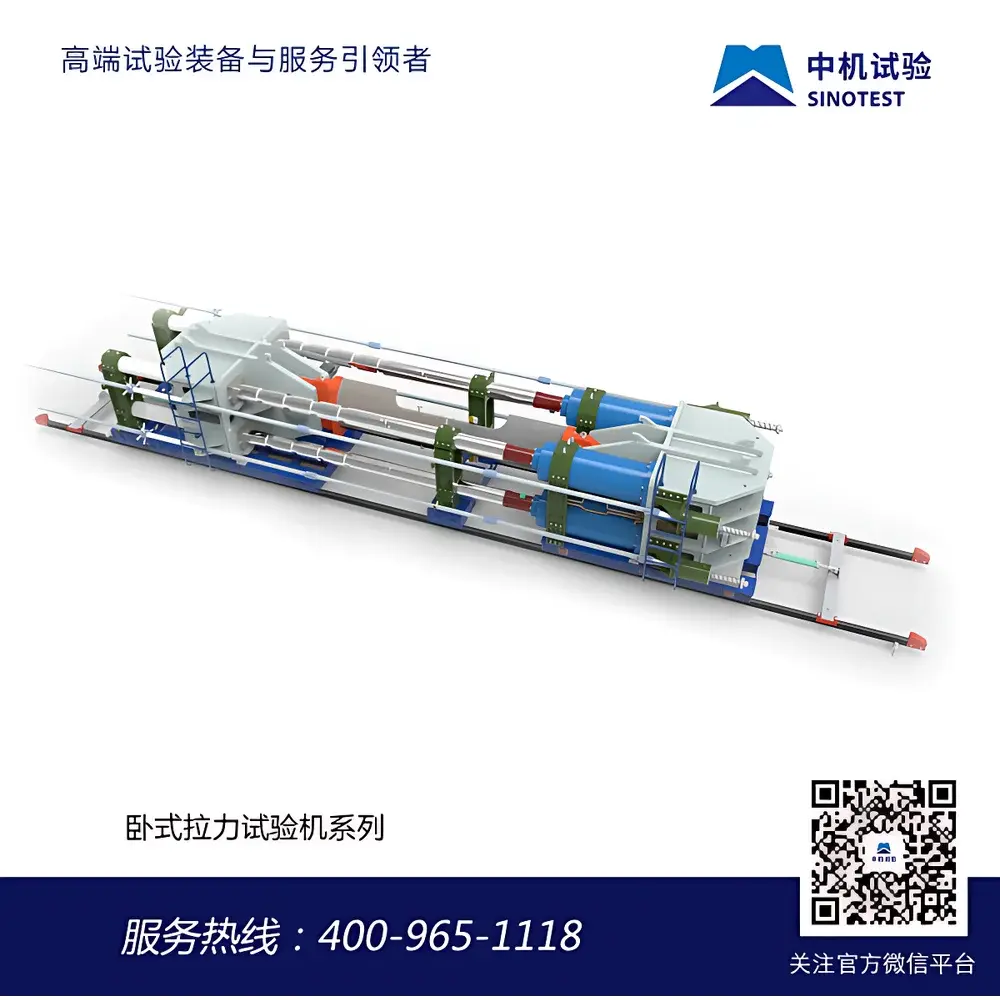
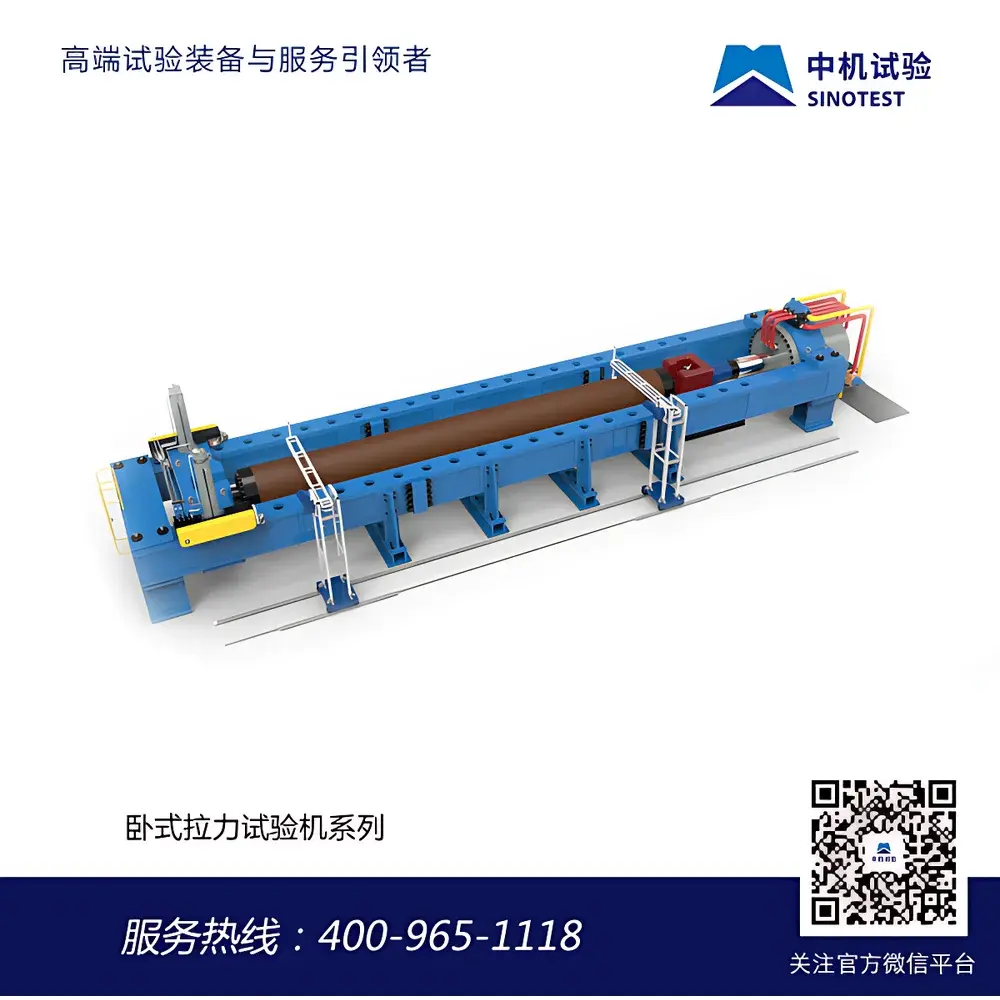
SINOTEST WLS Series Electro-Hydraulic Servo Horizontal Tensile Testing Machine
| Brand | SINOTEST |
|---|---|
| Origin | Jilin, China |
| Manufacturer Type | Direct Manufacturer |
| Equipment Type | Hydraulic Tensile Testing Machine |
| Model | WLS Series |
| Maximum Test Force | 50,000 kN |
| Force Measurement Range | 5,000–50,000 kN (10–100% FS) |
| Applicable Standards | JJG 556-2011, GB/T 3075-2008, GB/T 228-2010, GB/T 8358-2014, GB/T 24191-2009 |
Overview
The SINOTEST WLS Series Electro-Hydraulic Servo Horizontal Tensile Testing Machine is a high-capacity, precision-engineered system designed for static and dynamic mechanical characterization of structural metallic materials under axial tensile loading. Utilizing closed-loop electro-hydraulic servo control, the machine delivers stable force application with high fidelity across extended test durations—critical for creep, fatigue, and ultimate tensile strength evaluation. Its horizontal configuration accommodates exceptionally long or high-aspect-ratio specimens—such as pipelines, prestressed cables, rail tracks, and large-diameter steel wire ropes—that cannot be effectively tested in conventional vertical frames. The system operates on the principle of servo-controlled hydraulic actuation, where digital command signals modulate high-pressure oil flow to precisely regulate piston displacement and load output in real time, ensuring traceable force linearity and minimal hysteresis per ISO 7500-1 Class 0.5 requirements.
Key Features
- Robust horizontal frame architecture with reinforced steel crosshead and heavy-duty guide rails, engineered to withstand cyclic loads up to 50,000 kN without measurable deflection or resonance.
- High-stiffness, low-compliance hydraulic power unit featuring dual-stage servo valves and pressure-compensated flow control for consistent force ramping and hold stability—even during multi-hour creep tests.
- Integrated load cell calibrated to ISO 376 Class 0.5 accuracy, with temperature-compensated strain gauge technology and built-in verification port for in-situ calibration traceability.
- Modular extensometry support: compatible with clip-on, video-based, and non-contact laser extensometers for strain measurement across gauge lengths from 50 mm to 2,000 mm.
- Dual-channel digital controller supporting simultaneous closed-loop control of load and displacement, with programmable waveforms (sine, trapezoidal, block) for fatigue testing per ASTM E466 and GB/T 3075-2008.
- Emergency stop circuitry compliant with ISO 13850, including mechanical overload limit switches, hydraulic pressure relief valves, and redundant software safety interlocks.
Sample Compatibility & Compliance
The WLS Series accommodates specimens with diameters up to 300 mm and total lengths exceeding 20 m—ideal for full-scale pipe joint qualification, anchor cable validation, and railway axle component testing. Gripping systems include wedge-type hydraulic clamps (for rods and bars), U-bolt fixtures (for stranded wire ropes), and custom-designed flange adapters (for pipeline segments). All mechanical interfaces are designed to minimize stress concentration and ensure uniform axial alignment per ASTM E8/E8M recommendations. The system meets metrological and procedural requirements of multiple national and industry standards, including JJG 556-2011 (calibration of axial fatigue machines), GB/T 228.1-2021 (tensile testing of metallic materials), GB/T 8358-2014 (breaking strength testing of steel wire ropes), and GB/T 24191-2009 (determination of elastic modulus in wire ropes). It supports GLP-compliant operation through audit-ready test logs and electronic signature capability.
Software & Data Management
Control and analysis are executed via SINOTEST’s proprietary TestMaster Pro v4.2 software—a Windows-based platform compliant with FDA 21 CFR Part 11 for electronic records and signatures. The software provides real-time visualization of load-displacement, stress-strain, and cycle-count curves; automatic calculation of yield strength (Rp0.2), ultimate tensile strength (Rm), elongation at break (A%), and reduction of area (Z%). Raw data is exported in ASCII (.txt), CSV, and universal .tdms formats, preserving full metadata (test ID, operator, environmental conditions, calibration history). Audit trails record all user actions—including parameter edits, test aborts, and report generation—with timestamps and login credentials. Optional integration with LIMS platforms is supported via OPC UA and RESTful API protocols.
Applications
- Structural integrity validation of offshore pipeline girth welds under simulated service loads.
- Cyclic fatigue life assessment of pre-stressed concrete tendons used in bridge construction.
- Long-term creep behavior analysis of high-strength alloy steels at elevated temperatures (when coupled with environmental chambers).
- Breaking strength certification of galvanized steel wire ropes for mining hoisting systems.
- Mechanical property mapping of dissimilar metal joints (e.g., stainless steel to duplex steel) per ASME BPVC Section IX.
- Qualification testing of railway brake cables and overhead catenary wires per EN 13975 and TB/T 3110.
FAQ
What is the maximum specimen length supported by the WLS Series?
Standard configurations accommodate specimens up to 20 meters in length; custom extensions are available upon engineering review.
Does the system support high-temperature tensile testing?
Yes—when integrated with externally mounted furnace or environmental chamber systems (operating range: –70 °C to +1,200 °C), with appropriate thermal shielding and high-temperature extensometry.
Is remote monitoring and control possible?
Yes—the TestMaster Pro software supports secure remote access via TLS-encrypted VNC or browser-based thin-client interface, subject to network policy compliance.
How is force calibration maintained over time?
The system includes automated self-check routines prior to each test sequence, and supports periodic verification using certified dead-weight standards traceable to NIM (China National Institute of Metrology).
Can the machine perform hold-tests at constant load for >1,000 hours?
Yes—its hydraulic servo architecture and thermally stabilized oil reservoir enable stable load maintenance within ±0.5% of setpoint over multi-day creep intervals, per ISO 204 requirements.



