
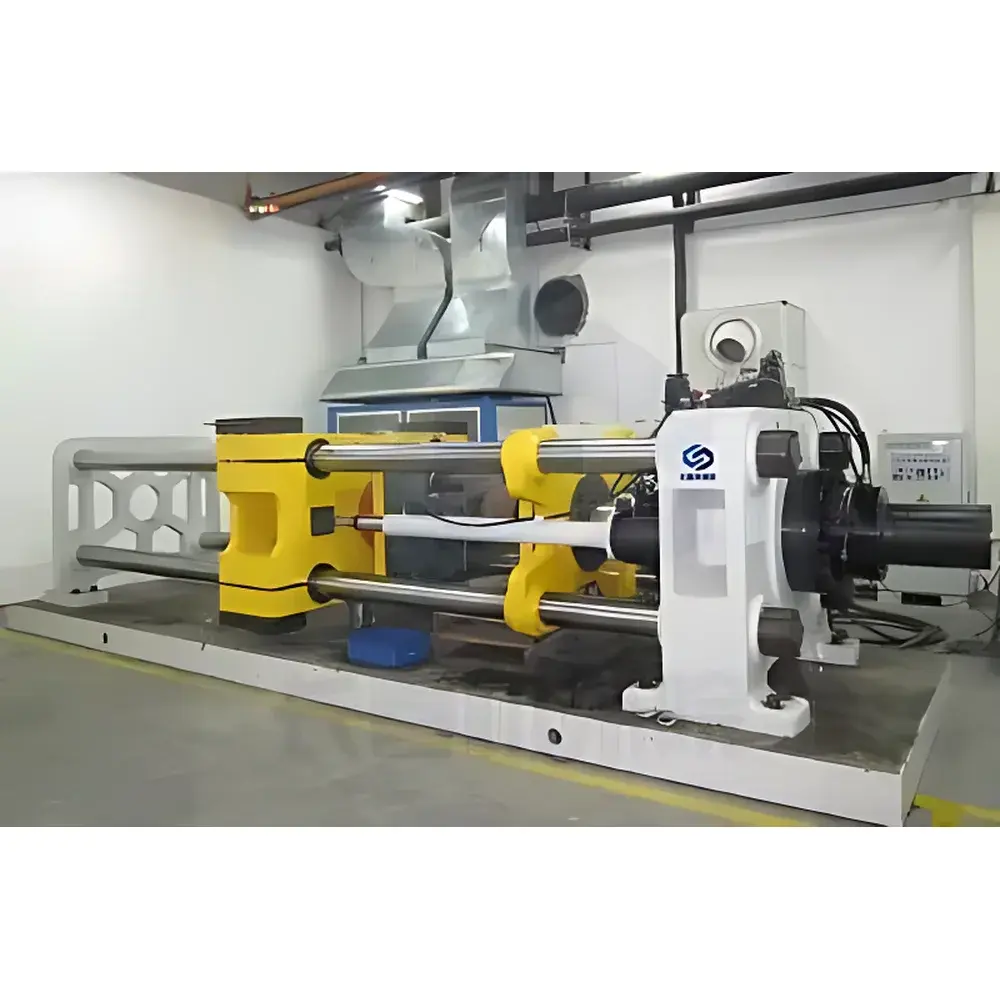
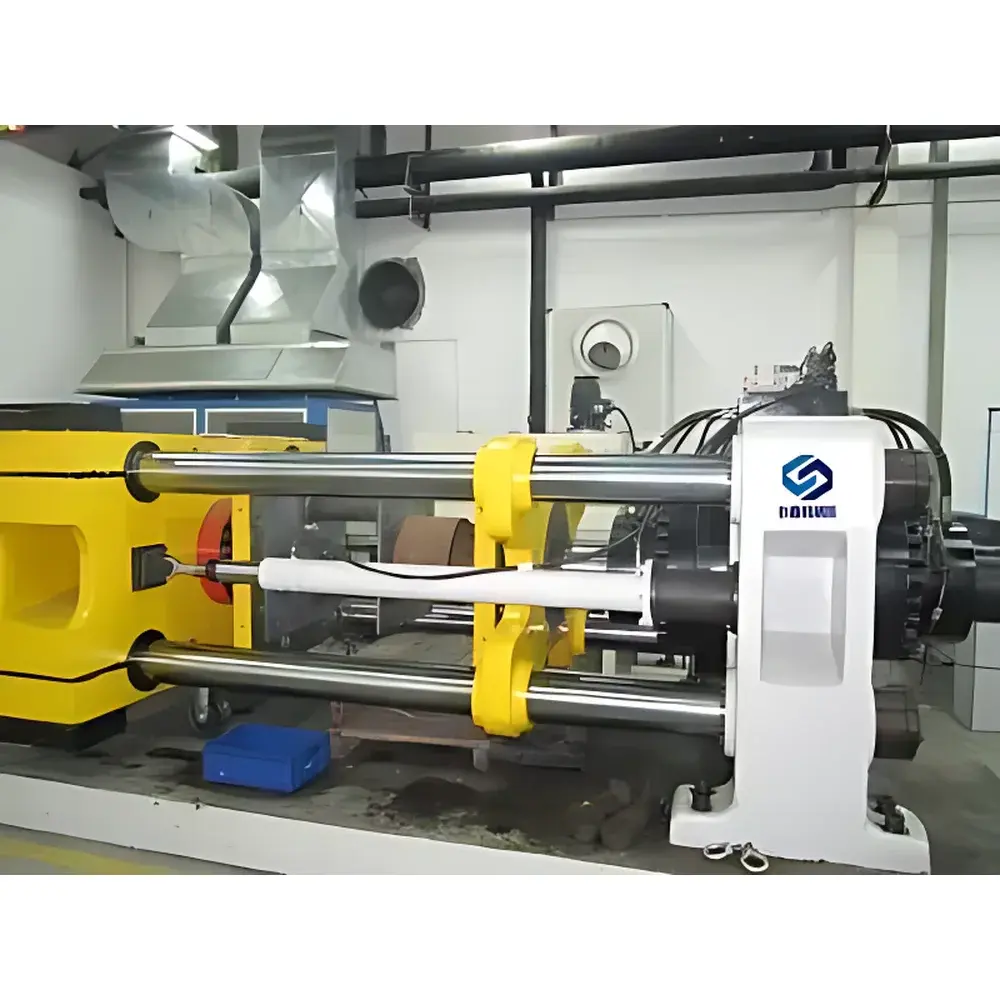
SINOTEST SDS3000 High-Capacity Electro-Hydraulic Servo Fatigue Testing Machine
| Brand | SINOTEST |
|---|---|
| Origin | Jilin, China |
| Manufacturer Type | Direct Manufacturer |
| Equipment Type | Electro-Hydraulic Servo Fatigue Testing Machine |
| Model | SDS3000 |
| Maximum Test Force | ±3000 kN |
| Frequency Range | 5 Hz |
| Host Weight | 30,000 kg |
Overview
The SINOTEST SDS3000 is a high-capacity electro-hydraulic servo fatigue testing machine engineered for rigorous dynamic and static mechanical characterization of structural components and advanced materials under controlled cyclic loading. Based on the Couette-type hydraulic actuation principle with closed-loop digital control, it delivers precise axial force application across a wide spectrum of test regimes—from ultra-low-cycle fatigue (ULCF) to high-cycle fatigue (HCF), fracture mechanics (e.g., ΔK-controlled crack growth), and quasi-static tensile/compression tests. Its monolithic TPHS (Twin-Post Heavy-Stiffness) frame architecture ensures minimal parasitic deformation (<0.05% of stroke under full load), enabling reproducible results in compliance-critical applications such as aerospace component certification and nuclear-grade material qualification.
Key Features
- Ultra-rigid seamless heavy-duty frame structure with zero-gap column-to-crosshead interface, achieving axial stiffness >1.2 × 10⁷ N/mm and minimizing lateral deflection during high-force cycling.
- Modular actuator configuration: top-mounted or bottom-mounted hydraulic cylinder options to accommodate diverse specimen geometries and boundary condition requirements (e.g., push-pull, cantilever, or biaxial fixtures).
- AC servo-driven hydraulic power unit with integrated gear-tooth belt + precision ball-screw transmission—ensuring <0.1 dB(A) acoustic emission at rated load, sub-micron positioning resolution, and energy efficiency exceeding ISO 5171 Class A standards.
- IDCD2K fully digital dynamic controller featuring dual-core 32-bit TI C2000 DSP processors (150 MIPS), PCI-bus real-time data highway, and 5 kHz closed-loop update rate across force, displacement, and strain channels (upgradable to 10 kHz for specialized waveforms).
- Proprietary radial-load-compensated load cell technology with non-linear calibration mapping and in-situ dynamic recalibration—maintaining ≤0.5% dynamic force error up to 50 Hz and eliminating thermal drift over 72-hour continuous operation.
- PIDF (Proportional-Integral-Derivative-Feedforward) control algorithm with adaptive amplitude/phase compensation, enabling stable tracking of complex composite waveforms (e.g., block-loading spectra, road-load simulation profiles) without phase lag.
Sample Compatibility & Compliance
The SDS3000 accommodates specimens ranging from miniature coupons (≥5 mm gauge length) to full-scale automotive suspension arms, turbine blades, and welded joints—supported by interchangeable hydraulic wedge grips, pneumatic side-action clamps, and high-temperature furnace integration (up to 1200 °C). It fully complies with international fatigue testing standards including ASTM E466, ISO 1099:2017, GB/T 3075–2008, EN 6072, and JIS Z 2275. All force transducers are traceably calibrated per ISO 376:2011 Class 0.5, and system-level dynamic verification follows ISO 4965:2016. The machine has been independently validated by GE S400 (CMTL) accredited laboratory for traceable metrological assurance.
Software & Data Management
SDS Series Control Software provides GLP-compliant test execution with FDA 21 CFR Part 11–ready audit trails, electronic signatures, and role-based access control. Real-time dynamic calibration adjusts sensor gain and offset during active testing based on specimen stiffness evolution. Curve processing includes localized zoom, manual annotation, hysteresis loop extraction, and cycle counting via ASTM E1037 algorithms. Supported output formats include ASCII, CSV, HDF5, and XML for integration with MATLAB, Python (SciPy), and commercial FEA postprocessors. All raw waveform data (force, displacement, strain) is timestamped with microsecond resolution and stored with metadata (environmental conditions, operator ID, calibration certificates).
Applications
- Aerospace: Fatigue life prediction of aluminum-lithium alloys, titanium IMI 834, and carbon-fiber-reinforced polymer (CFRP) laminates under spectrum loading per MIL-HDBK-5J.
- Automotive: Component-level durability validation of engine mounts, chassis links, and battery enclosures under road-simulated multi-axial loads.
- Energy: Crack propagation rate (da/dN) measurement in pipeline steels (X80/X100) per ASTM E647, creep-fatigue interaction studies in steam turbine rotor materials.
- Academic Research: In-situ synchrotron-compatible fatigue experiments (with optional X-ray transparent load train), thermo-mechanical fatigue (TMF) coupling with environmental chambers.
- Standards Development: Reference platform for national metrology institutes performing inter-laboratory round-robin fatigue testing per ISO/IEC 17043.
FAQ
What is the maximum static and dynamic force capacity of the SDS3000?
The SDS3000 delivers ±3000 kN static force and 3000 kN peak-to-peak dynamic force under sinusoidal excitation.
Does the system support external waveform input for custom loading profiles?
Yes—via analog voltage input (±10 V, 16-bit resolution) synchronized to the internal 5 kHz sampling clock, enabling hardware-in-the-loop (HIL) integration with vehicle dynamics simulators.
Is the controller compatible with third-party DAQ systems or LabVIEW?
The IDCD2K controller provides TCP/IP and EtherCAT interfaces with documented API libraries for LabVIEW, Python, and MATLAB, supporting remote command execution and real-time data streaming.
How is traceability maintained for long-term calibration validity?
Each system ships with NIST-traceable calibration certificates for all transducers; onboard self-diagnostic routines verify signal integrity before every test session, logging deviations exceeding ISO 9001 clause 7.6 thresholds.
Can the machine operate under elevated temperature or corrosive environments?
With optional environmental chambers (−70 °C to +1200 °C), inert gas purge kits, and corrosion-resistant hydraulic fluid conditioning modules, the SDS3000 meets ASTM G151 accelerated weathering and ISO 9223 classification requirements.



