
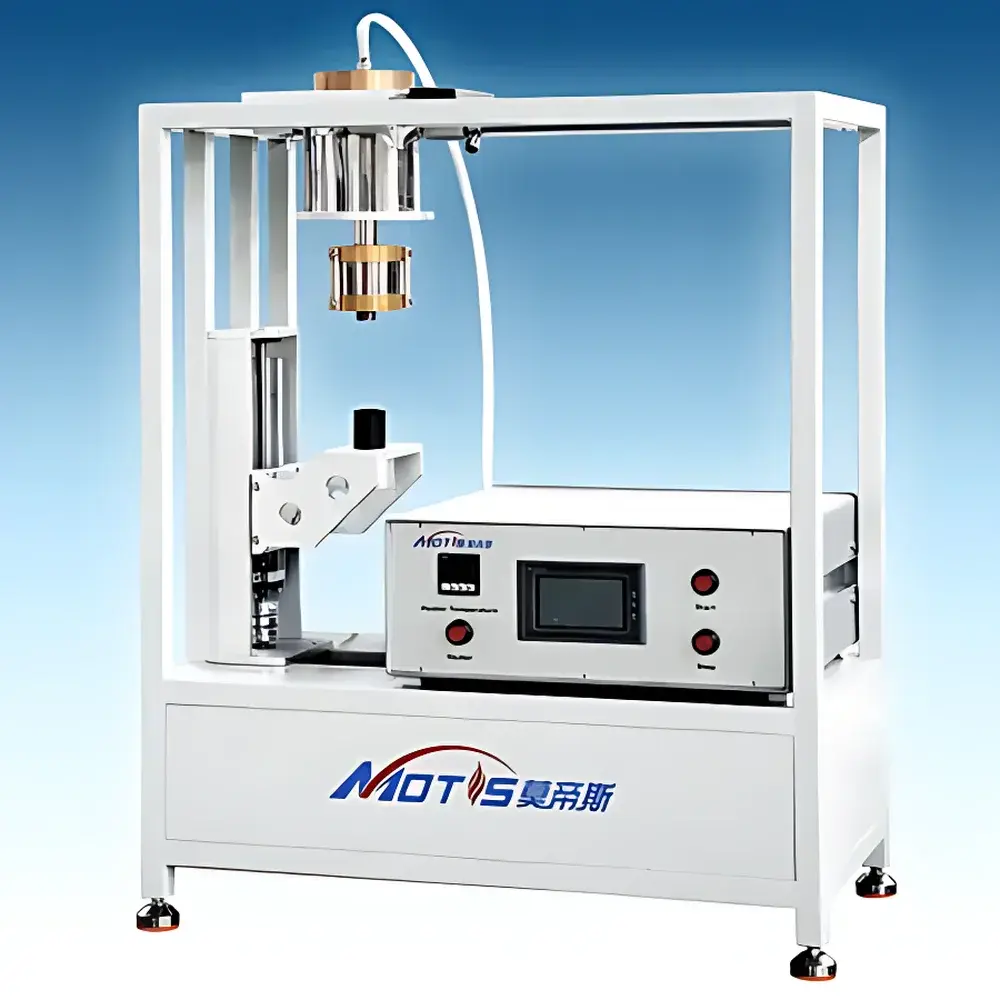
NYX CHT Contact Heat Resistance Tester
| Brand | NYX |
|---|---|
| Origin | Tianjin, China |
| Manufacturer Type | Manufacturer |
| Country of Origin | Domestic (China) |
| Model | CHT |
| Price Range | USD 10,600 – 13,250 |
| Heating Plate Temperature Range | Ambient to 500 °C |
| Contact Surface Diameter | 25.0 ± 0.05 mm × Depth: 5.0 ± 0.02 mm |
| Thermocouple Measurement Range | ≥ 500 °C |
| Contact Force | 49 N (± 1 N) |
| Contact Speed | 5 mm/s (± 0.2 mm/s) |
| Actuation | Servo-motor-controlled heat flux sensor with programmable vertical motion |
| Horizontal Sample Platform Translation | Motorized lateral displacement for safe, repeatable specimen loading |
| Data Acquisition | PLC-based real-time logging of onset temperature, threshold time, termination temperature, and continuous surface temperature |
Overview
The NYX CHT Contact Heat Resistance Tester is a precision-engineered instrument designed for quantitative evaluation of thermal protection performance in personal protective equipment (PPE), specifically heat-resistant gloves and flame-retardant garments. It operates on the principle of controlled contact heat transfer under standardized mechanical and thermal boundary conditions, measuring the time required for a defined temperature rise (typically 10 °C or 24 °C above initial contact temperature, depending on test protocol) at the interface between a heated metal surface and the test specimen. This threshold time directly correlates with the material’s ability to resist conductive heat penetration during brief, direct contact—critical for occupational safety in foundries, metalworking, firefighting, and emergency response environments. The system complies with the physical test methodology outlined in ISO 12127-1 (determining contact heat resistance of protective clothing), EN 407 (gloves against thermal risks), EN 702 (heat resistance of welding gloves), ISO 11612 (protective clothing against heat and flame), AQ 6103 (Chinese standard for fire-fighting gloves), FZ/T 73040 (knitted flame-retardant fabrics), and GB 38453 (general requirements for heat-resistant PPE). Its architecture integrates thermally stable heating elements, high-resolution servo positioning, and traceable temperature monitoring to ensure measurement repeatability across laboratories.
Key Features
- Programmable heating plate with precise ambient-to-500 °C temperature control and real-time digital display via integrated HMI interface.
- Calibrated contact probe featuring a cylindrical sensing surface (Ø25.0 ± 0.05 mm × depth 5.0 ± 0.02 mm) constructed from Inconel 600 and equipped with Class 1 platinum RTD or Type K thermocouple rated to ≥500 °C.
- Electromechanical actuation system delivering consistent 49 N contact force (±1 N tolerance) and 5 mm/s approach speed (±0.2 mm/s), fully governed by closed-loop servo control.
- Motor-driven horizontal translation stage enabling operator-safe specimen placement without manual intervention near hot surfaces.
- PLC-based data acquisition module recording timestamped values for initial contact temperature, threshold time (tth), termination temperature, and continuous thermal profile at 100 Hz sampling rate.
- Compliance-ready firmware supporting audit trails, user access levels, and configurable pass/fail criteria aligned with ISO/IEC 17025 documentation requirements.
Sample Compatibility & Compliance
The CHT accommodates flat, rigid, or semi-rigid specimens up to 150 mm × 150 mm and thickness ≤ 25 mm—including multi-layer composite gloves, quilted sleeves, and laminated fabric panels. Specimen mounting fixtures ensure planar alignment and eliminate air gaps that could compromise thermal coupling. All operational parameters—including dwell time, force calibration, and temperature ramp profiles—are preconfigured per relevant standards. The instrument meets mechanical and metrological requirements specified in ISO/IEC 17025:2017 for testing laboratories and supports full traceability to NIST-traceable temperature standards. It is validated for use in GLP-compliant safety certification workflows and referenced in third-party testing reports accepted by EU Notified Bodies and Chinese CNAS-accredited labs.
Software & Data Management
Data output is delivered via RS-485 or Ethernet interface to optional PC-based analysis software (sold separately), which enables automated report generation in PDF or Excel formats compliant with ISO 12127-1 Annex B templates. Raw thermal curves are exportable as CSV files for secondary analysis. Software modules include statistical process control (SPC) dashboards, batch comparison tools, and electronic signature support conforming to FDA 21 CFR Part 11 requirements when deployed in regulated manufacturing QA environments. Audit logs record all parameter modifications, user logins, and test executions with immutable timestamps.
Applications
- Determination of contact heat resistance class (F1–F5 per EN 407) for industrial and firefighting gloves.
- Quality assurance testing of heat-shield materials used in aerospace crew gear and automotive exhaust shielding.
- R&D validation of novel phase-change composites and aerogel-integrated textiles.
- Comparative benchmarking of thermal barrier performance across competing PPE suppliers.
- Supporting technical documentation for CE marking, CCC certification, and NFPA 1971 compliance submissions.
FAQ
What standards does the CHT tester fully support?
ISO 12127-1, EN 407, EN 702, ISO 11612, AQ 6103, FZ/T 73040, and GB 38453.
Is calibration certification included with shipment?
Yes—a factory calibration certificate traceable to national metrology institutes is provided; annual recalibration is recommended per ISO/IEC 17025 guidelines.
Can the system be integrated into an existing LIMS environment?
Yes, via Modbus TCP or OPC UA protocols; API documentation and driver packages are available upon request.
What maintenance is required for long-term accuracy?
Quarterly verification of contact force and temperature uniformity across the heating plate; annual thermocouple replacement and servo encoder recalibration.
Does the instrument meet electromagnetic compatibility (EMC) requirements for laboratory use?
Yes—it conforms to IEC 61326-1:2013 for electromagnetic immunity and emission limits in industrial and laboratory settings.



