
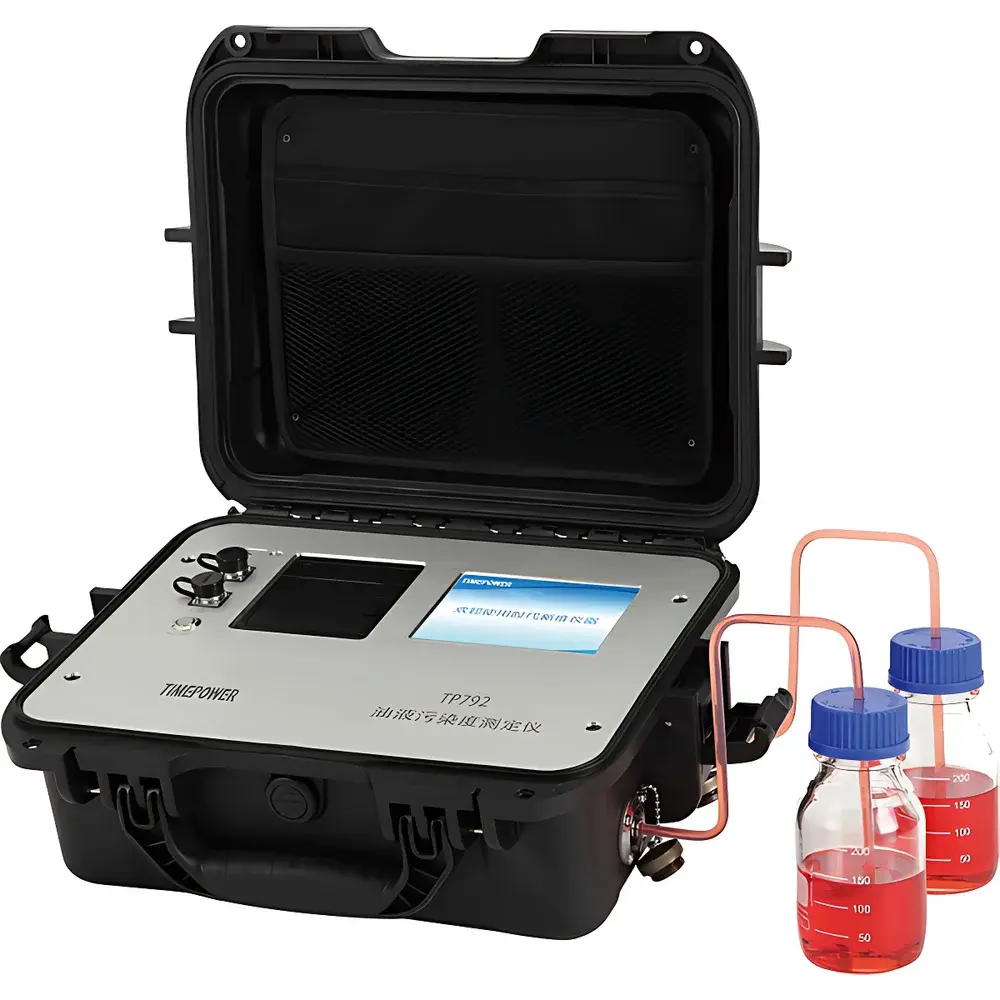
Timepower TP792 Portable Oil Contamination Analyzer
| Brand | Timepower |
|---|---|
| Origin | Beijing, China |
| Manufacturer | Timepower Co., Ltd. |
| Type | Optical Blockage (Light Obscuration) Particle Counter |
| Model | TP792 |
| Particle Size Range | 0.8 μm(c) to 500 μm(c) |
| Detection Channels | 8 user-configurable channels |
| Resolution | <10% |
| Repeatability | RSD < 2% |
| Sample Volume | 0.2–1000 mL |
| Sampling Accuracy | ±1% |
| Flow Rate | 5–80 mL/min |
| Coincidence Limit | 10,000 particles/mL |
| Data Storage | 100 test records |
| Power | AC 220 V ±10%, 50 Hz ±10% or internal battery (≥500 consecutive tests) |
Overview
The Timepower TP792 Portable Oil Contamination Analyzer is an optical blockage (light obscuration)–based particle counter engineered for field-deployable and laboratory-grade assessment of particulate contamination in hydraulic fluids, lubricating oils, turbine oils, and other petroleum-based industrial fluids. It operates on the principle that suspended particles passing through a focused laser beam cause transient reductions in transmitted light intensity—each pulse proportional to particle cross-sectional area. This method complies with internationally recognized metrological frameworks including ISO 11171 (calibration standards), ISO 4406 (contamination code reporting), NAS 1638 (aerospace fluid classification), GJB 420B (Chinese military standard), and DL/T 432 (power industry specification). The instrument delivers quantitative particle counts per unit volume across eight independently configurable size thresholds, enabling direct assignment of ISO or NAS contamination codes without post-processing.
Key Features
- Optical blockage detection using a high-stability semiconductor laser source, optimized for low-noise signal acquisition and minimal thermal drift
- Eight programmable detection channels supporting customizable size binning—from 0.8 μm(c) to 500 μm(c)—with resolution better than 10% per channel
- Precision metering pump system ensuring consistent sample aspiration at flow rates from 5 to 80 mL/min, with volumetric accuracy better than ±1%
- Built-in calibration libraries compliant with ISO 11171, GJB 420B, NAS 1638, SAE AS4059E, and ISO 4406; supports user-defined calibration curves and multi-standard reporting
- Integrated color touchscreen interface with full Chinese character input, real-time histogram visualization, and on-device report generation
- Onboard thermal printer for immediate hardcopy output of contamination codes, raw count data, and pass/fail status per selected standard
- Internal rechargeable battery enabling ≥500 consecutive measurements without external power—ideal for remote maintenance sites, mobile labs, or offshore platforms
- RS232 serial interface for bidirectional communication with LIMS, SCADA systems, or custom data analysis software; supports ASTM E2457–22 compliant metadata tagging
Sample Compatibility & Compliance
The TP792 is validated for use with mineral oils, synthetic esters, phosphate esters, and polyalphaolefin (PAO)-based lubricants within viscosity ranges up to 100 cSt at 40 °C. It accommodates standard 100-mL glass sampling bottles, stainless-steel vacuum vials, and disposable polymer cups—eliminating cross-contamination risk during sequential field testing. All measurement protocols align with Good Laboratory Practice (GLP) and support audit-ready documentation, including timestamped test logs, operator ID tracking, and electronic signature fields where integrated into 21 CFR Part 11–compliant environments. Calibration verification is traceable to NIST-traceable reference particles certified per ISO 21501-4.
Software & Data Management
The embedded firmware implements deterministic data handling: each test record stores raw pulse amplitude histograms, cumulative counts per channel, calculated contamination codes, and environmental metadata (temperature, pressure if externally sensed). Up to 100 complete datasets are retained with automatic overwrite protection. Export via RS232 enables structured ASCII or CSV output compatible with Excel, MATLAB, or enterprise asset management (EAM) platforms. Firmware updates are performed via USB flash drive with cryptographic signature validation to ensure integrity. Optional PC software provides trend analysis, fleet-level statistical process control (SPC), and automated alerting when particle counts exceed preset thresholds aligned with OEM-recommended limits.
Applications
- Routine condition monitoring of hydraulic systems in wind turbines, marine propulsion units, and heavy construction equipment
- Pre-commissioning verification of oil cleanliness prior to turbine startup in power generation facilities
- Acceptance testing of new lubricants against supplier specifications per ISO 4406 Class 13/11/8
- In-service oil analysis for predictive maintenance programs governed by MIL-STD-1797A or SAE ARP5055B
- Field verification of filter performance efficiency using upstream/downstream differential counting
- Supporting root-cause analysis of component wear through time-series particle morphology correlation (when paired with optional microscopy)
FAQ
What particle sizing standard does the TP792 use for its reported micron values?
The instrument reports particle sizes calibrated per ISO 11171 using NIST-traceable polystyrene latex (PSL) spheres; the “(c)” designation indicates equivalent circular diameter under light obscuration conditions.
Can the TP792 measure non-oil liquids such as water-glycol or phosphate ester fire-resistant fluids?
Yes—provided fluid refractive index falls between 1.33 and 1.52 and viscosity remains below 100 cSt at measurement temperature; optional wetted-material kits are available for aggressive chemistries.
Is the internal battery replaceable in the field?
Yes—the Li-ion battery pack is user-swappable with standard Torx tools and retains charge for ≥12 months in standby mode.
Does the device support GLP-compliant electronic record retention?
It generates immutable test logs with embedded timestamps, operator identifiers, and checksum-verified data packets; full 21 CFR Part 11 compliance requires integration with validated third-party audit trail software.
How is sensor fouling mitigated during extended operation?
The optical path incorporates hydrophobic anti-fouling coatings and automatic zero-check routines before each sample cycle; recommended cleaning intervals are defined per ASTM D7687 for optical particle counters.



