
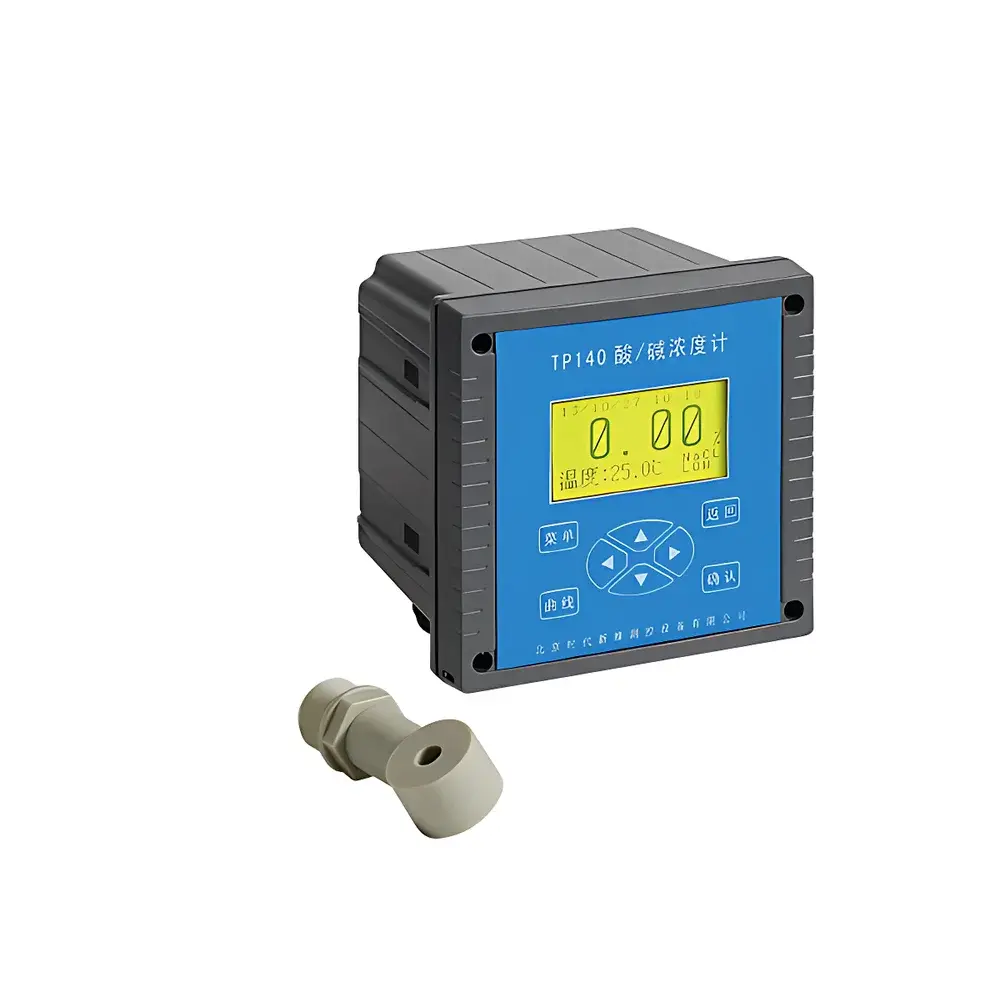
TimePower TP140 Online Alkali Concentration Analyzer
| Brand | TimePower |
|---|---|
| Model | TP140 |
| Origin | Beijing, China |
| Manufacturer | TimePower Measurement & Control Co., Ltd. |
| Measuring Range | NaOH (0–10.00%), Na₂CO₃ (0–10.00%), HCl (0–10.00%), H₂SO₄ (0–20.00%), HNO₃ (0–15.00%), NaCl (0–20.00%) |
| Accuracy | ±2% F.S. |
| Resolution | 0.01% |
| Repeatability | ≤1% |
| Temperature Compensation Range | 0.1–60.0 °C |
| Sensor Type | Pt1000 RTD |
| Output Signals | 0–10 mA / 0–20 mA / 4–20 mA (selectable) |
| Relay Outputs | 2 × SPST (AC220 V / 3 A or DC30 V / 3 A) |
| Display | 128×64 dot-matrix LCD, Chinese interface |
| Power Supply | AC 220 V ±10%, 50 Hz, <5 W |
| Enclosure Rating | IP65 |
| Dimensions (H×W×D) | 155×142×125 mm |
| Panel Cutout | 138×138 mm |
| Weight | 1.6 kg |
| Data Retention | >10 years (non-volatile memory) |
| Installation | Panel-mount / Wall-mount / Rack-mount |
| Electrode Mounting | Flow-through / Immersion / Flanged / In-line |
Overview
The TimePower TP140 Online Alkali Concentration Analyzer is an industrial-grade process analyzer engineered for continuous, real-time measurement of alkaline and acidic electrolyte concentrations in aqueous solutions. It operates on the principle of conductometric analysis—measuring solution conductivity and applying temperature-compensated algorithms to derive concentration values for key industrial reagents including sodium hydroxide (NaOH), sodium carbonate (Na₂CO₃), hydrochloric acid (HCl), sulfuric acid (H₂SO₄), nitric acid (HNO₃), and sodium chloride (NaCl). Designed for integration into high-purity water regeneration systems, boiler cleaning circuits, and chemical dosing control loops, the TP140 delivers stable, drift-resistant readings under variable flow, temperature, and ionic strength conditions. Its microprocessor-based architecture incorporates a 24-bit analog-to-digital converter and Pt1000-based temperature sensing to ensure traceable accuracy across its full operational range.
Key Features
- Corrosion-resistant sensor interface compatible with aggressive alkaline and acidic media, supporting long-term deployment in ion exchange regeneration tanks and acid/alkali storage vessels.
- Wide multi-analyte capability: pre-calibrated concentration ranges for six common process chemicals, each with independent calibration memory and user-selectable display units (% w/w).
- High-precision signal conditioning: 24-bit A/D conversion with auto-zero and auto-gain correction minimizes quantization error and thermal drift.
- Integrated temperature compensation using Pt1000 RTD sensors (0.0–99.9 °C range), with configurable compensation curves aligned to ASTM D1125 and ISO 7888 standards for conductivity-based concentration inference.
- Robust enclosure rated IP65, suitable for indoor industrial environments with ambient temperatures from 5–45 °C and relative humidity up to 90% RH (non-condensing).
- Flexible output architecture: isolated 4–20 mA (or 0–10/0–20 mA) analog output with HART-compatible configuration options; dual programmable relay outputs for alarm, pump interlock, or batch control functions.
- Non-volatile data storage retains calibration coefficients, alarm thresholds, and system settings for >10 years without power—compliant with GLP data integrity requirements.
Sample Compatibility & Compliance
The TP140 is validated for use with low-viscosity, non-suspended aqueous solutions within a sample temperature range of 5–60 °C. Electrode configurations—including flow-through, immersion, flanged, and in-line mounting—enable adaptation to pipelines, open tanks, and recirculating loops. All factory calibrations are traceable to NIST-certified reference standards. The analyzer meets electromagnetic compatibility requirements per IEC 61326-1 (industrial environment), safety compliance per IEC 61010-1, and environmental operating limits defined in GB/T 13978–2008 (Chinese national standard for industrial conductivity analyzers). While not certified for hazardous areas, it is routinely deployed in Class 1 Div 2 / Zone 2 environments when installed with appropriate conduit and grounding per NEC Article 500.
Software & Data Management
The TP140 features an embedded Chinese-language menu system with intuitive navigation, eliminating dependency on external PCs for routine operation. Calibration procedures follow a two-point standard method with automatic slope and offset calculation. All configuration parameters—including relay setpoints, analog output scaling, temperature compensation coefficients, and unit selection—are stored in EEPROM with write-protection logic. The device supports cyclic data logging of concentration, temperature, and diagnostic status (e.g., electrode impedance, signal noise level); overflow behavior is configured to overwrite oldest records automatically. Though no native Ethernet or Modbus TCP interface is included, optional RS-485 communication modules (Modbus RTU protocol) can be retrofitted for SCADA integration. Audit trail functionality is limited to manual logbook entries; for full 21 CFR Part 11 compliance, external historian systems are recommended.
Applications
- Monitoring NaOH concentration during caustic regeneration of mixed-bed ion exchange resins in power plant make-up water treatment systems.
- Controlling acid concentration in boiler tube descaling solutions (e.g., 5–8% HCl or 3–5% H₂SO₄) to prevent over-acidification and metal corrosion.
- Verifying Na₂CO₃ concentration in alkaline cleaning formulations used in pharmaceutical CIP (clean-in-place) skids.
- Continuous verification of neutralization titrant strength in wastewater pH control loops prior to discharge.
- Quality assurance of brine (NaCl) concentration in chlor-alkali cell feed streams.
FAQ
What concentration ranges does the TP140 support for sodium hydroxide?
The TP140 measures NaOH concentration from 0.00% to 10.00% w/w, with a resolution of 0.01% and a maximum error of ±2% of full scale.
Is temperature compensation mandatory for accurate readings?
Yes—conductivity is highly temperature-dependent. The built-in Pt1000 sensor enables automatic compensation across 0.1–60.0 °C; uncorrected measurements may deviate by >2%/°C.
Can the TP140 be used with viscous or particulate-laden solutions?
No. It is designed exclusively for clean, low-conductivity aqueous streams. Suspended solids or oils will foul the electrode surface and invalidate calibration.
Does the instrument comply with FDA or EU GMP requirements?
The TP140 meets general instrumentation design principles outlined in Annex 11 and USP , but lacks electronic signature, audit trail, and user access control features required for full Part 11 compliance.
What maintenance is required for the 140-001 conductivity electrode?
Routine cleaning with deionized water and periodic verification against certified standards (e.g., KCl 0.01 mol/L at 25 °C) every 3–6 months is recommended. Electrode replacement interval depends on chemical exposure intensity but typically exceeds 18 months in controlled applications.






