
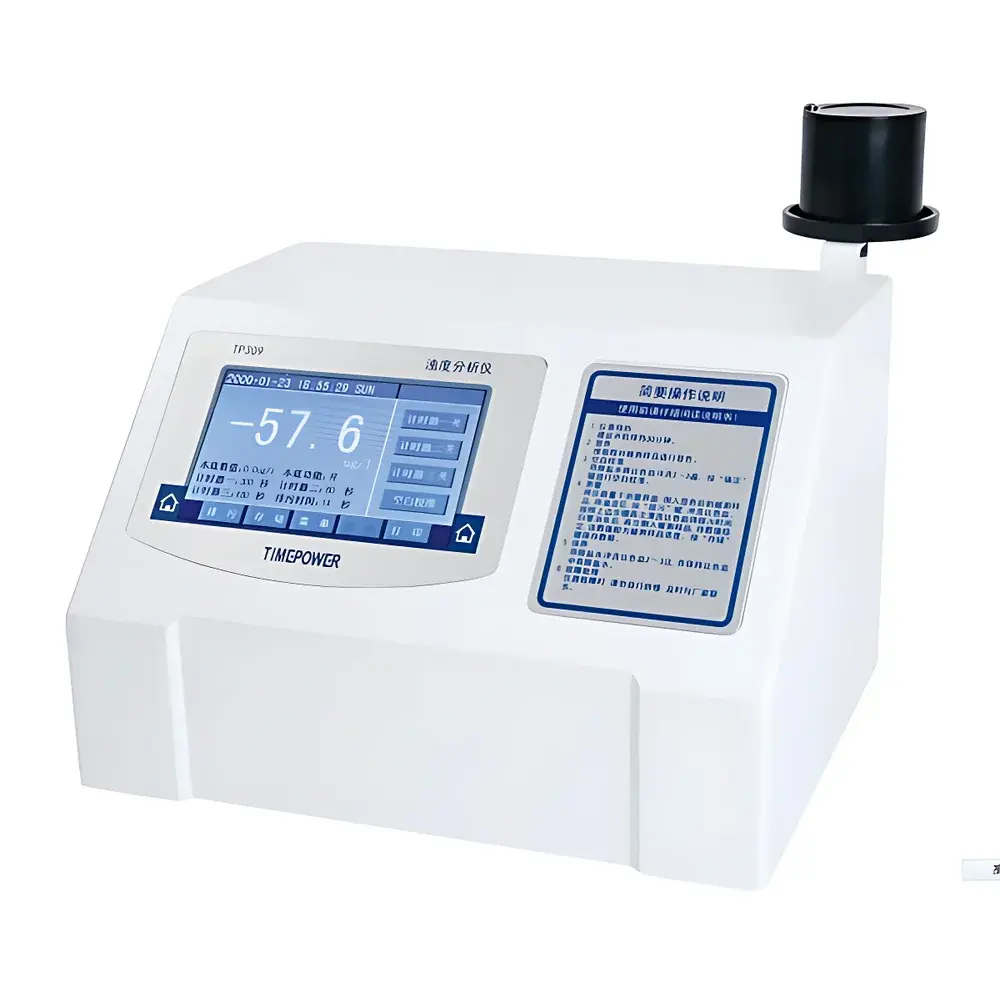
TimePower TP309 Benchtop Multi-Range Turbidimeter
| Brand | TimePower |
|---|---|
| Model | TP309 |
| Type | Benchtop Laboratory Turbidimeter |
| Measurement Range | (0.0–100) NTU or (100–1000) NTU |
| Resolution | 0.01 NTU (0–100 NTU range), 0.1 NTU (100–1000 NTU range) |
| Accuracy | ±2% F.S. (0–100 NTU), ±5% F.S. (100–1000 NTU) |
| Repeatability | ≤1% |
| Stability | ±1% F.S./4 h |
| Operating Temperature | 5–45 °C |
| Relative Humidity | ≤90% RH (non-condensing) |
| Power Supply | AC 85–265 V, 45–65 Hz |
| Power Consumption | ≤30 W |
| Dimensions | 260 × 200 × 180 mm |
| Weight | 3.2 kg |
| Display | 5.0-inch color touchscreen LCD |
| Calibration Method | Formazin-based standard (ISO 7027 compliant) |
| Data Storage | Up to 256 records with auto-overflow management |
| Compliance | Meets Chinese National Standard GB/T 13200-1991 and ISO 7027:1999 for turbidity measurement |
Overview
The TimePower TP309 Benchtop Multi-Range Turbidimeter is a precision optical instrument engineered for accurate, traceable turbidity measurement in laboratory and process control environments. It operates on the principle of nephelometry—measuring the intensity of light scattered at 90° by suspended particles in a liquid sample when illuminated by a stable monochromatic cold light source. This method conforms to ISO 7027:1999 and GB/T 13200-1991, ensuring metrological consistency with international reference standards based on formazin suspension. The TP309 supports dual-range operation (0.0–100 NTU and 100–1000 NTU), enabling high-resolution quantification across applications ranging from ultrapure water validation to industrial wastewater characterization. Its optical architecture integrates a high-stability LED light source with temperature-compensated photodetection circuitry, minimizing drift due to thermal or electrical fluctuations. Designed for GLP-compliant laboratories, the instrument delivers reproducible results under controlled ambient conditions (5–45 °C, ≤90% RH non-condensing), making it suitable for routine QC/QA workflows in drinking water utilities, pharmaceutical water systems, and environmental monitoring labs.
Key Features
- 5.0-inch full-color capacitive touchscreen interface with intuitive Chinese/English bilingual navigation (configurable via firmware)
- Dual-range automatic or manual switching with optimized signal-to-noise ratio in both low- and high-turbidity regimes
- Imported monochromatic cold-light LED source (860 ± 30 nm) offering long service life (>10,000 h), low power consumption, and minimal thermal emission
- Advanced surface-mount technology (SMT) PCB design with integrated analog front-end and microcontroller-based signal processing (ARM Cortex-M4 core)
- Zero-point compensation via blank calibration to correct for optical path contamination, electronic offset, and detector baseline drift
- Onboard data logging with circular buffer storage for up to 256 measurement records—including timestamp, NTU value, range mode, and calibration status
- Rugged benchtop enclosure (260 × 200 × 180 mm; 3.2 kg) with EMI-shielded housing and IP20-rated protection for laboratory use
Sample Compatibility & Compliance
The TP309 is validated for aqueous samples meeting standard formazin calibration protocols per ISO 7027. It accepts standard 25-mm round glass cuvettes (10-mm path length) and accommodates sample volumes ≥30 mL. The instrument supports compliance with regulatory frameworks requiring documented measurement traceability, including ISO/IEC 17025-accredited testing, USP <<731> turbidity assessment for pharmaceutical waters, and EPA Method 180.1 for environmental water analysis. All internal calibration routines adhere to documented procedures with audit-trail-capable metadata logging. Electrical safety complies with IEC 61010-1:2010 (Measurement Category II, Pollution Degree 2). No hazardous substances are used in construction per RoHS Directive 2011/65/EU.
Software & Data Management
Data export is supported via USB host interface (FAT32-formatted flash drive) in CSV format, preserving timestamps, operator ID fields (user-definable), and measurement metadata. Firmware supports configurable auto-calibration reminders (e.g., daily blank check, biweekly full-curve verification) aligned with internal QA protocols. While no proprietary PC software is bundled, exported files are compatible with LIMS platforms and statistical process control tools (e.g., Minitab, JMP, Excel). Audit trail functionality includes immutable logging of calibration events, range changes, and user-initiated zero adjustments—meeting minimum requirements for FDA 21 CFR Part 11 compliance when deployed with appropriate IT governance controls.
Applications
- Validation of purified water (PW) and water for injection (WFI) systems in pharmaceutical manufacturing
- Optimization of coagulation-flocculation-sedimentation processes in municipal drinking water treatment plants
- Monitoring filter integrity and backwash efficiency in membrane filtration units
- Quality control of boiler feedwater and steam condensate in power generation facilities
- Environmental compliance testing for effluent discharge permits (e.g., NPDES reporting)
- Educational use in university analytical chemistry and environmental engineering laboratories
FAQ
What calibration standards are required for routine operation?
Formazin standard solutions traceable to NIST SRM 2134 or equivalent national metrology institute references must be used. Primary standards (e.g., 0.1, 10, 100, 400, and 800 NTU) should be prepared fresh weekly from stock suspensions stored in certified polyethylene bottles.
Can the TP309 measure samples with color interference?
The 860 nm infrared LED minimizes absorption interference from yellow-to-brown colored dissolved organics (e.g., humic substances), but highly absorptive or fluorescent samples require spectral correction or alternative methods such as ratio-turbidimetry.
Is regular maintenance required beyond calibration?
Yes: optical windows must be cleaned weekly with lint-free wipes and reagent-grade isopropanol; cuvette alignment should be verified monthly using a reference cuvette; LED intensity decay is monitored automatically and flagged after >15% deviation from initial output.
Does the instrument support GLP-compliant electronic signatures?
The TP309 does not implement cryptographic user authentication or digital signature generation; however, its audit-log structure and timestamped event records satisfy foundational GLP data integrity requirements when paired with procedural controls and supervised access protocols.
What is the recommended frequency for full calibration curve verification?
Biweekly verification against five-point formazin standards (0.1, 10, 100, 400, 800 NTU) is recommended for regulated environments; daily blank calibration remains mandatory prior to each measurement session.




