
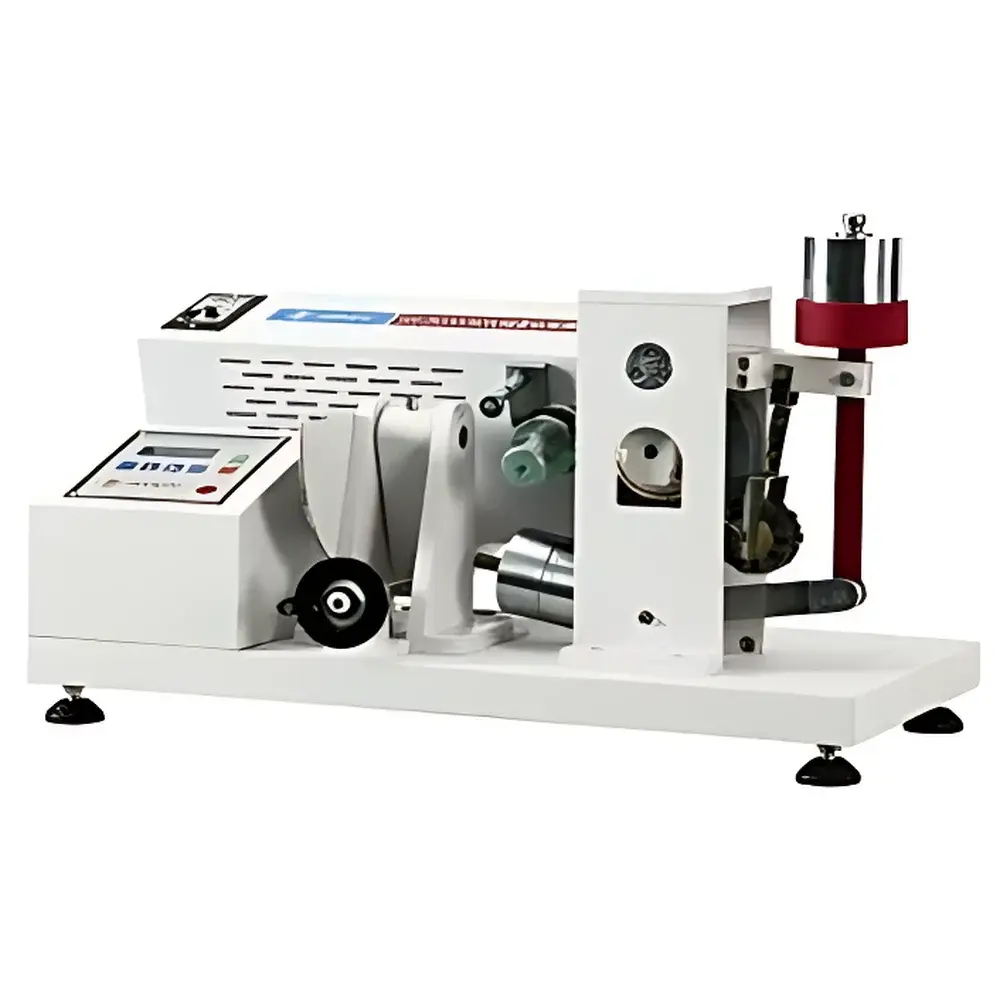
AKRON HY-763 Tribological Abrasion Tester
| Origin | Tianjin, China |
|---|---|
| Manufacturer Type | Authorized Distributor |
| Origin Classification | Domestic (China) |
| Model | HY-763 |
| Price | Upon Request |
| Abrasion Standard Compliance | GB/T 1689, BS 903-A9, CNS 734 |
| Wheel Dimensions | Ø150 × 25 mm (36# grit) or Ø150 × 38 mm (40# grit) |
| Applied Load | 27.5 N (standard), configurable |
| Rotational Speed | 76 ± 2 rpm |
| Counter | LCD, 0–999,999 cycles |
| Specimen Tilt Angle | 0°–45° adjustable |
| Calibration Certificate | CNAS-accredited calibration report included |
Overview
The AKRON HY-763 Tribological Abrasion Tester is a precision-engineered instrument designed to quantify the abrasive wear resistance of elastomeric materials under controlled, repeatable conditions. Based on the standardized Akron abrasion principle—where a rotating abrasive wheel applies tangential shear force against a stationary or oscillating rubber specimen—the tester delivers quantitative wear volume loss data essential for quality assurance and material development in rubber compounding, footwear, tire manufacturing, and industrial belt production. The device operates in accordance with internationally recognized test methodologies, including GB/T 1689 (Chinese National Standard), BS 903-A9 (British Standards Institution), and CNS 734 (Bureau of Standards, Metrology and Inspection, Taiwan), ensuring cross-laboratory comparability and regulatory acceptability in global supply chains.
Key Features
- Modular abrasive wheel mount accommodating dual standard configurations: Ø150 × 25 mm (36# silicon carbide grit) and Ø150 × 38 mm (40# grit), enabling method-specific validation per ASTM D1630 or ISO 4649 Annex A.
- Precision-machined specimen holder with fine-adjustment tilt mechanism (0°–45°), allowing systematic evaluation of angle-dependent wear mechanisms—critical for simulating real-world contact geometries in tread compounds and conveyor surfaces.
- Stable DC motor drive system maintaining rotational speed at 76 ± 2 rpm, compliant with tolerance requirements specified in GB/T 1689 Clause 5.3 and BS 903 Part A9 Section 6.2.
- High-resolution LCD cycle counter (0–999,999) with non-volatile memory retention, supporting uninterrupted long-duration tests and traceable endpoint determination.
- Calibrated dead-weight loading system delivering consistent 27.5 N nominal force (equivalent to ~2.8 kgf), with optional load adapters available for extended testing ranges per user-defined protocols.
- Integrated safety interlock and emergency stop circuitry conforming to IEC 61000-6-2/6-4 electromagnetic compatibility and basic functional safety requirements for laboratory equipment.
Sample Compatibility & Compliance
The HY-763 accommodates flat, rectangular rubber specimens (typically 25.4 × 25.4 × 6.4 mm per GB/T 1689) as well as curved or contoured samples via custom fixture adaptation. It supports vulcanized natural rubber (NR), styrene-butadiene rubber (SBR), butadiene rubber (BR), thermoplastic elastomers (TPE), and rubber–polymer composites used in footwear outsoles, automotive treads, mining conveyor belts, and hydraulic seals. All mechanical and operational parameters are traceable to national metrological standards through its supplied CNAS-accredited calibration certificate (ISO/IEC 17025:2017 accredited), satisfying internal audit requirements for GLP-compliant laboratories and supplier qualification programs under IATF 16949 and ISO 9001.
Software & Data Management
While the HY-763 operates as a stand-alone electromechanical tester without embedded software, it is fully compatible with external data acquisition systems via analog output (0–10 V) for real-time torque or load monitoring. Users may integrate the instrument into LIMS or ELN environments using RS-232 or USB-to-serial adapters (optional). Test logs—including cycle count, elapsed time, applied load, and tilt angle—are manually recorded in accordance with 21 CFR Part 11-aligned documentation practices; electronic records generated externally may include audit trails, user authentication, and version-controlled SOP references when deployed within validated workflows.
Applications
- Comparative wear ranking of rubber formulations during R&D phase screening.
- Batch release testing for tire tread compounds against OEM-specified abrasion index thresholds.
- Quality control of molded shoe soles per ASTM F2266 and ISO 20344 footwear performance standards.
- Evaluation of reclaimed rubber content impact on abrasion resistance in sustainable compound design.
- Accelerated aging studies correlating ozone exposure, thermal history, and post-abrasion mass loss.
- Supporting failure analysis investigations where surface degradation precedes structural fatigue in dynamic sealing applications.
FAQ
What standards does the HY-763 directly support?
The instrument is configured and verified for GB/T 1689, BS 903-A9, and CNS 734. With appropriate fixtures and procedural adjustments, it may be adapted for ISO 4649 (Annex A) and ASTM D1630 testing.
Is the CNAS calibration report sufficient for FDA-regulated environments?
The CNAS certificate provides metrological traceability to SI units and satisfies baseline calibration requirements; however, full 21 CFR Part 11 compliance requires additional procedural controls—such as secure electronic recordkeeping, access restrictions, and change management—which are implemented at the laboratory level, not by the instrument itself.
Can the tilt angle be locked at intermediate positions?
Yes—the angular adjustment mechanism features graduated刻度 (0.5° increments) and a locking screw for stable fixation at any setting between 0° and 45°.
Are replacement abrasive wheels supplied with certified grit distribution data?
Standard wheels are sourced from ISO 8501-1 certified suppliers; batch-specific particle size distribution reports and hardness certificates are available upon request for critical validation studies.
Does the tester require periodic recalibration beyond the initial CNAS report?
Per ISO/IEC 17025 and internal QA protocols, annual recalibration is recommended; users should also perform routine performance verification using reference rubber standards before each test series.
Related Products



