
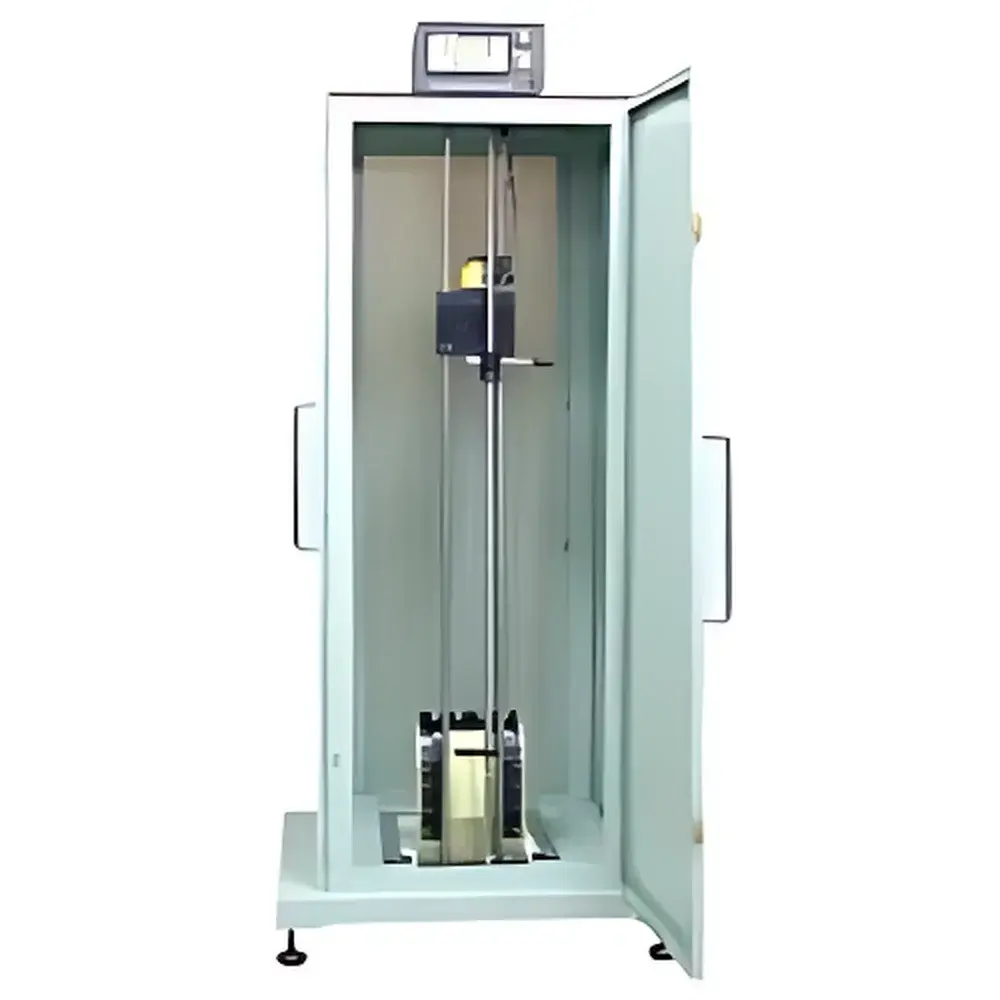
GB/T 24654 Compliant Dynamic Puncture and Tear Resistance Tester for Protective Clothing Materials
| Origin | Tianjin, China |
|---|---|
| Manufacturer Type | Authorized Distributor |
| Regional Origin | Domestic (PRC) |
| Model | GB/T 24654 |
| Price Range | USD 7,000 – 14,000 |
| Sample Dimensions | 110 mm width × 180–200 mm length |
| Hammer Mass | 1000 ± 10 g and 2000 ± 10 g (including auxiliary 1000 g weight) |
| Drop Height | Adjustable from 50 to 75 cm |
| Impact Energy Calculation | Based on real-time photogate-measured drop velocity and hammer mass (Joules) |
| Blade Specifications | 10 mm cutting edge length, 0.2R mm tip radius, 60° included angle, SK-3 tool steel, 58 HRC hardness |
| Drop Mechanism | Electromagnetic release with fail-safe mechanical brake |
| Timing Resolution | 0.1 ms (0–999 ms range) |
| Velocity Display | 0.0–9.9 m/s |
| Control Interface | Industrial-grade capacitive touchscreen HMI |
Overview
The GB/T 24654 Compliant Dynamic Puncture and Tear Resistance Tester is a precision-engineered instrument designed to evaluate the dynamic mechanical resistance of protective textile materials—particularly those used in occupational, medical, and emergency response personal protective equipment (PPE)—against sharp-object puncture and high-velocity tearing. Operating on the principle of controlled free-fall impact, the system delivers reproducible kinetic energy to standardized specimens via calibrated hammers equipped with geometrically defined blades. Unlike quasi-static tensile or tear tests, this apparatus replicates real-world transient threat scenarios: the sudden, localized penetration and propagation of tears under impact loading. The test method conforms to internationally harmonized mechanical performance assessment protocols, where impact energy (in joules) is calculated in real time using photogate-derived velocity and precisely certified hammer mass—ensuring traceability to SI units and eliminating reliance on nominal drop height alone. This physical model directly supports risk-informed material selection for EN ISO 13688-compliant garments and aligns with the biomechanical thresholds specified in ISO 13995 for cut-resistant fabrics.
Key Features
- Electromagnetically actuated drop mechanism with dual-mass hammer configuration (1000 g and 2000 g), enabling precise energy grading across 0.5–14.7 J ranges (at 50–75 cm drop heights)
- Integrated photogate sensor array for sub-millisecond timing resolution (±0.1 ms), enabling accurate pre-impact velocity calculation and kinetic energy derivation per ASTM E23 and ISO 13802 principles
- Hardened SK-3 steel blade (58 HRC) with metrologically certified geometry: 10 mm active edge, 60° included angle, and 0.2R mm tip radius—fully compliant with ISO 13995 Annex A and GB/T 20654 Clause 6.2
- Failsafe mechanical braking system engaged automatically upon hammer release failure or abnormal deceleration, meeting IEC 61508 SIL 2 functional safety requirements for laboratory impact testers
- Capacitive touchscreen HMI with embedded calibration logging, user-accessible parameter presets, and real-time graphical display of impact velocity, energy, and post-test tear length measurement
- Modular sample mounting plate (110 mm × 180–200 mm aperture) compatible with standard clamping fixtures per JIS T 8050 and GB/T 24654 Section 5.3
Sample Compatibility & Compliance
This tester accommodates woven, knitted, laminated, and coated textile substrates—including aramid, UHMWPE, stainless steel hybrid weaves, and polymer-coated nonwovens—commonly employed in cut-resistant gloves, surgical gowns, firefighter turnout gear, and ballistic underlayers. Specimen preparation strictly follows ISO 13995:2021 Section 4 (conditioning at 20°C ± 2°C and 65% ± 5% RH for ≥24 h) and GB/T 24654–2009 Clause 4.1. All mechanical outputs—including measured tear length (mm), calculated impact energy (J), and derived specific tear resistance (J/mm)—are reported in accordance with ISO/IEC 17025:2017 documentation requirements. The system’s traceable calibration chain supports audit readiness for GLP environments and regulatory submissions referencing FDA 21 CFR Part 11 (electronic records integrity) and EU MDR Annex II requirements for PPE performance validation.
Software & Data Management
The embedded control firmware provides ISO 17025-aligned data integrity features: automatic timestamping, operator ID logging, calibration certificate linkage, and immutable audit trails for all test parameters and results. Export formats include CSV (for LIMS integration) and PDF reports containing raw photogate timestamps, velocity curves, energy calculations, and annotated tear-length images captured via optional integrated macro-imaging module. Firmware updates are digitally signed and delivered via secure HTTPS endpoint, satisfying NIST SP 800-53 RA-5 (software integrity) controls. No cloud dependency: all data remains on-device unless explicitly exported, preserving confidentiality for proprietary material formulations.
Applications
- Validation of cut-and-puncture resistance for EN 388:2016+2023 Class X gloves and ISO 13997-compliant blade-resistant textiles
- Development-stage screening of novel high-modulus fiber architectures under dynamic loading conditions
- Quality conformance testing for medical isolation gowns per ASTM F1671 (viral penetration resistance correlation)
- Comparative benchmarking of multi-layer composite systems against ISO 13995 Level 1–5 energy thresholds
- Root-cause analysis of field failures through controlled replication of incident-level impact energies
FAQ
Does the system support automated tear length measurement?
Yes—when paired with the optional digital imaging module (sold separately), the system performs pixel-based tear length quantification with ±0.2 mm repeatability, eliminating manual ruler-based subjectivity.
Is calibration traceable to national metrology institutes?
Each unit ships with a UKAS-accredited calibration certificate for hammer mass (NPL-traceable), photogate timing (NIST-traceable oscilloscope verification), and blade geometry (certified coordinate measuring machine report).
Can test parameters be locked for regulated environments?
Administrative password protection enables parameter lockdown mode, restricting modifications to pre-approved test methods—fully compliant with 21 CFR Part 11 §11.10(a) for electronic signatures.
What maintenance intervals are recommended?
Photogate alignment verification every 200 tests; blade replacement after 50 impacts or visible edge degradation; annual full recalibration including electromagnetic release force profiling.
Is third-party software integration supported?
Yes—the device exposes RESTful API endpoints for bidirectional communication with LabVantage, Thermo Fisher SampleManager, and custom MES platforms via TLS 1.2-secured HTTP requests.





