
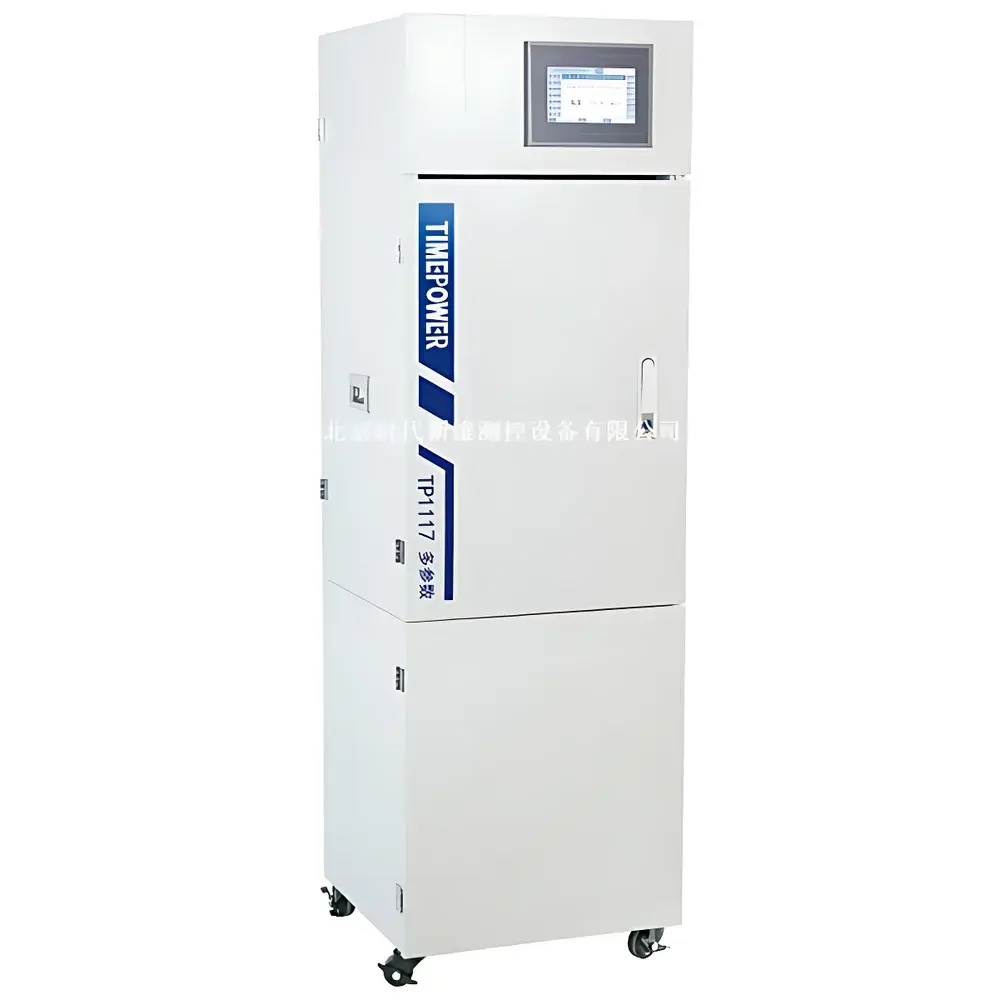
TimePower TP1111 Online COD Analyzer (Potassium Dichromate Method)
| Brand | TimePower |
|---|---|
| Origin | Beijing, China |
| Manufacturer Type | Manufacturer |
| Product Type | Domestic |
| Model | TP1111 |
| Instrument Category | Online Analyzer |
| Measurement Principle | Potassium Dichromate Digestion Method (Online) |
| Detection Wavelength | 610 ± 20 nm |
| Measurement Range | 5–1500 mg/L COD |
| Accuracy | ≤ ±10% |
| Repeatability | ≤ ±10% |
| Limit of Detection | 0.1 mg/L |
| Cycle Time | 30 min per measurement |
| Batch Capacity | 15 or 30 samples per run |
| Calibration Interval | 1–99 days (user-configurable) |
| Maintenance Interval | ~30 min monthly |
| Power Supply | AC 230 ±10 V, 50 ±10 Hz, 5 A |
| Dimensions | 1570 × 500 × 450 mm (H×W×D) |
| Environmental Operating Conditions | +5 to +28 °C, RH ≤90% (non-condensing) |
| Output Interfaces | RS-232, 4–20 mA, RS-485 (optional) |
| Data Retention | Non-volatile memory preserves logs during power loss |
| Compliance | GB 11914–1989 “Water Quality – Determination of Chemical Oxygen Demand – Potassium Dichromate Method” |
Overview
The TimePower TP1111 Online COD Analyzer is an industrial-grade, fully automated spectrophotometric system engineered for continuous, unattended monitoring of chemical oxygen demand (COD) in diverse aqueous matrices—including surface water, municipal drinking water, industrial effluent, and high-strength wastewater. It implements the standardized potassium dichromate digestion method (GB 11914–1989), a reference-grade wet-chemistry technique widely accepted for regulatory compliance and process control in environmental laboratories and wastewater treatment plants. The instrument performs complete on-board digestion at elevated temperature (165 °C) and pressure within a sealed reaction chamber, minimizing volatile losses and operator exposure. Following oxidation of organic constituents by Cr6+ under strongly acidic conditions—catalyzed by Ag2SO4 and masked for chloride interference using HgSO4—the resulting colorimetric change in the Cr3+/Cr6+ ratio is quantified at 610 nm using a precision photometric detection module. This optical signal is linearly correlated to COD concentration via NIST-traceable calibration curves, enabling traceable, reproducible results across the full 5–1500 mg/L range.
Key Features
- Sealed high-temperature/pressure digestion system (165 °C) eliminates corrosive vapor release and enhances oxidation completeness for recalcitrant organics.
- Valve-driven fluidic architecture with minimal dead volume ensures precise reagent metering, extended component lifetime, and simplified maintenance.
- Optical reagent dosing via visible-light photocell system replaces traditional peristaltic pump tubing—eliminating wear-induced volumetric drift and enabling accurate 1 mL reagent delivery per assay.
- Peristaltic pump operates under negative pressure with integrated air buffer zone, preventing direct contact between aggressive reagents (e.g., concentrated H2SO4, HgSO4) and pump tubing—significantly extending tube service life.
- Chemically resistant modified PTFE transparent tubing (ID >1.5 mm) minimizes clogging from suspended solids commonly found in raw wastewater streams.
- Integrated touchscreen HMI supports real-time status monitoring, parameter configuration, event logging, and guided troubleshooting—all accessible without external PC.
- Automatic post-failure recovery: Upon power resumption or fault reset, the system executes a purge sequence to evacuate residual digestate and resumes scheduled operation without manual intervention.
Sample Compatibility & Compliance
The TP1111 accommodates heterogeneous sample types—including turbid, saline, and particulate-laden waters—through adaptive sampling protocols and chloride compensation (via stoichiometric HgSO4 addition). Its methodology conforms strictly to GB 11914–1989, which aligns with ISO 6060:1989 and serves as the technical basis for many national discharge permits and environmental quality standards in Asia. While not certified to EPA Method 410.4 or ASTM D1253, its performance characteristics (±10% accuracy, LOD 0.1 mg/L, 24-h stability ≤±10%) meet typical requirements for Class II–III wastewater monitoring under China’s “Technical Specifications for Automatic Monitoring of Pollution Sources” (HJ 353–2019). All firmware and data handling routines support audit-ready operation, including time-stamped calibration logs, error codes, and reagent lot tracking—facilitating GLP-aligned recordkeeping.
Software & Data Management
Embedded firmware provides configurable measurement scheduling (interval: 40–9999 min; optional fixed-time or sunrise-triggered cycles), user-defined calibration intervals (1–99 days), and programmable maintenance alerts. Raw absorbance values, calculated COD concentrations, QC flags (e.g., digestion temperature deviation, blank drift), and diagnostic codes are stored in non-volatile memory with timestamping and retention ≥90 days. Communication interfaces include isolated RS-232 (for local PC connection), analog 4–20 mA output (linearly scaled to 0–1500 mg/L), and optional RS-485 Modbus RTU for integration into SCADA or DCS platforms. Data export is supported via USB flash drive (CSV format); no cloud dependency or proprietary software license is required.
Applications
- Continuous compliance monitoring at municipal wastewater treatment plant (WWTP) influent, effluent, and sludge dewatering streams.
- Real-time process optimization in industrial pretreatment systems (e.g., textile, pharmaceutical, food processing).
- Early-warning detection of accidental discharges or upstream contamination events in river basin monitoring networks.
- Supporting ISO 14001 environmental management systems through automated, auditable COD trend reporting.
- Supplemental verification for laboratory-based batch COD analysis—reducing manual sampling frequency while maintaining statistical confidence.
FAQ
Does the TP1111 require daily manual intervention?
No. Once commissioned and calibrated, it operates autonomously for up to 30 days between routine maintenance sessions (e.g., tubing inspection, reagent replenishment). Scheduled cleaning and calibration can be fully automated.
How does the system handle high-chloride wastewater?
It incorporates stoichiometric HgSO4 dosing prior to digestion to complex Cl− ions, preventing erroneous oxidation and ensuring accuracy in samples containing up to 2000 mg/L Cl− (per GB 11914–1989 specifications).
Is remote diagnostics supported?
Yes—via RS-485 Modbus, users can read real-time operational parameters (digestion temp, photometer voltage, valve actuation status) and trigger diagnostic routines from a central control room.
What safety provisions exist for hazardous reagents?
All reagent handling occurs within enclosed, leak-tested manifolds. The system includes liquid-level sensors, pressure relief valves, and emergency stop logic compliant with IEC 61508 SIL 2 functional safety principles.
Can historical data be exported for regulatory submission?
Yes—CSV-formatted files containing timestamps, measured values, calibration records, and system events are exportable via USB without third-party software or internet connectivity.







