
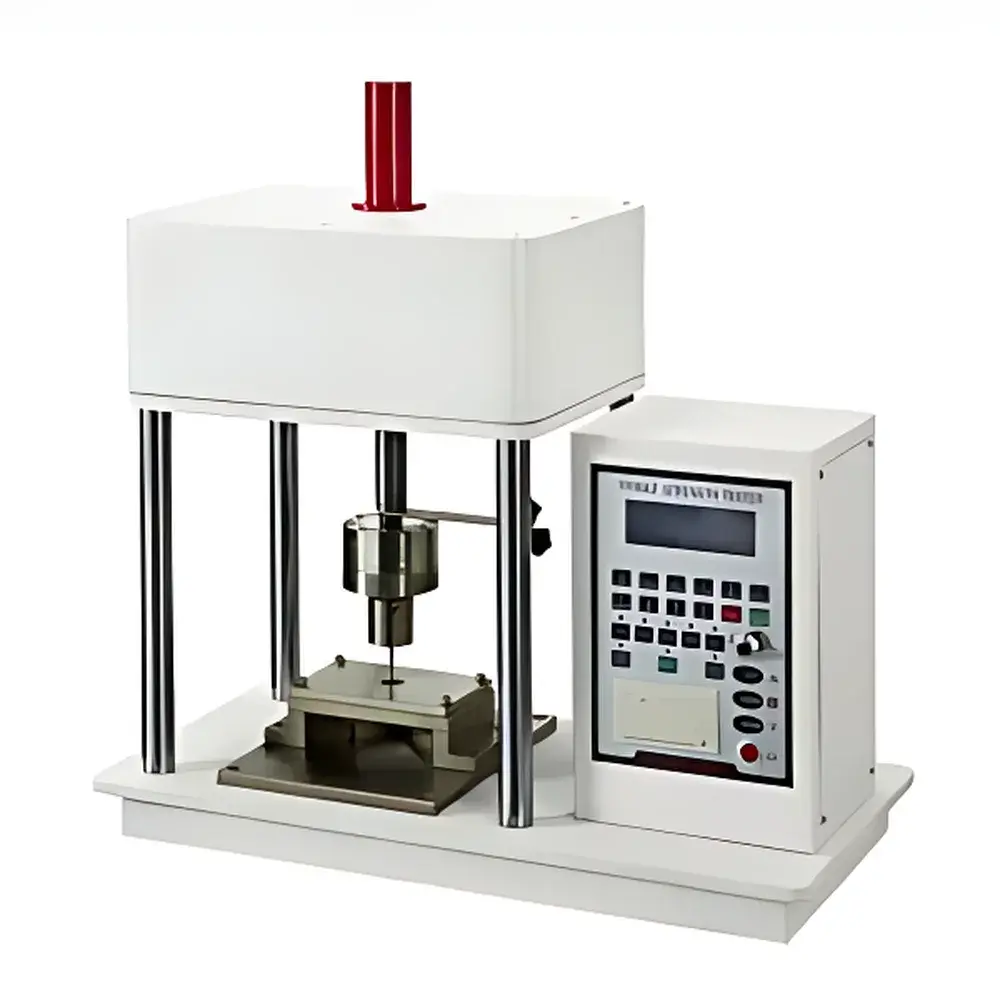
HY-610F Safety Footwear Compression and Puncture Resistance Tester
| Origin | Tianjin, China |
|---|---|
| Manufacturer Type | Authorized Distributor |
| Origin Category | Domestic (PRC) |
| Model | HY-610F |
| Pricing | Upon Request |
| Max Load Capacity | 20 kN |
| Compression/Puncture Speed | 2–12 mm/min (adjustable) |
| Force Resolution | 1/10,000 full scale (HY-2000 display) |
| Test Pin Diameter | 4.50 ± 0.05 mm (hardness ≥60 HRC) |
| Compression Platen Hardness | ≥60 HRC |
| Accessories | Dial indicator, modeling clay, aluminum foil sheet, precision mold set |
| Optional | Thermal micro-printer, CNAS-accredited calibration certificate, replacement test pins |
Overview
The HY-610F Safety Footwear Compression and Puncture Resistance Tester is a dedicated mechanical testing system engineered for standardized evaluation of protective footwear performance under static compressive and localized puncture loads. It operates on the principle of controlled quasi-static force application—applying calibrated axial load via a hardened steel platen or precision-ground test pin to simulate real-world occupational hazards such as falling objects or stepping on sharp debris. Designed in strict alignment with international regulatory frameworks governing personal protective equipment (PPE), the instrument enables laboratories and quality assurance departments to verify compliance of safety footwear with EN 344 (now superseded by EN ISO 20344), ISO 20344:2018, and GB/T 20991–2007. Its modular fixture architecture supports both toe-cap compression testing (to assess resistance to static crushing forces up to 20 kN) and sole puncture resistance evaluation (using a defined 4.5 mm diameter pin), ensuring traceable, repeatable, and auditable test outcomes required for CE marking, CCC certification, and internal QA documentation.
Key Features
- High-precision dual-mode operation: configurable for either static compression (toe cap) or localized puncture (midsole/outer sole) testing per ISO 20344 Annex B and Annex C protocols
- Adjustable crosshead speed range (2–12 mm/min) with closed-loop motor control, enabling consistent strain-rate application across test cycles
- Load frame constructed with rigid cast-iron base and hardened steel guide columns to minimize deflection and ensure parallel force transmission
- Integrated high-stability load cell with 20 kN capacity and 0.01% FS linearity, coupled with HY-2000 digital controller offering 1/10,000 force resolution and real-time data sampling
- Hardened compression platen (≥60 HRC) and interchangeable puncture pins (4.50 ± 0.05 mm diameter, ≥60 HRC) meet dimensional and metallurgical requirements specified in ISO 20344
- Dedicated fixture sets include calibrated toe-cap compression jig, puncture test assembly with standardized support plate, and auxiliary tools (dial indicator, modeling clay, aluminum foil, precision mold)
Sample Compatibility & Compliance
The HY-610F accommodates standard adult-sized safety footwear (EU sizes 36–48) with minimal sample preparation. Test specimens are secured using non-deforming clamping mechanisms that preserve structural integrity during loading. All test procedures adhere to the geometric, environmental, and reporting stipulations of ISO 20344:2018 (Clause 6.2 – Compression Resistance; Clause 6.3 – Puncture Resistance), EN ISO 20344:2022, and GB/T 20991–2007. The system supports GLP-compliant operation when paired with optional thermal printer and CNAS-accredited calibration documentation—ensuring metrological traceability to SI units and facilitating audit readiness for ISO/IEC 17025 accredited laboratories.
Software & Data Management
While the base configuration utilizes the HY-2000 standalone controller with LED display and manual data readout, the system is compatible with optional PC-based data acquisition modules supporting USB or RS-232 interfaces. Raw force-displacement curves can be exported in CSV format for post-processing in MATLAB, Excel, or statistical analysis platforms. When configured with the optional thermal micro-printer, test reports include date/time stamp, operator ID, sample ID, peak load value, displacement at failure, and pass/fail status relative to threshold criteria (e.g., ≤15 mm toe-cap deformation at 15 kN per ISO 20344). Audit trails and electronic records comply with FDA 21 CFR Part 11 requirements when implemented with validated software and user access controls.
Applications
- Verification of steel/composite toe-cap crush resistance in occupational safety footwear prior to market release
- Assessment of midsole puncture resistance for footwear used in construction, logistics, and utility sectors
- Quality conformance testing for OEMs, third-party certification bodies (e.g., SGS, TÜV, CQC), and national PPE inspection agencies
- R&D validation of novel composite materials (e.g., thermoplastic polyurethane, aramid laminates) intended for puncture-resistant insoles
- Internal production line QC screening to monitor batch-to-batch consistency in protective element performance
FAQ
What standards does the HY-610F explicitly support?
EN ISO 20344:2022, ISO 20344:2018, and GB/T 20991–2007 for compression and puncture resistance testing of safety footwear.
Is the test pin geometry certified to standard tolerances?
Yes—the supplied puncture pins are manufactured to 4.50 ± 0.05 mm diameter and hardness ≥60 HRC, satisfying ISO 20344 Annex C dimensional and material specifications.
Can test data be exported for regulatory submission?
Yes—when equipped with optional data interface hardware and compliant software, force-displacement datasets and summary reports are exportable in CSV or PDF format with full metadata for regulatory review.
What calibration documentation is available?
A CNAS-accredited calibration certificate (traceable to NIM, China) is available as an optional add-on, including uncertainty budgeting and verification against reference standards.
Does the system require external environmental conditioning?
No—testing is conducted at ambient laboratory conditions (15–30°C, 40–60% RH) as specified in ISO 20344; no climate chamber integration is necessary for standard compliance testing.



