
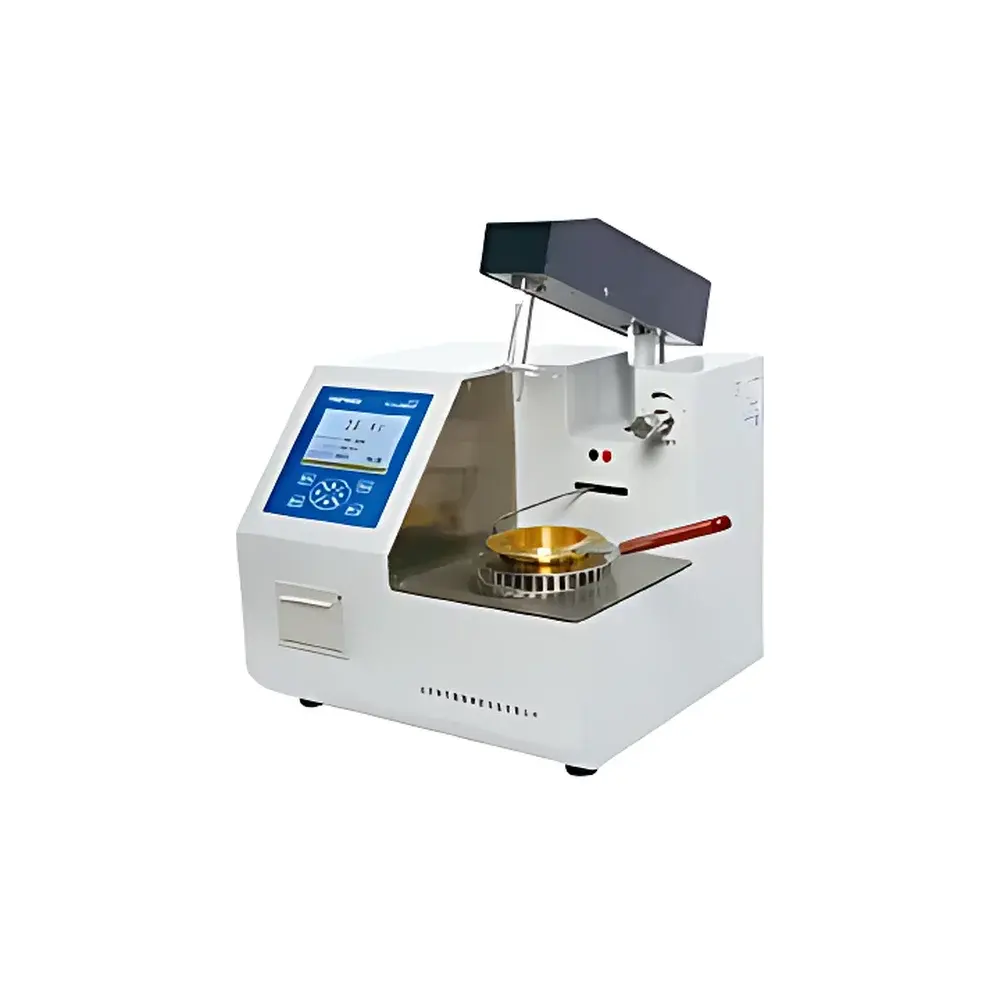
Timepower TP612 Cleveland Open Cup Flash Point Tester
| Brand | Timepower |
|---|---|
| Origin | Beijing, China |
| Manufacturer Type | Manufacturer |
| Country of Origin | Domestic (China) |
| Model | TP612 |
| Detection Method | Cleveland Open Cup (COC) |
| Measurement Range | 79–370 °C |
| Accuracy | ±2 °C |
| Repeatability | ≤4 °C |
| Resolution | 0.1 °C |
| Heating Rate | Adjustable |
| Ignition Modes | Gas Flame Scanning or Electronic Spark Ignition (user-selectable) |
| Temperature Sensor | Imported Pt100 RTD, Stainless Steel Housing |
| Display | TFT Color LCD (480 × 272, 260K colors) |
| Cooling | Integrated High-Flow Air Cooling System |
| Printer | Thermal Printer (36-character width, Chinese/English support) |
| Power Supply | AC 220 V ±10%, 50 Hz ±10% |
| Power Consumption | ≤600 W |
| Dimensions | 350 × 310 × 300 mm |
| Weight | 14.5 kg |
| Atmospheric Pressure Compensation | Yes |
| Safety Features | Overtemperature Auto-Shutoff, Self-Diagnostic Fault Detection, Automatic Test Arm Retraction, Ventilation Cabinet Requirement |
Overview
The Timepower TP612 Cleveland Open Cup Flash Point Tester is an automated analytical instrument engineered for precise determination of the open cup flash point of petroleum products in strict compliance with internationally recognized standard test methods — primarily ASTM D92 and GB/T 3536. Based on the Cleveland Open Cup (COC) principle, the instrument heats a representative sample in a standardized brass test cup under controlled conditions while continuously monitoring vapor concentration above the liquid surface. Flash point is defined as the lowest temperature at which the evolved hydrocarbon vapors form an ignitable mixture with ambient air, producing a momentary flash upon exposure to a calibrated ignition source. This thermodynamic endpoint reflects critical safety-related volatility characteristics essential for storage, transportation, and handling classification of lubricating oils, residual fuels, bitumens, and other high-boiling petroleum fractions.
Key Features
- Fully automated operation sequence: cup positioning, heating ramp control, ignition triggering, flash detection, data logging, arm retraction, and air cooling — all executed without manual intervention.
- Two selectable ignition modes: programmable gas flame scanning (using LPG or propane via external cylinder) or contactless electronic spark ignition — enabling method flexibility and eliminating consumable flame sources where required.
- High-reliability flash detection via precision ionization ring sensor, delivering consistent response to transient flame events with minimal false positives.
- Adjustable heating rate conforming to ASTM D92 and GB/T 3536 procedural requirements; thermal profile dynamically optimized to maintain prescribed ramp tolerances throughout the test.
- Integrated atmospheric pressure compensation algorithm — automatically corrects raw flash point readings based on real-time barometric input, ensuring traceable results across varying elevation and weather conditions.
- Robust hardware architecture: stainless steel sensor housing, corrosion-resistant internal components, and sealed electronics designed for laboratory environments with moderate hydrocarbon vapor exposure.
- Comprehensive safety interlocks: overtemperature cutoff, leak detection alert (for gas mode), ventilation cabinet status monitoring, and automatic power-down after test completion.
Sample Compatibility & Compliance
The TP612 is validated for use with non-volatile or semi-volatile petroleum derivatives including but not limited to lubricating base oils, heavy fuel oils (e.g., No. 4, No. 5, No. 6), asphalt binders, cutting fluids, and industrial hydraulic oils. It excludes low-flash liquids such as gasoline, naphtha, or solvents — which require closed-cup methodology (e.g., ASTM D56 or D93). All operational parameters align with ASTM D92’s procedural constraints for COC testing, including cup geometry, thermometer placement, stirrer speed (if applicable), and flame diameter specifications. The system supports GLP-compliant documentation through timestamped thermal records, operator ID tagging (via optional login module), and audit-ready printouts satisfying internal quality protocols and regulatory review requirements.
Software & Data Management
Data acquisition and instrument control are managed through an embedded real-time operating system with localized Chinese/English UI. Each test generates a complete digital record comprising start time, ambient pressure, heating curve coordinates (temperature vs. time), detected flash event timestamp, final reported value, and pass/fail flag against user-defined specification limits. Results are stored internally (≥1000 test logs) and exported via USB interface in CSV format for integration into LIMS or QA databases. Thermal printer output includes full test metadata, instrument ID, calibration status indicator, and compliance statement referencing ASTM D92 or GB/T 3536. Optional firmware upgrade path supports future alignment with FDA 21 CFR Part 11 electronic signature and audit trail capabilities.
Applications
This instrument serves routine quality assurance laboratories in power generation facilities (transformer oil monitoring), petrochemical refineries (finished product release testing), third-party inspection agencies (SGS, BV, CCIC), customs laboratories (import/export compliance), and academic research groups studying thermal stability and volatility behavior of complex hydrocarbon mixtures. Typical use cases include batch certification of turbine oils per ISO 8502, verification of flash point conformity for marine bunker fuels under MARPOL Annex VI, and forensic analysis of degraded insulating oils exhibiting abnormal volatility shifts.
FAQ
What standards does the TP612 comply with?
ASTM D92 and GB/T 3536 for Cleveland Open Cup flash point determination.
Can the TP612 be used for gasoline or diesel testing?
No — gasoline, kerosene, and light distillates require closed-cup methods (e.g., ASTM D56 or D93); the TP612 is designed exclusively for higher-boiling petroleum products.
Is atmospheric pressure correction mandatory?
Yes — accurate flash point reporting requires real-time barometric input; the instrument will prompt entry if uncalibrated.
Does the system support network connectivity or remote monitoring?
Not natively; data export is USB-based. Ethernet or Wi-Fi modules are available as factory-installed options upon request.
What maintenance is required for long-term reliability?
Routine cleaning of the test cup and ionization ring after each series of tests; annual verification of Pt100 sensor calibration using NIST-traceable reference thermometers.






