
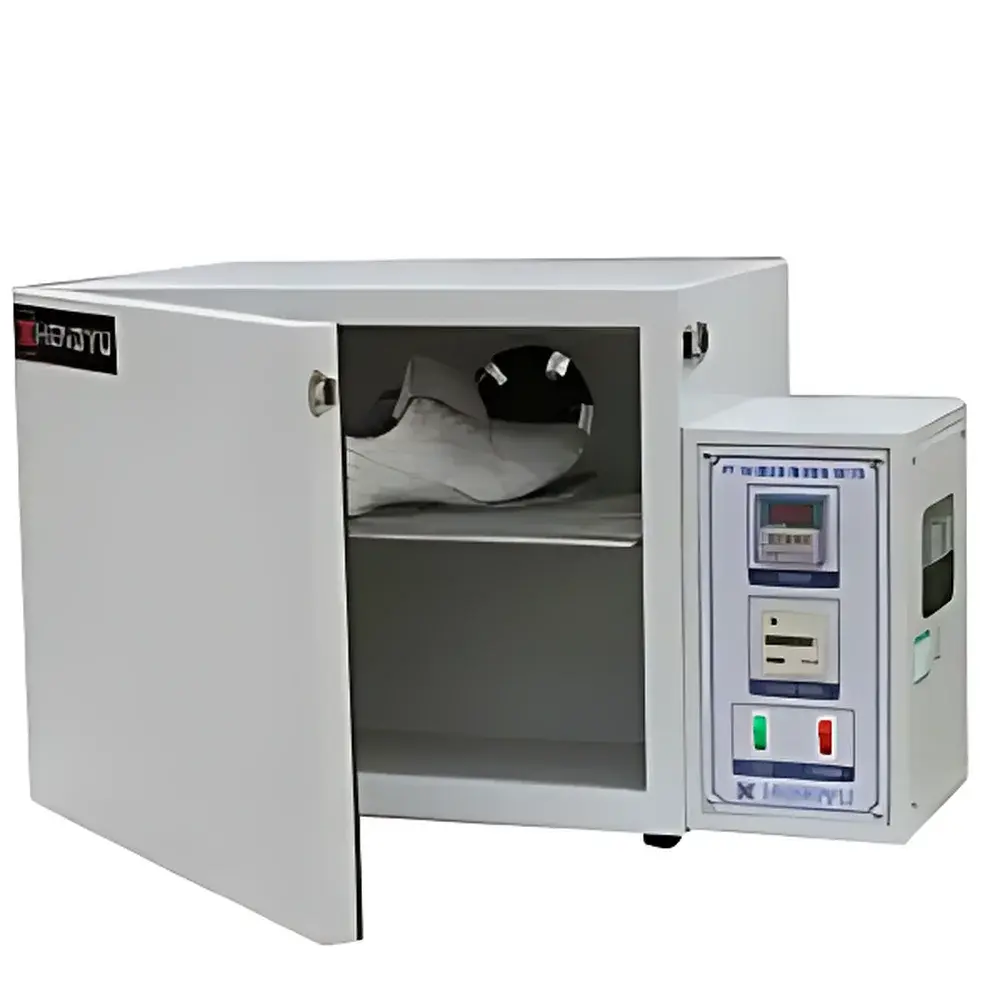
HY-764B UV Yellowing Test Chamber
| Origin | Tianjin, China |
|---|---|
| Manufacturer Type | Authorized Distributor |
| Origin Category | Domestic (China) |
| Model | HY-764B |
| Pricing | Upon Request |
| Timer | LCD digital, 0–24 h range |
| UV Source | Two 15 W fluorescent UV lamps |
| UV Wavelength Range | 280–400 nm |
| Internal Chamber Dimensions | 50 × 30 × 35 cm (L × W × H) |
| Calibration Certificate | ISO/IEC 17025-accredited CNAS calibration report included |
Overview
The HY-764B UV Yellowing Test Chamber is a purpose-built environmental test instrument engineered for quantitative assessment of yellowing resistance in light-colored or white polymeric materials—particularly footwear components including uppers, outsoles, midsoles, and synthetic leathers. It operates on the principle of controlled ultraviolet (UV) irradiation under non-condensing, ambient-temperature conditions, simulating accelerated photochemical degradation induced by solar-spectrum UV radiation. Unlike broad-spectrum xenon arc or weathering chambers, the HY-764B employs low-intensity, narrow-band UV fluorescent lamps to isolate the photodegradation pathway most directly linked to chromophore formation and oxidative discoloration in amine- or phenol-based polymer systems. This makes it especially relevant for QC labs requiring repeatable, standardized evaluation per ASTM D1148 (Standard Test Method for Rubber Deterioration—Discoloration from Ultraviolet Light) and HG/T 3689–2014 Method B (Ultraviolet Lamp Method), both of which specify fixed lamp wattage, spectral output, exposure duration, and sample orientation protocols.
Key Features
- Two calibrated 15 W UV-A/UV-B fluorescent lamps delivering stable irradiance across 280–400 nm—covering the critical UVA (315–400 nm) and UVB (280–315 nm) bands responsible for photooxidative yellowing in elastomers and thermoplastics.
- LCD digital timer with precision 1-minute resolution and programmable exposure windows up to 24 hours, enabling strict adherence to standardized test durations without manual intervention.
- Compact internal chamber (50 × 30 × 35 cm) optimized for uniform irradiance distribution and minimal thermal drift; constructed from corrosion-resistant stainless steel interior and insulated outer housing to maintain ambient-temperature operation during extended exposures.
- Integrated lamp holder assembly designed for consistent lamp-to-sample distance (standardized at 200 mm per HG/T 3689 B method), ensuring reproducible irradiance geometry across test cycles.
- Supplied with an ISO/IEC 17025-accredited CNAS calibration certificate verifying lamp spectral output, intensity stability, and timer accuracy—fully traceable to national metrology standards and compliant with GLP documentation requirements.
Sample Compatibility & Compliance
The HY-764B accommodates flat, rigid, or semi-flexible specimens up to 100 mm × 100 mm × 20 mm, including cut sections of shoe uppers (PU, PVC, TPU), EVA foams, rubber compounds, and textile laminates. Samples are mounted vertically on non-reflective black aluminum holders to minimize secondary irradiation effects and ensure direct frontal exposure. The chamber meets the physical and operational criteria defined in ASTM D1148–18 (Section 6.2: Apparatus Requirements) and HG/T 3689–2014 (Clause 5.2: UV Lamp Configuration). Its design supports audit-ready compliance for laboratories operating under ISO/IEC 17025, IATF 16949, or footwear-specific quality management systems (e.g., SATRA TM144, BSI PAS 78). No forced-air convection or humidity control is implemented—consistent with the “dry UV” exposure mode mandated by both referenced standards.
Software & Data Management
The HY-764B is a manually operated, hardware-only instrument with no embedded microprocessor or data logging capability. All test parameters—including start time, exposure duration, lamp batch numbers, and sample identification—are recorded externally using laboratory-controlled paper-based or LIMS-integrated electronic test records. The inclusion of a CNAS-accredited calibration report satisfies traceability requirements for FDA 21 CFR Part 11–aligned environments where instrument qualification (IQ/OQ) is performed. Users are advised to pair the chamber with spectrophotometric color measurement (e.g., CIE L*a*b* Δb* or YI E313) conducted pre- and post-exposure using a calibrated benchtop colorimeter (not supplied) to quantify yellowing magnitude per ASTM D1148 Section 8.
Applications
- Quality control screening of raw material batches (e.g., white EVA, PU resins, nylon 66 filaments) for susceptibility to UV-induced yellowing prior to molding or lamination.
- Formulation validation for UV stabilizers, hindered amine light stabilizers (HALS), and antioxidant packages in footwear compound development.
- Comparative aging studies between alternative sole materials (e.g., TPU vs. rubber) under identical UV stress conditions to support durability claims.
- Internal R&D correlation testing against outdoor field exposure data, supporting predictive modeling of shelf-life and in-service discoloration.
- Supplier qualification audits requiring documented evidence of yellowing resistance per contractually specified test methods.
FAQ
Does the HY-764B include radiometric calibration or irradiance monitoring?
No. The chamber delivers fixed-output UV lamps per specification; irradiance is not measured in real time. The CNAS calibration report confirms initial spectral distribution and nominal power output at time of certification.
Can the HY-764B be used for ISO 4892-3 or ASTM G154 testing?
No. It does not meet the irradiance control, cycle programming, or condensation requirements of those standards. It is strictly configured for ASTM D1148 and HG/T 3689 B-method compliance.
What is the expected service life of the UV lamps?
Typical useful life is 1,600–2,000 hours under continuous operation. Lamps must be replaced in pairs to maintain symmetrical irradiance, and recalibration is recommended after each lamp set replacement.
Is temperature control available as an option?
No. Ambient-temperature operation is integral to the test method; adding heating or cooling would invalidate conformance with ASTM D1148 and HG/T 3689.
How is sample positioning verified for repeatability?
A machined aluminum sample holder fixture ensures fixed 200 mm lamp-to-specimen distance and perpendicular alignment. A reference template and alignment gauge are included in the standard configuration.



