
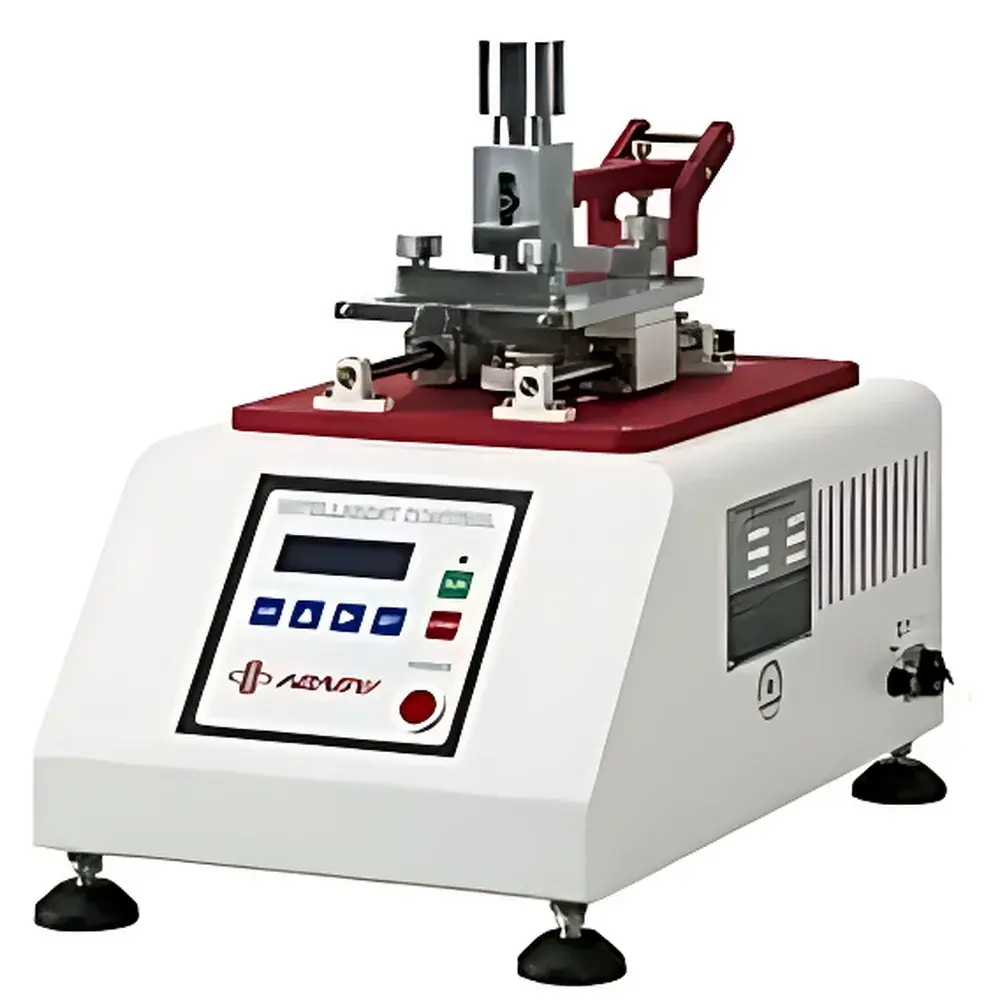
Hengyu HY-759 Leather Rubbing Fastness Tester
| Brand | Hengyu |
|---|---|
| Origin | Tianjin, China |
| Model | HY-759 |
| Sample Size | 120 × 20 mm |
| Wool Fabric Specimen | 15 × 15 mm |
| Abrader Mass | 500 g |
| Auxiliary Weight | 500 g |
| Stroke Rate | 40 ± 1 cycles/min |
| Stroke Length | 35 cm |
| Sample Elongation Scale | 0–20% |
| LCD Counter Range | 0–999,999 |
| Compliance | ISO 640, QB/T 2537, QB/T 2882–2007 Method A, GB/T 20991, SATRA PM173 |
Overview
The Hengyu HY-759 Leather Rubbing Fastness Tester is a precision-engineered instrument designed to evaluate color transfer resistance under controlled mechanical abrasion for leather materials. It operates on the principle of standardized reciprocating rubbing—applying defined pressure, stroke length, and cycle frequency to simulate real-world wear conditions encountered during handling, footwear use, or upholstery contact. Unlike general-purpose textile rub fastness testers, the HY-759 incorporates structural adaptations specific to leather substrates, including calibrated sample clamping geometry, adjustable tension control for dimensional stability during elongation, and dual-mode dry/wet testing capability. Its design aligns with internationally recognized test methodologies used in quality assurance laboratories, R&D centers, and third-party certification facilities serving tanneries, footwear OEMs, and automotive interior suppliers.
Key Features
- Robust cast-aluminum frame with anti-vibration base for high repeatability across extended test sequences
- Dual-mode operation: configurable dry-rub and wet-rub testing using standardized wool fabric pads (15 × 15 mm) saturated to specified moisture content per ISO 640 and QB/T 2537
- Motor-driven linear actuator delivering consistent 35 cm stroke length at precisely regulated 40 ± 1 cycles per minute
- Integrated 500 g abrading head with removable mounting interface for rapid pad replacement and traceable wear calibration
- Dedicated auxiliary 500 g weight system enabling standardized load application during shoe insole abrasion evaluation per GB/T 20991
- Adjustable sample elongation scale (0–20%) with engraved stainless-steel ruler for monitoring substrate deformation during dynamic friction
- High-resolution LCD counter (0–999,999) with auto-reset function and non-volatile memory retention
- Compliance-ready documentation package including CNAS-accredited calibration certificate traceable to national metrological standards
Sample Compatibility & Compliance
The HY-759 accommodates flat leather specimens measuring 120 × 20 mm—dimensions selected to ensure representative surface area coverage while maintaining edge stability in the clamping mechanism. Test pads conform to EMPA 701 (white) and EMPA 702 (black) specifications, supplied in certified batches with documented fiber composition and density. The instrument satisfies full technical alignment with ISO 640:2021 (Leather — Determination of colour fastness to rubbing), QB/T 2537–2001 (Leather — Test method for colour fastness to dry and wet rubbing), QB/T 2882–2007 Method A (Footwear — Test method for sole and insole abrasion resistance), GB/T 20991–2007 (Footwear — Test methods for upper material), and SATRA PM173 (Abrasion resistance of leathers). All operational parameters—including stroke timing, mass tolerance, and pad conditioning protocols—are validated against the measurement uncertainty budgets defined in these standards.
Software & Data Management
The HY-759 operates as a standalone electromechanical tester without embedded software; however, it is fully compatible with laboratory data management workflows. The LCD counter output can be manually recorded or interfaced via optional RS-232/USB adapter (sold separately) for integration into LIMS or ELN platforms supporting ASTM E1482 or ISO/IEC 17025-compliant audit trails. Calibration records—including CNAS report number, date, uncertainty values, and technician signature—are maintained offline in accordance with GLP documentation requirements. For regulated environments subject to FDA 21 CFR Part 11 or EU Annex 11, users may implement supplementary electronic logbooks with digital signatures to satisfy data integrity criteria for test result archiving.
Applications
- Quantitative assessment of dye migration in finished bovine, ovine, and synthetic leathers following ISO 640 dry/wet rub protocols
- Validation of chromophore bonding stability in eco-friendly dye systems (e.g., metal-free azo, natural tannin-based dyes)
- In-process quality control of drum-dyed hides prior to finishing and embossing operations
- Comparative analysis of topcoat adhesion performance across polyurethane, acrylic, and wax-based sealants
- Shoe component qualification per GB/T 20991, particularly for inner lining materials subject to foot perspiration and mechanical shear
- Supporting sustainability claims by correlating rub fastness results with lifecycle durability metrics in EPD (Environmental Product Declaration) reporting
FAQ
Does the HY-759 support automatic humidity control for wet-rub testing?
No—the instrument requires manual pre-conditioning of wool pads per standard-specified moisture content (e.g., ISO 640 mandates 100% RH saturation followed by controlled blotting). Environmental chamber integration is external.
Is the CNAS calibration certificate valid for ISO/IEC 17025 accreditation purposes?
Yes—the issued certificate includes measurement uncertainty statements, traceability to NIM (National Institute of Metrology, China), and CNAS registration number, satisfying Clause 6.5 of ISO/IEC 17025:2017.
Can the elongation scale be used for tensile pre-stress verification?
The 0–20%刻度 is strictly for visual monitoring of lateral stretch during rubbing; it is not a calibrated tensile gauge. Pre-test tension must be applied externally using torque-controlled fixtures.
Are EMPA-certified pads included with the base unit?
No—EMPA 701 and EMPA 702 pads are optional consumables. Each batch is supplied with CoA (Certificate of Analysis) verifying wool fiber purity, pile height, and compressive resilience.
What maintenance intervals are recommended for long-term accuracy?
Lubrication of linear guide rails every 500 operating hours; annual verification of stroke length and cycle timing using certified stopwatch and vernier caliper; biannual re-calibration recommended for GLP-regulated labs.




