
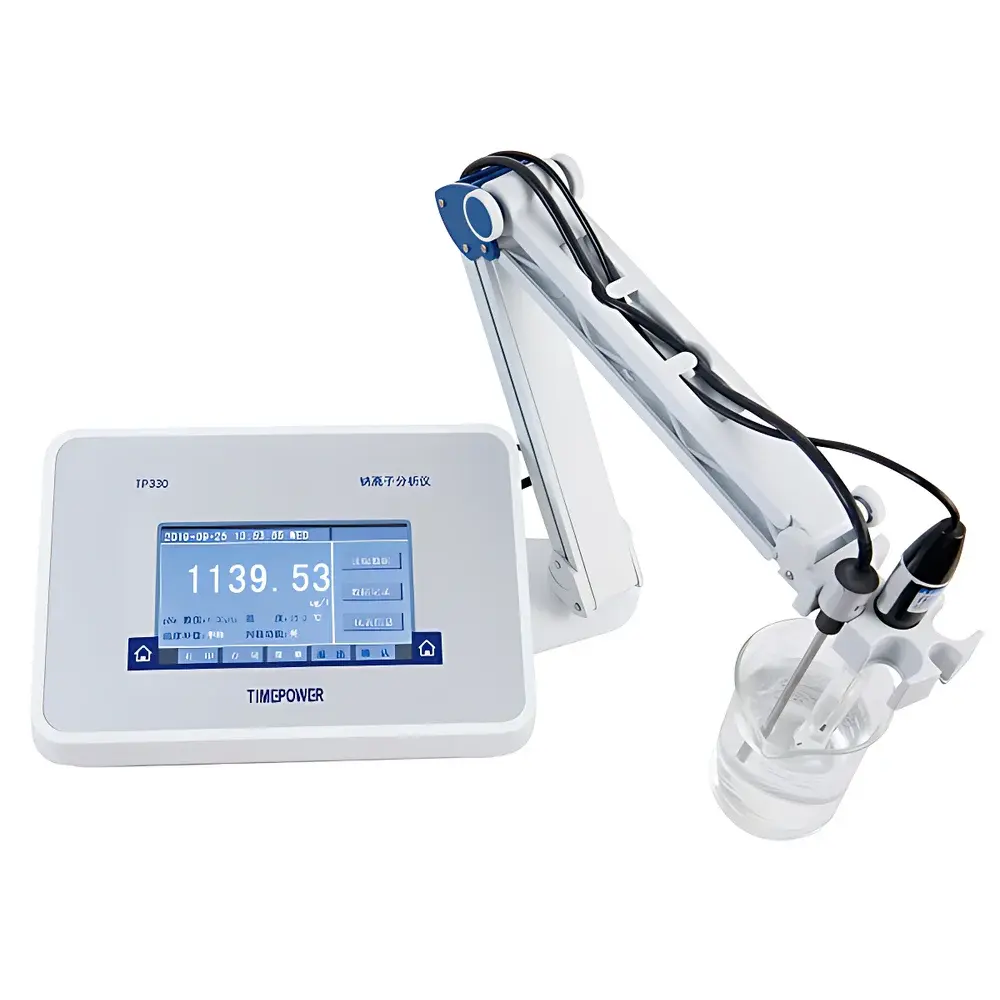
Timepower TP330 Benchtop Sodium Ion Analyzer
| Brand | Timepower |
|---|---|
| Origin | Beijing, China |
| Manufacturer Type | Manufacturer |
| Product Category | Domestic |
| Model | TP330 |
| Pricing | Upon Request |
Overview
The Timepower TP330 Benchtop Sodium Ion Analyzer is a precision electrochemical instrument engineered for accurate, trace-level sodium ion (Na⁺) quantification in aqueous solutions. It operates on the principle of potentiometric measurement using a sodium-selective ion electrode (ISE), grounded in the Nernst equation. At 25 °C, the theoretical electrode slope is 59.16 mV per decade change in Na⁺ activity; however, real-world electrode performance deviates due to membrane composition, hydration, and surface condition—necessitating two-point calibration against certified standard solutions to determine the actual slope and zero potential. The analyzer is designed for laboratory environments requiring compliance with GB 12156–1989 (“Methods for analysis of boiler water and cooling water — Determination of sodium — Static method”), making it suitable for applications where low-concentration sodium monitoring directly impacts process integrity, corrosion control, or product purity.
Key Features
- 5.0-inch full-color capacitive touchscreen with intuitive Chinese-language UI for streamlined operation and parameter navigation.
- High-impedance input circuitry (≥1 × 10¹² Ω) optimized for signal stability with sodium-selective electrodes, minimizing leakage current and polarization errors.
- 24-bit analog-to-digital conversion ensures high-resolution data acquisition, supporting reproducible pNa measurements across the full dynamic range.
- Integrated Pt1000 temperature sensor enables automatic temperature compensation (0–60 °C), critical for accurate Nernstian response correction in variable-temperature samples.
- Embedded microcontroller architecture delivers low power consumption (<5 W) and robust thermal management, enabling continuous operation in ambient lab conditions (5–45 °C, ≤90% RH non-condensing).
- Non-volatile memory retains calibration data, measurement history, and system settings for ≥10 years without power—supporting GLP-compliant record retention.
- Compact benchtop form factor (215 × 150 × 85 mm; 1.0 kg) facilitates integration into QC labs, power plant chemistry stations, or university teaching laboratories.
Sample Compatibility & Compliance
The TP330 is validated for use with low-conductivity water matrices typical of high-purity steam cycles (e.g., condensate, feedwater, demineralized water), as well as process streams in pharmaceutical water systems (PW, WFI), pulp & paper effluents, and food-grade rinse solutions. Its measurement range spans 0.01 μg/L to 23.0 g/L Na⁺ (equivalent to 0.00–9.36 pNa), covering both ultra-trace detection and industrial-strength brine analysis. The instrument conforms to GB 12156–1989 for static-mode sodium determination and supports alignment with ISO 17025 documentation practices when used with traceable Na⁺ standards (e.g., NIST SRM-certified solutions). While not inherently 21 CFR Part 11 compliant, audit trails and electronic records may be implemented via external LIMS integration under controlled procedural governance.
Software & Data Management
All operational parameters—including calibration coefficients, date/time stamps, user ID inputs, and raw mV/pNa readings—are stored locally in cyclic memory with overflow overwrite logic. Data export is supported via USB interface (device mode) for transfer to spreadsheet or laboratory informatics platforms. The firmware implements automatic data tagging by measurement session, enabling retrospective review without manual annotation. Calibration logs retain slope (% of theoretical), intercept (mV), and R² values from linear regression of standard points—essential for trending electrode health and verifying analytical validity per internal SOPs.
Applications
- Power generation: Monitoring sodium breakthrough in mixed-bed ion exchange resins and detecting condenser tube leaks in fossil and nuclear plants.
- Pharmaceutical manufacturing: Verifying sodium content in purified water (PW) and water for injection (WFI) per USP and EP 2.2.38.
- Microelectronics: Controlling sodium contamination in ultrapure water (UPW) used in wafer cleaning processes.
- Research & education: Teaching fundamental concepts of ion-selective electrode theory, Nernst behavior, and calibration uncertainty in analytical chemistry courses.
- Environmental testing: Quantifying sodium leaching from soils, sediments, or landfill leachates where alkali metal mobility influences cation exchange capacity assessments.
FAQ
What calibration standards are required for daily operation?
Two certified sodium standard solutions spanning the expected sample range—typically 0.01 μg/L and 100 μg/L (or 1 mg/L)—are recommended for two-point calibration. Standards must be prepared in low-ionic-strength background electrolyte (e.g., 0.001 M KCl) to minimize activity coefficient effects.
Can the TP330 measure sodium in high-TDS or seawater samples?
Direct measurement is not advised above 1 g/L Na⁺ without matrix-matched dilution and ionic strength adjustment, as junction potential drift and electrode saturation may compromise accuracy.
Is electrode maintenance documented in the instrument firmware?
No built-in maintenance log exists; however, users may manually record electrode cleaning dates, storage conditions, and slope drift trends using the timestamped calibration history.
Does the instrument support RS-232 or Ethernet communication?
The TP330 features USB-B (device) only; serial or network connectivity requires external protocol converters compatible with Modbus RTU or ASCII command sets.
How is temperature compensation applied during measurement?
The integrated Pt1000 sensor continuously monitors sample temperature and applies a first-order correction to the Nernst slope (mV/decade) based on the measured value, ensuring thermodynamic consistency across 5–60 °C.






