
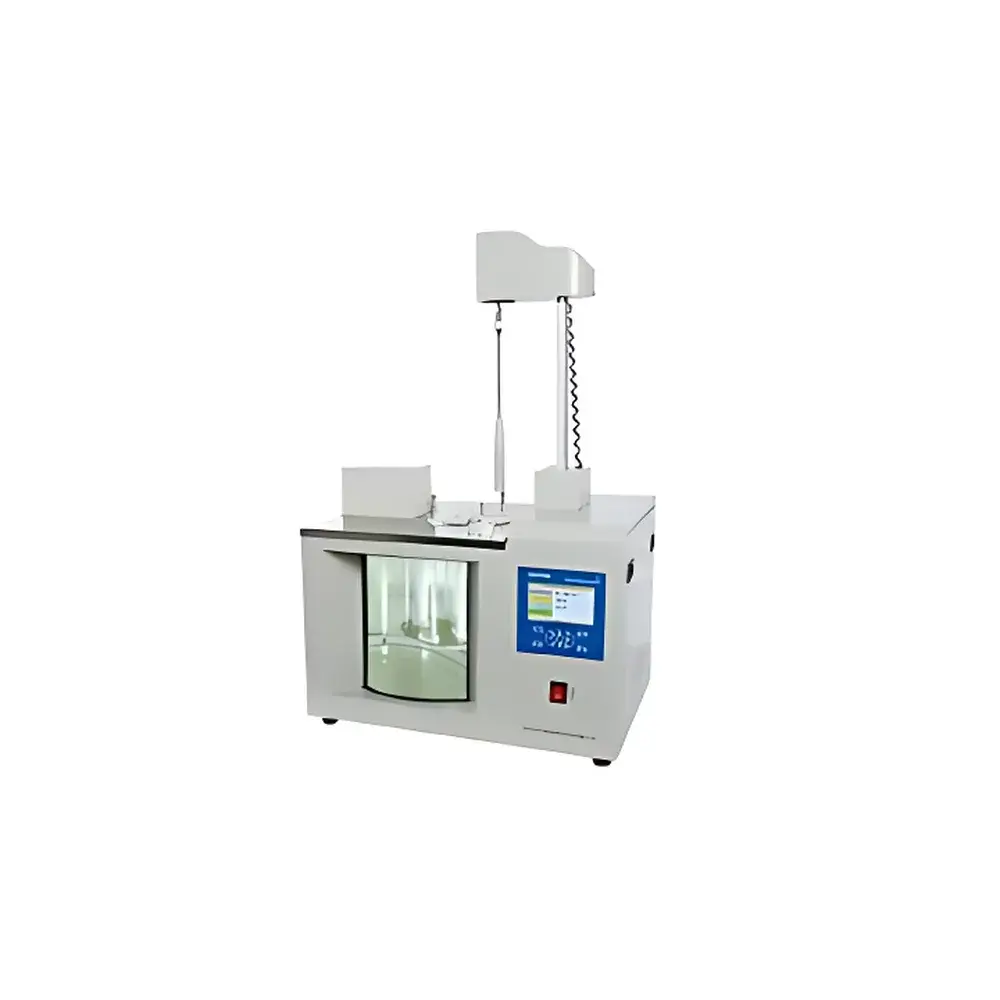
TimePower TP651 Petroleum Demulsibility Tester
| Brand | TimePower |
|---|---|
| Model | TP 651 |
| Temperature Range | Room Temp. to 100 °C |
| Temp. Accuracy | ±2 °C |
| Temp. Resolution | 0.1 °C |
| Repeatability | ≤4 °C |
| Stirring Duration | 5 min (fixed) |
| Stirring Depth | 6 mm above cylinder bottom |
| Cylinder Capacity | 100 mL |
| Power Supply | AC 220 V ±10%, 50 Hz ±10% |
| Max. Power Consumption | ≤1600 W |
| Dimensions (W×D×H) | 510 mm × 360 mm × 580 mm |
| Net Weight | 23.5 kg |
| Operating Ambient | 5–40 °C, ≤85% RH |
| Compliance | GB/T 7305 |
Overview
The TimePower TP651 Petroleum Demulsibility Tester is an automated benchtop instrument engineered for precise evaluation of the demulsification performance of petroleum-based and synthetic lubricants, transformer oils, hydraulic fluids, and turbine oils under standardized test conditions. It operates in strict accordance with GB/T 7305—China’s national standard equivalent to ASTM D1401 (Standard Test Method for Determining the Separability of Oil and Water by Agitation), which defines the methodology for quantifying the time required for oil–water emulsions to separate into distinct layers following controlled mechanical agitation and thermal conditioning. The instrument employs a thermostatically regulated water bath, programmable electromechanical stirring, and synchronized timing logic to deliver repeatable, operator-independent demulsibility assessments critical for quality assurance in power generation, petrochemical refining, and industrial lubricant formulation.
Key Features
- Fully automated test sequence: integrated microcontroller initiates heating, stirring, lifting, and timing functions without manual intervention after sample loading.
- Precision temperature control: digital PID-regulated water bath maintains setpoints at 54 °C ±1 °C (or 82 °C ±1 °C for high-viscosity samples) with resolution of 0.1 °C and accuracy within ±2 °C.
- Motorized vertical actuation: linear electric push rod ensures smooth, repeatable positioning of the stirring paddle at exactly 6 mm above the bottom of the 100 mL calibrated cylinder—critical for consistent shear application per GB/T 7305.
- Intuitive human–machine interface: 480×272-pixel color LCD display with full Chinese menu navigation, context-sensitive prompts, and real-time status feedback during test execution.
- Robust mechanical architecture: reinforced chassis, optimized thermal insulation, and fail-safe interlocks—including cylinder travel lock verification and water-level monitoring—to ensure operational safety and long-term stability.
- Low-maintenance design: stainless-steel stirring assembly, corrosion-resistant bath tank, and modular electronics facilitate routine calibration and service compliance with ISO/IEC 17025 laboratory requirements.
Sample Compatibility & Compliance
The TP651 accommodates standard 100 mL graduated cylinders conforming to GB/T 7305 dimensional specifications. It supports testing of mineral oils, polyalphaolefins (PAOs), phosphate esters, polyol esters, and other synthetic base stocks used in transformers, turbines, and compressors. Results are directly traceable to GB/T 7305 and interoperable with ASTM D1401 reporting formats. While not certified to IEC 61000 or UL standards, its electrical design meets GB 4793.1 (Safety Requirements for Electrical Equipment for Measurement, Control, and Laboratory Use). The system supports GLP-compliant documentation when paired with external lab information management systems (LIMS) via RS232 or USB data export.
Software & Data Management
The embedded firmware implements deterministic real-time control over all hardware subsystems—temperature regulation, motor sequencing, and elapsed-time logging—with no external PC dependency. Test parameters (target temperature, dwell time, cylinder ID) are stored in non-volatile memory. Each completed test generates a timestamped record containing start/end times, actual bath temperature profile, and user-confirmed separation endpoint. Data can be exported as CSV files for integration into enterprise QA databases or statistical process control (SPC) platforms. Audit trail functionality includes operator ID entry (via keypad), session timestamps, and error-code logging—all supporting FDA 21 CFR Part 11 readiness when deployed in regulated GMP environments.
Applications
- Quality release testing of new transformer oils prior to commissioning in high-voltage substations.
- Monitoring additive depletion or oxidation-induced surfactant degradation in in-service turbine oils.
- Evaluating demulsibility retention of hydraulic fluids exposed to water ingress in offshore drilling equipment.
- Comparative screening of alternative base stocks during R&D of biodegradable lubricants for marine applications.
- Third-party verification for customs clearance and import compliance in cross-border trade of industrial oils (e.g., CNCA-certified testing labs).
- Teaching laboratories demonstrating interfacial phenomena, emulsion thermodynamics, and ASTM/GB method equivalency.
FAQ
What standards does the TP651 comply with?
It is designed and validated specifically for GB/T 7305 and functionally equivalent to ASTM D1401. It does not perform tests referenced in ISO 6614 or IP 173, which employ different agitation geometries and reporting criteria.
Can the instrument be used for non-petroleum fluids such as bio-lubricants?
Yes—provided the fluid exhibits Newtonian behavior within the shear rate range generated by the paddle geometry and meets viscosity limits specified in GB/T 7305 Annex A (typically < 1000 cSt at 40 °C). Validation per ASTM D1401 Appendix X1 is recommended for novel formulations.
Is calibration traceable to national metrology institutes?
Temperature sensors are factory-calibrated against NIM (National Institute of Metrology, China)-traceable references. Users may perform periodic verification using certified RTD probes and secondary standards per JJG 2051-2019.
How often should the stirring paddle be cleaned, and what cleaning agents are safe?
Clean immediately after each test using lint-free wipes and analytical-grade n-hexane or isopropanol. Avoid abrasive scrubbing or ultrasonic baths, as deformation of the paddle blade compromises shear consistency and violates GB/T 7305 Clause 6.2.
Does the system support multi-language UI beyond Chinese?
No—the firmware currently supports only Simplified Chinese. English-language operation requires interpretation of on-screen prompts via printed SOPs or external translation tools; no firmware localization is available.





