
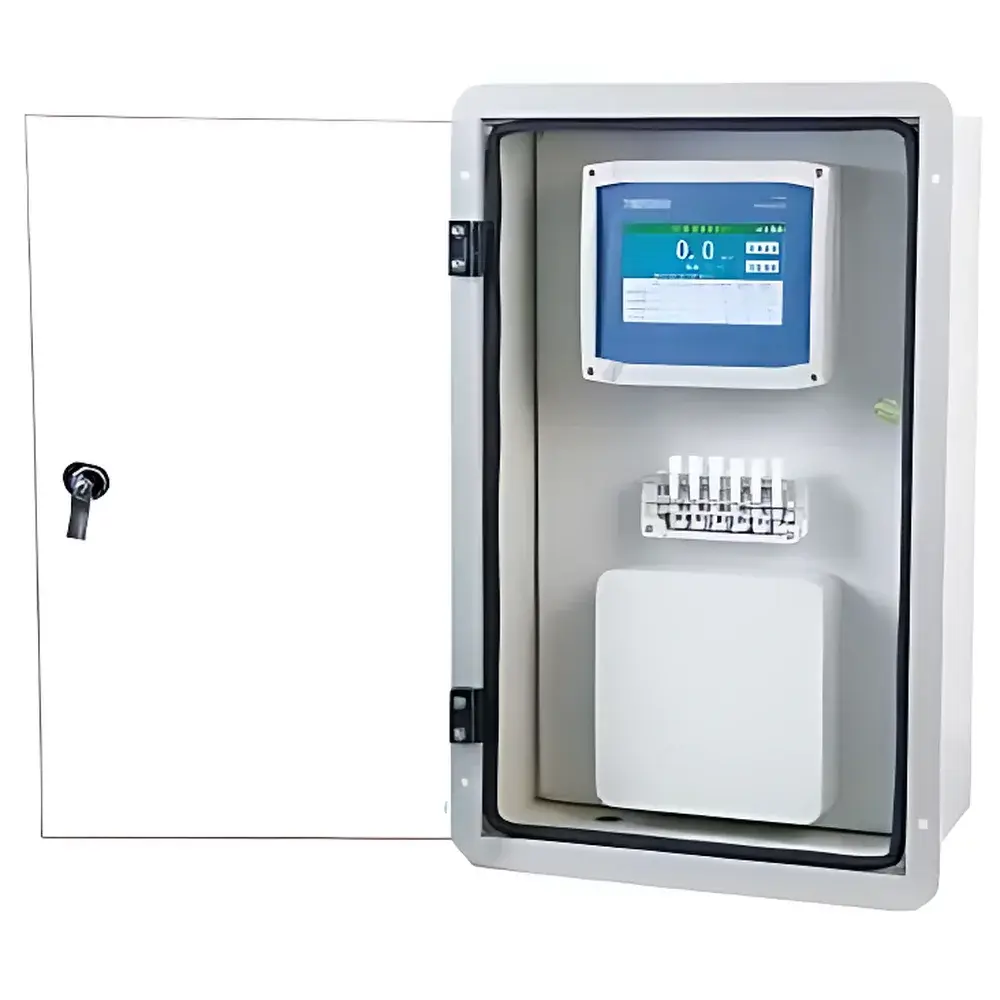
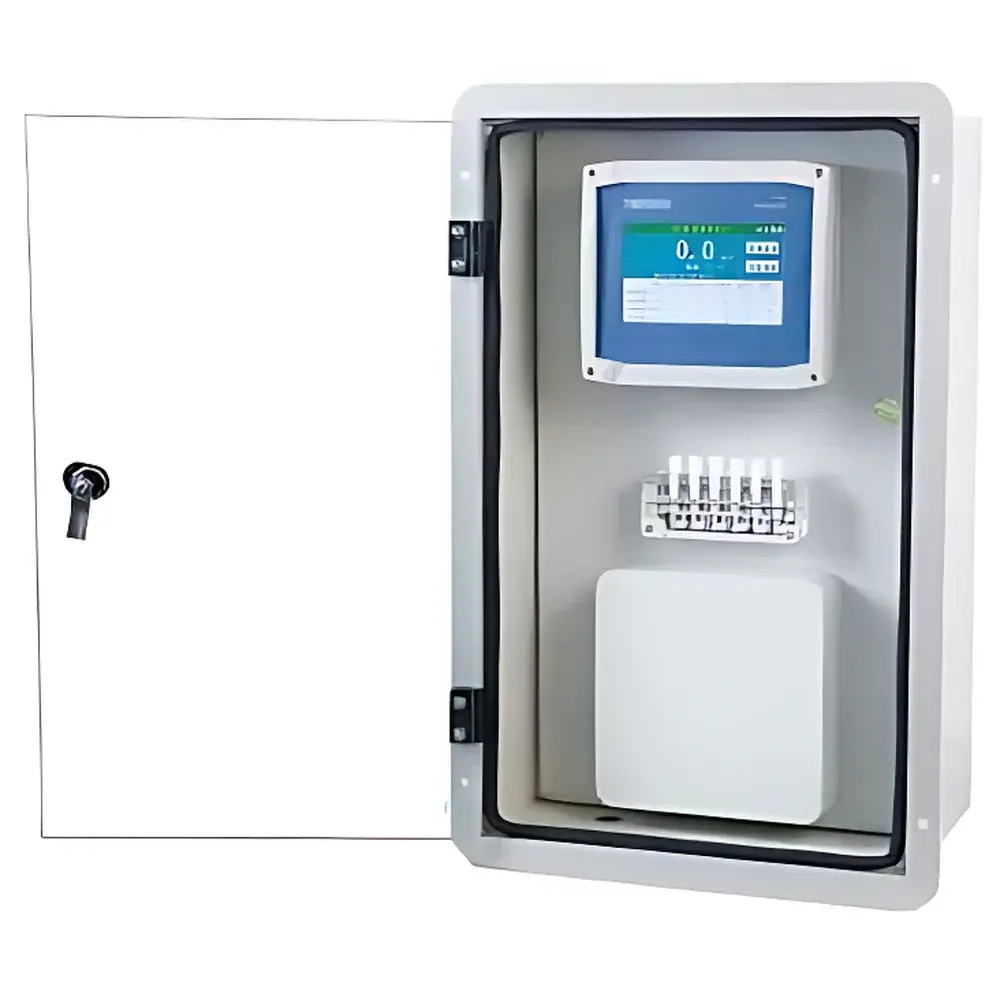
Hydrazine Online Monitor TP-108 by TimePower
| Brand | TimePower |
|---|---|
| Origin | Beijing, China |
| Manufacturer Type | Manufacturer |
| Country of Origin | Domestic (China) |
| Model | TP-108 |
| Pricing | Upon Request |
Overview
The TimePower TP-108 Hydrazine Online Monitor is an industrial-grade, multi-channel photometric analyzer engineered for continuous, real-time quantification of hydrazine (N₂H₄) concentration in aqueous process streams. It operates on the principle of selective colorimetric reaction—hydrazine reacts with p-dimethylaminobenzaldehyde (DMAB) under controlled acidic conditions to form a stable yellow azine derivative, measurable at 455 nm using a monochromatic cold light source. Designed for deployment in high-purity water circuits and aggressive chemical environments, the TP-108 meets the stringent accuracy, stability, and reliability requirements of boiler feedwater monitoring in thermal power plants, catalyst protection loops in ammonia synthesis units, and corrosion inhibitor dosing control in petrochemical refineries. Its architecture complies with IEC 61511 functional safety guidelines for analyzers used in safety-related instrumented systems (SIS), and supports integration into plant-wide asset management frameworks via standardized analog and digital interfaces.
Key Features
- Configurable 1–6 independent measurement channels—enables simultaneous monitoring of multiple sampling points without hardware duplication
- High-precision imported solenoid valves with >1 million actuation cycles lifetime; ensures repeatable reagent dispensing and sample aspiration
- Automated dual-point calibration (zero/span) triggered per user-defined schedule (e.g., every 6/12/24 hours), minimizing manual intervention while maintaining traceable measurement integrity
- 7-inch TFT color LCD with touch interface—displays real-time concentration trends, channel status, alarm flags, and diagnostic logs simultaneously
- 30-day local data storage (1-min resolution); supports CSV export via USB port for audit trail reconstruction and regulatory review
- Stable monochromatic LED light source (455 ± 2 nm bandwidth) with <0.5% intensity drift over 12 months—eliminates lamp replacement downtime
- Four isolated 4–20 mA outputs per channel (configurable as concentration, temperature, or fault status signals), compatible with DCS, PLC, and automatic chemical dosing controllers
- Front-panel cutout mounting (standard 138 × 138 mm aperture); modular internal layout allows field-replaceable fluidic cartridges and optical modules
Sample Compatibility & Compliance
The TP-108 accepts liquid samples with conductivity <5 µS/cm and suspended solids <1 mg/L—typical of deionized boiler feedwater, condensate return lines, and purified process cooling water. It tolerates ambient temperatures from 5–45 °C and operating pressures up to 1.0 MPa (with optional pressure regulator). Reagent consumption is optimized to ≤12 mL/hour per channel (DMAB + HCl + buffer), reducing hazardous waste generation. The analyzer conforms to ISO 9001:2015 manufacturing controls and supports GLP-compliant operation through time-stamped calibration records, user-access-level authentication (admin/operator/guest), and immutable event logging. While not certified to US EPA Method 379.1 or ASTM D3795, its analytical methodology aligns with the reaction kinetics and detection limits specified in those standards for hydrazine quantification in low-conductivity matrices.
Software & Data Management
Embedded firmware provides full local control—no external PC required for routine operation. Configuration, calibration, and diagnostics are managed via intuitive menu navigation. Historical data is stored in non-volatile memory with automatic overwrite policy. Optional RS-485 Modbus RTU or Ethernet TCP/IP communication enables remote configuration and data polling by SCADA or MES platforms. Audit trails include operator ID, timestamp, parameter change type, and pre-/post-value—fully compliant with FDA 21 CFR Part 11 requirements when deployed with validated IT infrastructure and electronic signature protocols. Firmware updates are performed via secure USB key with SHA-256 hash verification.
Applications
- Continuous hydrazine residual monitoring in ultra-high-purity boiler feedwater systems (target range: 5–50 µg/L) to prevent copper alloy corrosion and maintain ASME PTC 19.11 compliance
- Real-time feedback control of hydrazine injection pumps in ammonia synthesis purge gas scrubbers
- Quality assurance in pharmaceutical water-for-injection (WFI) distribution loops where hydrazine may originate from degraded nitrogen-containing sterilants
- Environmental compliance tracking in effluent discharge streams from hydrazine-handling facilities (per local regulatory thresholds)
- Process validation support during startup/shutdown of hydrogenation reactors and catalytic reformers
FAQ
What is the typical detection range and limit of detection (LOD) for the TP-108?
The standard configuration measures 0–200 µg/L with an LOD of 2 µg/L (based on 3σ of blank signal); extended-range variants (0–1000 µg/L) are available upon request.
Does the TP-108 require daily maintenance or manual reagent refills?
Reagents are supplied in sealed, pre-pressurized cartridges rated for 30 days of continuous operation at 1-channel mode; no daily intervention is needed beyond periodic cartridge replacement and quarterly optical path cleaning.
Can the TP-108 be integrated with existing DCS systems using analog signals?
Yes—each channel provides four independently configurable 4–20 mA outputs with HART protocol support for device diagnostics and configuration readback.
Is third-party certification (e.g., CE, UL) available for international deployment?
CE marking (EMC Directive 2014/30/EU and LVD Directive 2014/35/EU) is standard; UL 61010-1 listing is available under custom order with additional factory testing.
How does the system handle sample turbidity or iron interference?
Integrated inline filtration (5 µm) and optional UV pretreatment module suppress particulate scattering; iron(III) interference is mitigated by precise pH control and chelating buffer formulation per ISO 15593:1999 Annex B guidance.
Related Products







