
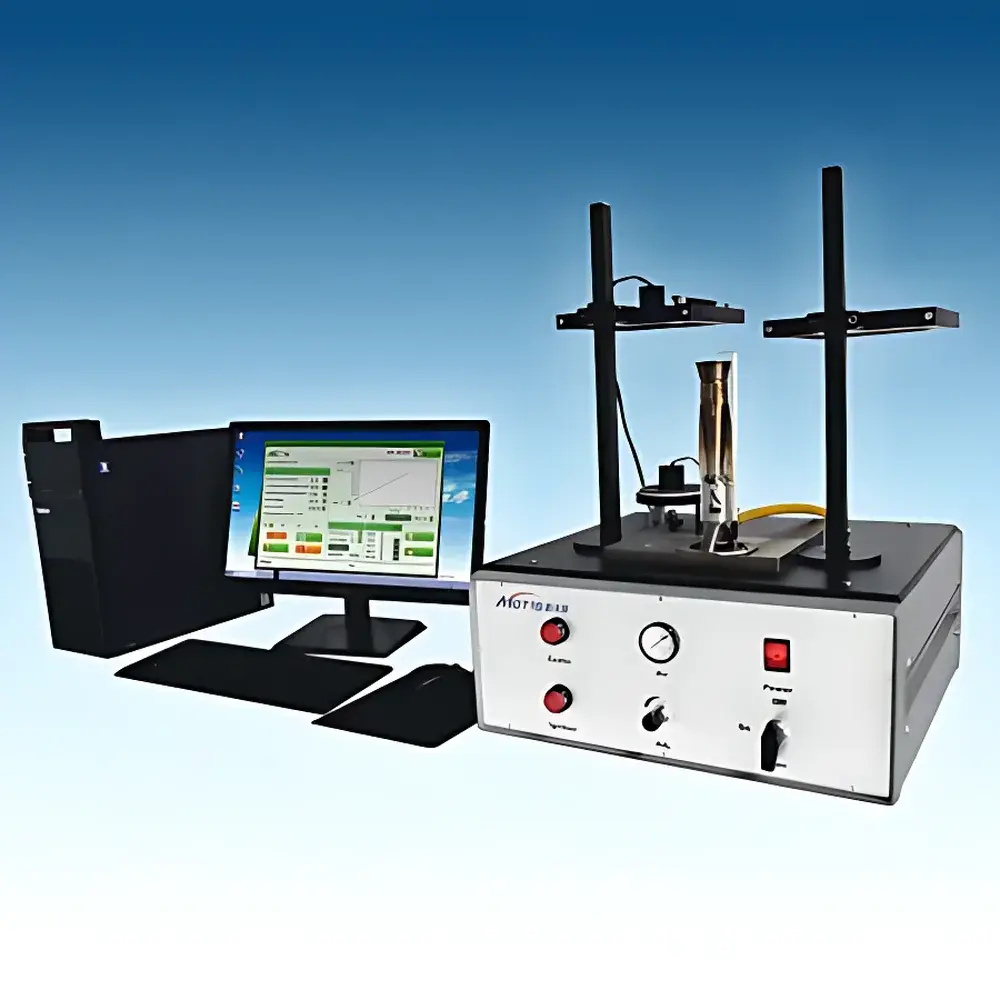
NYX HTI Convection Heat Resistance Tester
| Brand | NYX |
|---|---|
| Model | HTI |
| Origin | Tianjin, China |
| Manufacturer Type | Direct Manufacturer |
| Compliance Standards | AQ 6103, ISO 9151, EN 367, ISO 11612, GB 38453 |
| Heat Flux | 80 kW/m² |
| Temperature Rise Targets | (24 ± 0.2) °C and (12 ± 0.1) °C |
| Measurement Principle | Calorimetric determination of heat transfer index (HTI) via copper calorimeter |
| Cooling Method | Forced-air cooling of copper calorimeter |
| Automation | Pneumatic actuation of heat shield and specimen holder |
| Data Output | HTI-24 and HTI-12 values (seconds), averaged across three replicates |
| Software Features | Real-time thermal recording, automatic heat flux correction, GLP-compliant audit trail |
Overview
The NYX HTI Convection Heat Resistance Tester is an engineered system designed for standardized evaluation of thermal protective performance (TPP) in personal protective equipment (PPE), specifically heat-resistant gloves and flame-retardant garments. It operates on the principle of controlled convection heat exposure—applying a defined thermal flux of 80 kW/m² via a calibrated gas-fired burner to the underside of a horizontally mounted specimen. A water-cooled copper calorimeter positioned directly against the specimen’s reverse surface continuously monitors temperature rise over time. The instrument calculates the Heat Transfer Index (HTI), defined as the time required for the calorimeter to register a temperature increase of either (24 ± 0.2) °C (HTI-24) or (12 ± 0.1) °C (HTI-12) under steady-state exposure. This metric quantifies the material’s ability to delay heat penetration and is directly referenced in international test standards including ISO 9151, EN 367, and AQ 6103. The system integrates precision mechanical actuation, real-time thermal data acquisition, and algorithmic heat flux compensation to ensure measurement repeatability and regulatory alignment.
Key Features
- Calibrated convection heat source delivering a stable 80 kW/m² thermal flux, traceable to national metrological standards
- Pneumatically actuated heat shield and specimen holder enabling precise, repeatable positioning and rapid test cycle initiation
- High-stability copper disk calorimeter with integrated forced-air cooling—reducing post-test cooldown time by >65% compared to passive systems
- Real-time temperature sampling at 10 Hz resolution, capturing transient thermal response with sub-second temporal fidelity
- Automated calculation of HTI-24 and HTI-12 values from three consecutive trials, with statistical averaging and outlier detection per ISO/IEC 17025 guidelines
- Embedded software module performing dynamic heat flux correction based on calorimeter emissivity, ambient drift, and thermal inertia compensation
Sample Compatibility & Compliance
The HTI tester accommodates flat textile specimens up to 150 mm × 150 mm, including multilayer composite fabrics, coated leathers, and knitted aramid blends used in firefighting turnout gear, foundry gloves, and industrial heat barrier applications. Specimen mounting conforms to ISO 11612 Annex B and EN 367 Clause 6 requirements for clamping force and edge sealing. All operational parameters—including burner geometry, standoff distance, airflow velocity, and calorimeter calibration intervals—are validated against the procedural constraints of AQ 6103 (China’s occupational safety standard for heat-resistant gloves) and ISO 9151 (determination of heat transmission on clothing materials). The system supports full documentation traceability for GLP and GMP environments, with timestamped test logs, user authentication, and electronic signature capability compliant with FDA 21 CFR Part 11 requirements.
Software & Data Management
The proprietary HTI Control Suite runs on Windows-based industrial PCs and provides a dual-mode interface: guided workflow mode for routine QA/QC testing and advanced configuration mode for method development and validation. Each test generates a structured XML dataset containing raw thermocouple readings, actuator timestamps, environmental metadata (ambient T/RH), and calculated HTI metrics. Data export supports CSV, PDF reports (with embedded digital signatures), and direct integration into LIMS platforms via OPC UA protocol. Audit trails record all user actions—including parameter modifications, calibration events, and report generation—with immutable timestamps and operator ID linkage. Calibration certificates and uncertainty budgets are stored within the software database and auto-linked to corresponding test records.
Applications
- Quality assurance of heat-insulating gloves per AQ 6103 and ISO 11612 Class 3/4 certification
- R&D evaluation of novel ceramic fiber composites, aerogel laminates, and phase-change material (PCM)-integrated textiles
- Comparative benchmarking of thermal barrier performance across supplier batches and material revisions
- Regulatory submission support for CE marking (EN 367), NFPA 1971 compliance, and Chinese LA certification
- Failure analysis of thermal degradation mechanisms through time-resolved backside temperature profiling
FAQ
What standards does the HTI tester fully support?
ISO 9151, EN 367, ISO 11612, AQ 6103, and GB 38453 — all implemented with hardware and software configurations verified per standard annexes.
Is the copper calorimeter calibrated traceably?
Yes — each unit ships with NIST-traceable calibration certificate for thermal response, and field recalibration is supported using certified reference heat flux sensors.
Can the system be integrated into an existing laboratory network?
Yes — it supports Ethernet TCP/IP communication, SCADA-level monitoring, and secure API access for automated data ingestion into enterprise quality management systems.
Does the software meet regulatory requirements for electronic records?
Yes — audit trail, electronic signatures, and data integrity controls comply with FDA 21 CFR Part 11 and EU Annex 11 for computerized systems in regulated environments.
What maintenance is required for long-term accuracy?
Annual verification of burner output, calorimeter thermal time constant, and pneumatic actuation timing — all documented in the included Preventive Maintenance Logbook.



